"El ex ministro de Trabajo y vicepresidente de la Fundación de Estudios Progresistas, Jesús Caldera, ha afirmado que la actual situación económica 'tiene mucho que ver con el pensamiento neoconservador por el que ha apostado' el líder de EEUU, George Bush, que ha permitido un capitalismo sin límites éticos.
Translation:
"The former Labor Minister and Vice President of the Foundation of Progressive Studies, Jesus Caldera, has stated that the current economical situation "has a lot to do with the neoconservative thought school as propagated by the leader of the United States, George Bush, who has allowed an unchecked capitalism."
Got that? Four years of socialist rule stalled the economic locomotive set in motion by Jose Maria Aznar. Unemployment numbers are skyrocketing again, economic growth is expected to be a meagre 2% in 2008 (and even predicted by the Spanish Banking Association to be negative in 09), car sales in May were 24.3% less than in May 2007 and... and... it's all Bush's fault!!! You will have noticed Caldera is the "former" Labor Minister. Indeed, while the man filled that post in the first Zapatero government, apparently his talents were judged such that he was needed to spearhead the intellectual efforts at the PSOE's new think tank, said "Foundation of Progressive Studies", of which he assumed chairmanship on July 6. That an important PSOE personage, presumed to represent the intellectual capital of his party, comes up with such a ludicrous explanation at a time when any dog with a hat on can see that socialist tenure ruins an economy, speaks bookmarks about the petrified, dogmatic state of mind of Spain's, and by extension Europe's, leftist leaders.
But Caldera is only parroting his master. Last June 26, Zapatero himself blamed Spain's economic downfall on... America's neoconservative model, the subprime crisis and the war in Iraq:
"Esta crisis alimentaria es fruto de varias causas. Entre otras, la crisis financiera vivida en Estados Unidos con las famosas hipotecas subprime. Es una crisis financiera fruto de un modelo neoconservador basado en el capitalismo sin fronteras, sin límites, y sin ética. Es fruto también del problema energético, de la subida del precio del petróleo, que ha disparado su valor a partir de la guerra de Irak y que ha incorporado los peores objetivos a lo que ha de ser una evolución respetuosa ante la lucha contra el cambio climático.
Or:
This crisis [of rising food prices] is the fruit of several causes. Amongst others, the subprime crisis in the United States. It's a financial crisis borne out of the neoconservative model and an uncontrolled capitalism without borders and without ethics. It's a crisis finding its origin in the energy sector which raised fuel costs as a result of the war in Iraq, and whose very modest goals [with regards to limiting carbon dioxide emission] necessitate a strong effort to combat climate change.
Not sure that's a totally exact translation, but you get the gist. What a fool!!! As you will recall, Zapatero's predecessor, Jose Maria Aznar of the rightwing Partido Popular, was the author of a second "Milagro Espanol", or Spanish Miracle (the first "Spanish Miracle" was an accomplishment of the Franco government). Aznar's economic measures slashed unemployment by half, reduced the public sector, transformed the labor market, privatized cumbersome key state industries, and generally improved the lives of the majority of Spaniards (in the 2000 elections, Aznar's opponent, the socialist Almunia, claimed that the Aznar government "played Robin Hood backwards" and that "it put a lot of power and money in just a few hands". In short, the eternal old nonsense).
In 2004, the Spaniards rewarded Aznar by voting for Zapatero, who managed to undo all his accomplishments in just under four years. This remarkable reversal of economic fortune is yet further proof for an economic paradigm of the post World War II western world, by extension applicable to all modern, industrialized countries, namely, that Rightwing governments herald an economic boom, while leftwing governments ensure economic downfall. Indeed, anno 2008 a vast body of evidence can be presented that makes the case for this paradigm. Speaking for my own country, I could refer to the mid-eighties, the last time that Belgium was ruled by a center-right government, in which Guy Verhofstadt, Belgium's previous PM, was Budget Minister. At the time, Verhofstadt profiled himself as a true Hayekian disciple. With his essays the "Burgermanifesten" (Citizen's Manifests) he established himself as party ideologue for the then rightwing PVV (Partij voor Vrijheid, Party for Freedom) - and indeed, during his short tenure he achieved very remarkable results, earning him the scornful soubriquet "Baby Thatcher". He and the government he was in were torpedoed in 1987 by a coordinated action of Belgium's christian-democratic and socialist labor unions, and Belgium has since been ruled by center-leftist and leftist governments. Needless to say, economic growth has been sluggish ever since. Verhofstadt and his liberal VLD (the old PVV) would return in 1999, but as PM of a coalition with the socialists and the greens until 2003, and a coalition with the socialists from 2003 till 2007. During those eight years he gradually forsaked all his principles and every classical liberal example he ever stood for (keep in mind that in Europe, "liberal" is, or was at least, often associated with rightwing). Verhofstadts betrayal of his rightwing principles was one of the reasons of my disenchantment with the VLD, of which I was a longtime member until the party did not oppose voting rights for immigrants in 2004, upon which I joined the VB. A fitting anecdote in this regard took place during a debate in 2004 organised by a liberal students association, during which Filip Dewinter, VB strongman, asked Karel De Gucht, one of Verhofstadt's sidekicks, "whether Verhofstadt now denounced his Citizen's Manifests - whether they [the VLD] now denounced Thatcher and Reagan, which they ideolized in the eighties". De Gucht's reply was: "Yes, and I have no problem calling that [adoration of Thatcher and Reagan] a mistake. You do."
Belgium's example however misses the magnitude of the events in bigger countries. Telling examples of the tandem rightwing tenure - prosperity/leftwing tenure - downfall can be found all over the western world and in industrialised countries in other continents as well. Think of Margaret Thatcher's very succesful tenure following the disastrous years under Labour's James Callaghan, an evolution very much like Aznar's reign after Felipe Gonzalez' socialist government. Think, naturally, of the Reagan years after the disastrous Carter Administration. Think of Australia's four very successful John Howard administrations, starting in 1996, after the wasteland of thirteen years Labor. Think of Denmark's own economic miracle, a product of the centre-right Anders Fogh Rasmussen governments, which followed miserable years of socialist rule under Poul Nyrup Rasmussen (not related to the current Danish PM).
Of course, not every rightwing government behaves like a rightwing government, nor does every leftwing government follow a genuinely leftwing policy. Former British PM Tony Blair e.g. was Labor - yet his "Third Way" incorporated the key elements of Thatcher's economic agenda. In Jacques Chirac France had a "rightwing" President - yet during his many years in power touching on his bloated état français or bidding his protectionist tendencies farewell was totally out of the question. On the other hand, when centrist or even leftist governments apply rightwing measures, they invariably are successful. One of the most striking examples is Ireland, where taoiseach Charles Haughey of the centrist Fianna Fail party introduced Reaganomics from the mid-eighties on, leading to that country becoming the proverbial "Celtic Tiger". But do not forget Germany's socialist leader Gerhard Schroeder, yes, Schroeder of all people (!) who, in his last years in office, adopted typically rightwing measures to combat high unemployment (see e.g. the Hartz IV-plan), which almost immediately produced astonishing results.
Grasping the quintessential truthfulness of the paradigm that rightwing policies lead to prosperity while leftwing policies ruin a country, does of course not require a scientific degree - in fact only basic common sense. Rightwing governments generally favor companies, and it's companies which are the original and main creators of prosperity. In the words of former Spanish PM Jose Maria Aznar, "If anybody can come up with a better form of social protection than having a job, then please tell me". By contrast, leftwing governments foster an inherenently unfavorable view of companies, on the totally illogical mercantilist pretext that if some entity, be it an individual, a company or a state, acquires a significant concentration of wealth, that entity can only have done so by taking it from another entity or other entities. Consequently, that entity has to be punished - by taxes, fines or, in the worst possible scenario, nationalization, which is basically institutionalized theft. Again, it does not require a genius to understand that by thus hampering, or even rendering impossible, the proper functioning of wealth's original creators - the companies - actually the exact opposite outcome of what the socialist agenda aimed for is reached.
The paradigm extends even to non-democratic forms of government and offers an explanation as to why rightwing dictatorships are self-extinguishing while leftwing dicatorships cling decade after decade to a perpetually prolonged poverty-stricken existence, with dire consequences for its desperate citizenry. Again, examples abound. Chili e.g. under Pinochet - long execrated as a monster, in reality the savior of Chilean democracy - is a typical example, but also Taiwan under the Guomindang, Greece under the colonels, Portugal under Salazar and Spain under Franco. In all these countries, rightwing dictators professed the not insurmountable philosophy that one could prosper economically if only one shut up politically. The result was that the gradually enhancing wealth in time created a prosperous middle class which was incrementally able to conquer democratic reform after democratic reform - and which was allowed to do so since not carrying the burden of suspicion meted out to ideological adversaries such as union leaders, leftwing ideologues etc. The opposite holds true of course, which is why leftwing dictaorships such as Cuba and North Korea are dirt-poor, and which is why Bolivia and Venezuela, if they don't watch out, will become economic basket cases too.
Nothing of this all matters much to Spain's Zapatero and Caldera, of course. The left is characterized by many ominous traits, but one that is easily overlooked is their incapacity to learn from history and past mistakes. That is why they think that Spain's current economic woes are to blame on heartless capitalism. It is also why another protagonist of the "Latinosphere", Bolivia's Morales, thinks that nationalizing key industries will definitely work this time.
 Is there then really no silver lining to the dark clouds hovering over Spain? There is. Because for all the ominous news, there is a bright glimmer of hope for Jose Q, recently divorced from his wife with whom he had three abortions, and now living in the Calla del Miseria next to an apartment filled with Moroccan formerly illegal immigrants, whose muezzin wakes him up at five in the morning with a call to prayer from the minaret of a mosque built in 2006 with government funds. The good news is that on June 26, 2008 the Spanish Parliament granted human rights to gorillas, urangutans, chimpanzees and bonobos. Henceforth, using apes in circuses, TV commercials or films will now be banned, and all dvd copies of "Planet of the Apes" will be burnt publicly on the Generalissimo Franco, whoooooops, the Hugo Chavez Square.
And there really is a ray of hope out there. I for one can very well imagine a future Spanish government run by apes pulling off a better job than Zapatzero.
MFBB.


 Muslims outraged at police advert featuring cute puppy sitting in policeman's hat.
 After vehement demands, a muslim obtained the removal of a crucifix hanging from the wall of the room of a Catholic clinic in Bourgoin-Jallieu (Isère) where his daughter was being treated… Monday afternoon, at the Saint-Vincent de Paul clinic, the father of a young girl, who had just underwent scheduled preventative surgery, demanded that personnel unfasten a crucifix from his daughter’s room. "For almost 15 minutes, the father, in the presence of his wife, verbally ranted, demanding that the crucifix be taken down", reported a witness. The establishment’s personnel eventually gave in to this demand.


 Once upon a time there was a small, shy boy with far too big glasses who screwed up completely in sports, blew math and got scared shitless by females. By and large, it was books which got him through this quagmire, and one of the authors whose works he devoured was a noble French gentleman, alas long deceased. That boy was your servant, and that gentleman was Jules Gabriel Verne, the Father of Modern Science Fiction. Among the books that left the deepest impression on me were Michael Strogoff (1876), Twenty Thousand Leagues under the Sea (1870), Journey to the Center of the Earth (1864), and especially From the Earth to the Moon (1865). Recalling how fascinating - and credible - Verne's fiction still was more than a century after it was written, one wonders how the sheer novelty of these fantastic stories must have been received, and perceived, in the author's days. And what made him do it? What inspired him? After all, this son to an attorney who was born in the busy western French port of Nantes in 1828, wrote about space exploration when the first flight of an aeroplane was still a half century away. He predicted gas-powered automobiles, skyscrapers built of glass and steel, high-speed trains, helicopters and even the Internet (a worldwide "telegraphic" communications network) while very little, if anything, hinted at the advent of these technological wonders. The accuracy of his predictions sometimes reached an uncanny level, such as when NASA chose to launch its rockets from Cape Canaveral, 130 miles from the supposed building site (Tampa Town)of the Supergun in Verne's lunar voyage novel. Not to mention that the Apollo 11 capsule came down only miles from where the manned bullet landed in the book. The power of Verne's imagination reverberates through the decades, leading to the US Navy baptising its first nuclear submarine after Captain Nemo's
  The ATVs, of which the development cost an estimated 1.35 billion EUR, are not only designed to supply the International Space Station (ISS). Another important feature is their ability to, if necessary, boost the station into a higher orbit. Four more have been ordered already, to be used until 2015, with an option for a further two. The small number implies that the ATV's are meant to complement, not subsitute, the existing Russian-made

 May 20, 2008 -- DO we still have troops in Iraq? Is there still a conflict over there? If you rely on the so-called mainstream media, you may have difficulty answering those questions these days. As Iraqi and Coalition forces pile up one success after another, Iraq has magically vanished from the headlines. Want a real "inconvenient truth?" Progress in Iraq is powerful and accelerating.
 In early March 2008, Belgian newspapers broke the news that Abdelkader Belliraj (photo), a dangerous terrorist with dual Belgian/Moroccan citizenship, had been arrested in Morocco on February 18 on charges of involvement in an islamist terror circle. The group had links to other islamist and/or terrorist groups such as Moroccan Chabiba Islamiya (Islamic Youth), Moroccan Revolutionary Islamic Movement, the Mujahidine Movement in Morocco, Al Haraka Min Ajli Al Umma (Movement for the Ummah) etc etc. What has this all to do with Belgium? Simple.
  Anderlecht, Brussels, January 2, 2006. Willy Roobaert (52), having missed the last tram from the Hallepoort to the Beurs (Brussels Stock Exchange), asks and gets a lift from four youths in a black Opel Kadett. The "youths" are Khalid Hamui (23), Bilal Bouquersa (21), Ridouan Hmidou Lamarti (20) and Mohamed El Hakkouni (23), four Moroccans with Belgian passports. Great is Mr. Roobaert's surprise when the Opel doesn't stop at the Beurs, but instead continues towards an open field near the Navezstraat. There they take his money and his cell phone and ask for his credit card's pin code. When Mr. Roobaert refuses, blows start to fall.
  On December 4, 2007, three criminals entered a house in Lot, a small community just southwest of Brussels, with the aim of obtaining the keys of a light lorry which they thought belonged to the proprietor of the house. The pepetrators gravely wounded the latter with two bullets in the stomach and one in the leg, but in the meantime an alert neighbour had alarmed the police. Just as a police vehicle stopped in front of the house,
  Amsterdam, April 28, 2008. City Councilor for the PvdA (Partij van de Arbeid, one of the two socialist Dutch parties) Yman Mahrach, of Moroccan descent, publicly states that her party should not press too much for a "moderate" islam.
  Moroccan youths and hooligans, but especially the former category, destroyed bus stalls, damaged cars and busted shop windows. There was a hail of stones, beer bottles and even fences. The police deployed watercannons, horse charges and even pepper spray. Filip Van Laenen from The Brussels Journal notes the following:
  From the Vlaams Belang online magazine, March 29, 2003:
 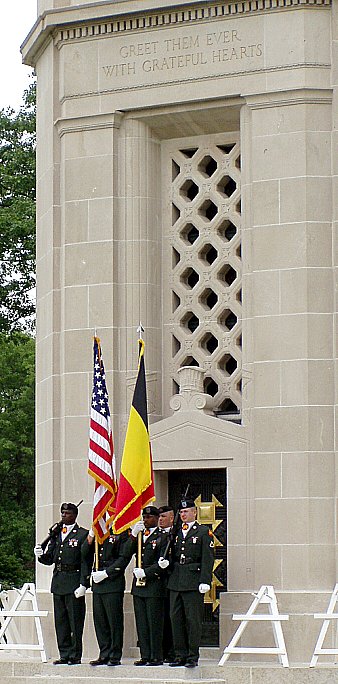 May 25, 2008. Memorial Day ceremony at Flanders Field American Cemetery, Waregem, Belgium. This was my first visit to the cemetery, the final resting place of 368 servicemen who died in World War I, and the smallest US cemetery in Belgium (the other ones are the Ardennes America Cemetery in Neuville-en-Condroz and the Cemetery Henri-Chapelle in Hombourg). Flanders Field AMC is basically a rectangular field covering 6.2 acres, with the white stone chapel you see on the photo in the centre. A curtain of trees and shrubbery effectively shields the place from the traffic on the adjacent roads and the activities on the industrial estate lying no more than a few hundred yards away, and lends it a solemn, tranquil and graceful atmosphere. The graves are neatly arranged on four sides, with paths leading between them towards circular retreats with stone benches and urns at three of the corners of the cemetery.
  The following video presents a short tour of Flanders Field American Cemetery's landscaped grounds and the architecture and interior of the chapel:


 Tom apparently had ample occasion to see the IDF and meet with some of its members, see the picca (more
 Then, in 1860,
  From then on, developments followed quickly. In 1917 the Balfour Declaration, issued by then British Foreign Secretary Arthur James Balfour, stated that the British government "viewed favourably" the creation in Palestine of "a national home for the Jewish people" on the condition that "nothing shall be done which may prejudice the civil and religious rights of existing non-Jewish communities in Palestine" or "the rights and political status enjoyed by Jews in any other country." A few years later, after the Allied victory, Great Britain fittingly assumed responsibility for Palestine (formerly part of the Ottoman Empire) with a mandate from the League of Nations, and the Jewish National Home for the first time became an ever more realistic concept. Needless to say, the return of many mostly European Jews to their ancient homeland was not welcomed by the Arab tribes who had lived all those times in the area between the Mediterranean Sea and the Jordan river. The interbellum saw several massacres against the Jews, and not just the newcomers. Few of those who claim that the immigrants took the land of the Arabs (in fact they paid for it - and some of it was even conquered by the Jewish Legion which assisted the British in World War I), do not acknowledge, willingly or unwillingly, that the infamous Hebron Massacre of 1929, which claimed the lives of 67 Jews and saw such horrible atrocities as the beheading of babies or the castration of old rabbis, was aimed at an existing Jewish community which had been there since before the birth of Christ. Other massacres took place in Safed, Tel Aviv, Motza and Kfar Uriyah. More Jewish lives still would be claimed in the
  The left side of the map to the right shows the areas allocated to the Jews in purple, and those of the Arabs in green. Notice that most of the Jewish part was the barren Negev desert, and that the parts reserved for the Arabs were far larger than today's equivalents the Gaza Strip and the West Bank. The 1947 "Gaza Strip" was thrice as large and L-shaped, and its counterpart the "West Bank" was twice as big as today. The key region for the Jews was a narrow slice of land, barely 15 kilometers wide and containing Tel Aviv and Haifa, along the Mediterranean.