Via Space Matters:
Wild that for the first 380,000 years or so the nascent universe was so unbelievably hot that it precluded nuclei and electrons from combining to atoms, with as a result that the hot soup of elementary particles prevented light - photons - litterally from 'shedding light' on what was happening!
MFBB.
Showing posts with label Science and Technology. Show all posts
Showing posts with label Science and Technology. Show all posts
Friday, December 05, 2025
Friday, April 04, 2025
RECOMMENDED READS: "A BRIEF HISTORY OF QUANTUM COMPUTERS."
Via Physics in History (X: @PhysInHistory):
Further interesting tweets from this account:
Nite.
MFBB.
A brief history of Quantum computers 👇
— Physics In History (@PhysInHistory) April 1, 2025
1905: Albert Einstein explains the photoelectric effect and suggests that light consists of quantum particles or photons
1924: Max Born uses the term quantum mechanics for the first time
1925: Werner Heisenberg, Max Born, and Pascual… pic.twitter.com/qdKJMT8GLa
Further interesting tweets from this account:
Distributed quantum computing across an optical network link https://t.co/mwsbyoRtaR
— Jim Bergquist (httprover2) (@httprover2) April 2, 2025
Nite.
MFBB.
Sunday, March 30, 2025
RECOMMENDED READS: SOMMERFELD's FINE STRUCTURE CONSTANT.
Over at Space dot com, astrophysicist Paul M. Sutter has this interesting column on Sommerfeld's Fine Structure Constant, a universal constant which is a measure of the strength of the interaction between charged particles and the electromagnetic force. It's value is approximately 1/137.
MFBB.
MFBB.
Sunday, March 09, 2025
CHINA'S ZUCHONGZHI-3 BASED QUANTUM COMPUTER OUTPACES GOOGLE'S SYCAMORE BY SIX ORDERS OF MAGNITUDE.
🇨🇳CHINA’S NEW QUANTUM COMPUTER CRUSHES GOOGLE—BY A MILLION TIMES
— Mario Nawfal (@MarioNawfal) March 8, 2025
China just pulled ahead in the quantum race, unveiling Zuchongzhi-3—a 105-qubit machine that makes Google's Sycamore processor look slow.
Researchers say this quantum beast performs calculations one million times… https://t.co/qhKsd2H9p3 pic.twitter.com/gCgCuk5h7S
Via SciTechDaily:
"...A new quantum computing breakthrough has sent shockwaves through the tech world. Researchers at USTC unveiled Zuchongzhi-3, a 105-qubit machine that processes calculations at speeds that dwarf even the most powerful supercomputers. It marks another leap forward in the quest for quantum supremacy, with the team demonstrating computational power orders of magnitude beyond Google’s latest results.
Breakthrough in Quantum Computing with Zuchongzhi-3
A research team from the University of Science and Technology of China (USTC), part of the Chinese Academy of Sciences, along with its partners, has made significant progress in random quantum circuit sampling using Zuchongzhi-3 — a superconducting quantum computing prototype equipped with 105 qubits and 182 couplers. Zuchongzhi-3 operates at an astonishing speed, performing computations 1015 times faster than the most powerful supercomputer available today and one million times faster than Google’s latest published quantum computing results. This achievement marks a major breakthrough in quantum computing, building on the success of its predecessor, Zuchongzhi-2. The study, led by Jianwei Pan, Xiaobo Zhu, Chengzhi Peng, and other researchers from both China and abroad, was published as a cover article in Physical Review Letters.
The Road to Quantum Supremacy
Quantum supremacy, the ability of a quantum computer to perform tasks beyond the reach of classical computers, has been a key goal in the field. In 2019, Google’s 53-qubit Sycamore processor completed a random circuit sampling task in 200 seconds, a feat estimated to take 10,000 years on the world’s fastest supercomputer at the time. However, in 2023, USTC researchers demonstrated more advanced classical algorithms capable of completing the same task in 14 seconds using over 1,400 A100 GPUs. With the advent of the Frontier supercomputer, equipped with expanded memory, this task can now be performed in just 1.6 seconds, effectively challenging Google’s earlier claim of quantum supremacy.
Pushing the Boundaries: Jiuzhang and Zuchongzhi Milestones
Subsequently, using the optimal classical algorithm as its benchmark, the same team at USTC achieved the first rigorously proven quantum supremacy with the Jiuzhang photonic quantum computing prototype in 2020. This was followed in 2021 by a superconducting demonstration using the Zuchongzhi-2 processor. In 2023, the team’s development of the 255-photon Jiuzhang-3 demonstrated quantum supremacy that surpassed classical supercomputers by 1016 orders of magnitude. In October 2024, Google’s 67-qubit superconducting quantum processor, Sycamore, demonstrated quantum supremacy by outperforming classical supercomputers by nine orders of magnitude.
Zuchongzhi-3: A Leap in Quantum Performance
Building upon the 66-qubit Zuchongzhi-2, the USTC research team significantly enhanced key performance metrics to develop Zuchongzhi-3, which features 105 qubits and 182 couplers. The quantum processor achieves a coherence time of 72 μs, a simultaneous single-qubit gate fidelity of 99.90%, a simultaneous two-qubit gate fidelity of 99.62%, and a simultaneous readout fidelity of 99.13%. The extended coherence time provides the necessary duration for performing more complex operations and computations.To evaluate its capabilities, the team conducted an 83-qubit, 32-layer random circuit sampling task on the system. The results demonstrated a computational speed that outpaces the world’s most powerful supercomputer by 15 orders of magnitude and surpasses Google’s latest quantum computing results by six orders of magnitude, establishing the strongest quantum computational advantage in a superconducting system to date..."
MFBB.
Thursday, December 12, 2024
RECOMMENDED VIDEO: EVEN BANANAS WITH "THE MOST NEUTRINOS EVER".
An immense amount of neutrino research is going on in the US, Japan and even Antarctica. On DowneastBlog, we've already mentioned several of these projects. This Even Bananas video deals with Fermilab's "near" detector, the SBND, for Short-Baseline Near Detector (the "far" one being ICARUS).
MFBB.
MFBB.
Sunday, December 08, 2024
RECOMMENDED VIDEO: "THORIUM REACTORS: WHY IS THIS TECHNOLOGY QUITE SO EXCITING."
The Thorium Fuel Cycle has been known for over 50 years and had staunch advocates, a.o. in The Netherlands, which in the 70s even boasted an experimental Thorium Reactor, KEMA, in Arnhem. But nothing came of it because it was the height of the Cold War, and the Thorium Fuel Cycle doesn't lead to Plutonium for atom bombs (to recap, in the thorium fuel cycle Th-232 absorbs a neutron, so that it transmutes into Th-233. Th-233 then beta decays to Pa-233 and finally undergoes a second beta minus decay to become U-233).
But, after that false start, Thorium may well become an important fuel in the nuclear technology mix:
Good night.
MFBB.
But, after that false start, Thorium may well become an important fuel in the nuclear technology mix:
Good night.
MFBB.
Sunday, October 20, 2024
FERMILAB SHORT LESSON: MUON TO ELECTRON CONVERSION.
On X, formerly twitter, I discovered Fermilabs (very) short educational videos, all the more reason to follow Fermilab's account!
First some background. An electron, with a mass of 0.511 megaelectron volts (MeV), is the lightest of the charged leptons (leptons are elementary particles of half-integer spin, i.e. spin 1/2, that don't not undergo strong interactions).
The next-heavier charged lepton is the muon. It has a mass of 106 MeV, which is some 200 times greater than the electron's mass but is significantly less than the proton's mass of 938 MeV (I recall from my physics lessons in high school that an electron's mass is about 1/2000th, to be precise 1/1854th or so, of a proton's mass, so 1,854 times 0.511 will indeed give you something in the neighborhood of 938 MeV). Apart from the great mass discrepancy, muons are elementary particles similar to electrons, with the same electric charge of −1 e and spin of -1/2. As with other leptons, the muon is not thought to be composed of any simpler particles. A muon is an unstable subatomic particle with a mean lifetime of 2.2 μs, which is however much longer than many other subatomic particles.
Be that as it may, that up quarks can become down quarks and one kind of neutrino another, I can understand. After all, the mass stays the same. However, what this video fails to tell me is how a muon could morph into an electron when it's some 200 times heavier??? Where would all the surplus mass go?
MFBB.
First some background. An electron, with a mass of 0.511 megaelectron volts (MeV), is the lightest of the charged leptons (leptons are elementary particles of half-integer spin, i.e. spin 1/2, that don't not undergo strong interactions).
The next-heavier charged lepton is the muon. It has a mass of 106 MeV, which is some 200 times greater than the electron's mass but is significantly less than the proton's mass of 938 MeV (I recall from my physics lessons in high school that an electron's mass is about 1/2000th, to be precise 1/1854th or so, of a proton's mass, so 1,854 times 0.511 will indeed give you something in the neighborhood of 938 MeV). Apart from the great mass discrepancy, muons are elementary particles similar to electrons, with the same electric charge of −1 e and spin of -1/2. As with other leptons, the muon is not thought to be composed of any simpler particles. A muon is an unstable subatomic particle with a mean lifetime of 2.2 μs, which is however much longer than many other subatomic particles.
#ExplainIn20Seconds Curious about muon-to-electron conversion? This short video explains it. Mu2e experiment @Fermilab is looking for such conversion, which would point us towards new physics beyond the standard model. pic.twitter.com/lVQ5EjyPFp
— Fermilab Education Office (@FermilabEd) October 3, 2024
Be that as it may, that up quarks can become down quarks and one kind of neutrino another, I can understand. After all, the mass stays the same. However, what this video fails to tell me is how a muon could morph into an electron when it's some 200 times heavier??? Where would all the surplus mass go?
MFBB.
Wednesday, July 03, 2024
FORMULA OF THE DAY: THE FINE-STRUCTURE CONSTANT.
Fine-Structure Constant (approx. 1/137) is a dimensionless constant that characterizes the strength of the electromagnetic interaction between elementary charged particles. Its value is approximately 1/137, and it's one of the fundamental constants of nature whose origin remains… pic.twitter.com/VIteZcu4K2
— Physics In History (@PhysInHistory) January 31, 2024
* e is the elementary charge (1.602176634×10⁻¹⁹ C);
* h is the Planck constant (6.62607015×10⁻³⁴ J⋅Hz−1);
* ħ is the reduced Planck constant, ħ = h/2π (1.054571817...×10−34 J⋅s)
* c is the speed of light (299792458 m⋅s−1);
* ε0 is the electric constant (8.8541878188(14)×10−12 F⋅m−1).
So the Fine-Structure Constant is essential in defining the electromagnetic force, one of the four fundamental forces in nature.
MFBB.
Sunday, May 26, 2024
RECOMMENDED THREAD: JORDAN TAYLOR'S THE OPEN ROTOR CONCEPT.
One of the best technological accounts on X is Jordan Taylor's. In this thread, which dates from two years ago already, he focuses on the Open Rotor Concept - the ultimate turbofan!
MFBB.
In this thread we'll alight on my favourite aerospace efficiency concept: The open rotor engine. This strange looking beast was envisaged in the 70s oil embargo and still promises double digit fuel efficiency improvements. Has it's time now arrived? 1/ pic.twitter.com/towBuGPBXU
— Jordan Taylor (@Jordan_W_Taylor) November 19, 2022
An update to this thread...
— Jordan Taylor (@Jordan_W_Taylor) March 20, 2023
It's happening! CFM International and Airbus are rolling the dice on this beautiful concept. https://t.co/3LwK2gISRe
MFBB.
Friday, May 10, 2024
HYDROGEN ENGINES: ICE OR FUEL CELLS?
I am against EVs for several reasons, and the most obvious ones are in all likelihood the ones that spring to mind right away: limited autonomy and charge stress, depletion of rare metals, damage to the environment primarily during the mining operations needed to extract Lithium, Cobalt etc.
Now, while all that is true in the current EV development state, these issues will probably have been solved ten years hence, what with the introduction of new battery technologies (graphene, solid state...).
No, the REAL reason I am against EVs is because widespread usage of this type of transport will make countries extremely vulnerable for any disruption in the generation and/or distribution of electricity. In our everyday lives we are already completely dependent on electricity. Imagine if on top of that we would all be driving EVs too: in the blink of an eye so to say, a country could be rendered deaf and blind. In the late nineties, NATO used graphite bombs to short-circuit the Serbian power grid and the results were devastating: no lighting or electrical appliances; no electrical trains; factories, hospitals, schools unable to function; no traffic lights, no computers, no internet, no air traffic control etc...
...but at least the Serbs were able to drive their cars.
You can see why it would be an extremely bad idea to completely rely on electricity for road transport too. Imagine that in a not too distant future Russia launches a two-pronged offensive in Western Europe with graphite bombs delivered by drones launched from the North Sea on the one hand, and hackers on the other hand. In a matter of hours, large swaths of Europe are without electricity! Now imagine, too, that greens have unfortunately had their way and we are all driving EVs...
No, if we are to phase out ICE engines using fossil fuels, we should not replace them with EVs; at least not EVs that derive their juice from a power grid. We should switch to hydrogen-powered cars, trucks and buses.
And then two options present themselves: vehicles using hydrogen in a combustion engine, or vehicles using hydrogen in fuel cells.
This chap explains why the latter option *seems* by far the best...
...until you compare the price tag, of course. While it's true that fuel cell powered hydrogen cars are roughly twice as efficient as their ICE counterparts burning H2, they are also far more expensive. Which is why there probably will be a market for the two versions. Time will tell how it will all pan out. Nite.
MFBB.
Now, while all that is true in the current EV development state, these issues will probably have been solved ten years hence, what with the introduction of new battery technologies (graphene, solid state...).
No, the REAL reason I am against EVs is because widespread usage of this type of transport will make countries extremely vulnerable for any disruption in the generation and/or distribution of electricity. In our everyday lives we are already completely dependent on electricity. Imagine if on top of that we would all be driving EVs too: in the blink of an eye so to say, a country could be rendered deaf and blind. In the late nineties, NATO used graphite bombs to short-circuit the Serbian power grid and the results were devastating: no lighting or electrical appliances; no electrical trains; factories, hospitals, schools unable to function; no traffic lights, no computers, no internet, no air traffic control etc...
...but at least the Serbs were able to drive their cars.
You can see why it would be an extremely bad idea to completely rely on electricity for road transport too. Imagine that in a not too distant future Russia launches a two-pronged offensive in Western Europe with graphite bombs delivered by drones launched from the North Sea on the one hand, and hackers on the other hand. In a matter of hours, large swaths of Europe are without electricity! Now imagine, too, that greens have unfortunately had their way and we are all driving EVs...
No, if we are to phase out ICE engines using fossil fuels, we should not replace them with EVs; at least not EVs that derive their juice from a power grid. We should switch to hydrogen-powered cars, trucks and buses.
And then two options present themselves: vehicles using hydrogen in a combustion engine, or vehicles using hydrogen in fuel cells.
This chap explains why the latter option *seems* by far the best...
...until you compare the price tag, of course. While it's true that fuel cell powered hydrogen cars are roughly twice as efficient as their ICE counterparts burning H2, they are also far more expensive. Which is why there probably will be a market for the two versions. Time will tell how it will all pan out. Nite.
MFBB.
Saturday, March 30, 2024
RECOMMENDED VIDEO: THE IMAGES THAT WILL CHANGE YOUR VIEW OF THE MOON FOREVER (AND BLOW YOUR MIND).
A fascinating journey to our closest celestial neighbor!
If you follow this link, you can explore the Moon yourself!
Good night.
MFBB.
If you follow this link, you can explore the Moon yourself!
Good night.
MFBB.
Saturday, March 23, 2024
RECOMMENDED VIDEO: NEUTRON STARS ARE MORE BIZARRE THAN YOU THINK.
An interesting video by Space Matters on neutron stars, the collapsed cores of massive supergiant stars which had total masses of between 10 and 25 times the mass of our Sun (M☉). They are the smallest and densest known stellar objects, except for Black Holes, having a radius of about 10 kilometers (and a mass of about 1.4 M☉).
They are called neutron stars because, well, their gravitational pressure is so gigantic that atomic nuclei and their electrons are forced onto one another and combine to form neutrons. Further collapse is prevented by a phenomenon called neutron degeneracy pressure.
Nite.
MFBB.
They are called neutron stars because, well, their gravitational pressure is so gigantic that atomic nuclei and their electrons are forced onto one another and combine to form neutrons. Further collapse is prevented by a phenomenon called neutron degeneracy pressure.
Nite.
MFBB.
Friday, February 23, 2024
INTUITIVE MACHINES' ODYSSEUS LANDER TOUCHES DOWN ON MOON.
After more than half a century, America finally made it back to the Moon, as Intuitive Machines's NOVA C-Lander, called Odysseus, touched down on the lunar surface near the South Pole:
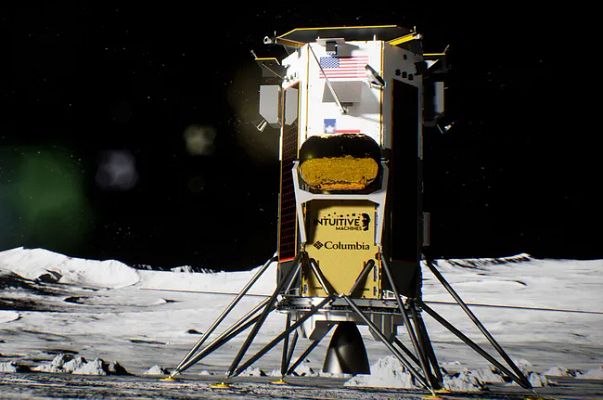
Intuitive Machines is a participant in NASA's Commercial Lunar Payload Services (CLPS) Programme, another contender being Astrobotic, which in January launched Peregrine, an attempt to reach the Moon that unfortunately failed due to an anomaly shortly after launch. Astrobotic will do a follow up later this year though with a second lander, Griffin.
After IM's confirmation that Odysseus was standing upright and sending data...
...photos failed to come through though. Apparently the camera didn't deploy during descent. I suppose IM's engineer right now are hard at work to solve that problem though. In any case, with this successful landing on the heels of Japans and India's lunar landers, it's clear that interest for our celestial neighbor is finally back to late 60s/early 70s levels, and hopefully we will finally see a Moon Base in the very near future!
MFBB.
Today, for the first time in half a century, America has returned to the Moon 🇺🇸.
— Bill Nelson (@SenBillNelson) February 23, 2024
On the eighth day of a quarter-million-mile voyage, @Int_Machines aced the landing of a lifetime.
What a feat for IM, @SpaceX & @NASA.
What a triumph for humanity.
Odysseus has taken the Moon. pic.twitter.com/JwtCQmMS2K
Intuitive Machines is a participant in NASA's Commercial Lunar Payload Services (CLPS) Programme, another contender being Astrobotic, which in January launched Peregrine, an attempt to reach the Moon that unfortunately failed due to an anomaly shortly after launch. Astrobotic will do a follow up later this year though with a second lander, Griffin.
After IM's confirmation that Odysseus was standing upright and sending data...
After troubleshooting communications, flight controllers have confirmed Odysseus is upright and starting to send data.
— Intuitive Machines (@Int_Machines) February 23, 2024
Right now, we are working to downlink the first images from the lunar surface.
...photos failed to come through though. Apparently the camera didn't deploy during descent. I suppose IM's engineer right now are hard at work to solve that problem though. In any case, with this successful landing on the heels of Japans and India's lunar landers, it's clear that interest for our celestial neighbor is finally back to late 60s/early 70s levels, and hopefully we will finally see a Moon Base in the very near future!
MFBB.
Sunday, January 21, 2024
RECOMMENDED VIDEO: SABINE HOSSENFELDER ON WHY YOU HAVE MASS.
Sabine Hossenfelder is a theoretical physicist at the Frankfurt Institute for Advanced Studies. I got to know her (well... not personally) via X/twitter and so discovered that she also has her own Youtube Channel, Science Without the Gobbledygook.
Maybe you heard left or right already that protons and neutrons are themselves composed of elementary particles called quarks. A proton e.g. is made up of one down and two up quarks. A neutron of one up and two down quarks. Quarks are not massless and their mass can be determined. Yet here's the thing: when these masses are added up, the result is nowhere near the well-known mass of a proton or a neutron. So where does the difference come from? Mrs Hossenfelder explains it in this video: other composite particles called pions, denoted with, you guess it, π, and made up of a quark and an anti-quark, are responsible for it:
You can follow Sabine on: @skdh
Nite.
MFBB.
Maybe you heard left or right already that protons and neutrons are themselves composed of elementary particles called quarks. A proton e.g. is made up of one down and two up quarks. A neutron of one up and two down quarks. Quarks are not massless and their mass can be determined. Yet here's the thing: when these masses are added up, the result is nowhere near the well-known mass of a proton or a neutron. So where does the difference come from? Mrs Hossenfelder explains it in this video: other composite particles called pions, denoted with, you guess it, π, and made up of a quark and an anti-quark, are responsible for it:
You can follow Sabine on: @skdh
Nite.
MFBB.
Tuesday, January 09, 2024
THE HUNT FOR STERILE NEUTRINOS - MINIBOONE, MICROBOONE, SBND AND ICARUS.
The hunt is on…. https://t.co/jNJQcsWw4a
— DUNE Science (@DUNEScience) December 26, 2023
"The neutrino is perhaps the most fascinating inhabitant of the subatomic world. Nearly massless, this fundamental particle experiences only the weak nuclear force and the much fainter force of gravity. With no more than these feeble connections to other forms of matter, a neutrino can pass through the entire Earth with just a tiny chance of hitting an atom. Ghosts, who are said to be able to pass through walls, have nothing on neutrinos.
The neutrinos’ phantom properties are not the only thing that sets them apart from other fundamental particles. They are unique in that they don’t have a fixed identity. The three known forms of neutrinos are able to transform into one another through a cyclical process called neutrino oscillation. In addition to being subatomic specters, they are also quantum chameleons.
Although the phenomenon of neutrino oscillation has been studied in many experiments, the data don’t tell a unified story. Based on the evidence of some experiments, some scientists have begun to suspect that there may be more than three types of neutrinos. These hypothetical additional neutrino types, unlike their familiar counterparts, would not even interact via the weak nuclear force and thus would be called sterile neutrinos.
Sterile neutrinos are not part of the Standard Model, the accepted theory of matter and energy in the subatomic world. If these extra neutrinos exist, they will force physicists to revisit the theory and possibly substantially revise it. A new experiment set to begin measurements soon may be able to settle the question of whether previous investigations have seen sterile neutrinos or not.
CONFUSING SIGNALS
The three known types of neutrinos are the electron neutrino, muon neutrino and tau neutrino, each named for the charged particle that is produced simultaneously with it. Early in our understanding of neutrino physics, each of these types seemed to be different from the other two. However, the situation became murkier in the 1960s and 1970s, when experiments began to show puzzling results.
Electron neutrinos are produced in nuclear reactions, and the biggest nuclear reactor around is the sun. Researchers used the energy output of our home star to calculate how many electron neutrinos they expected to arrive here on Earth. However, measurements yielded a third as many electron neutrinos as predicted. In addition, the cascade of particle interactions that result when high-energy cosmic protons hit our planet’s atmosphere was expected to produce twice as many muon neutrinos as electron ones. Yet experiments measured roughly equal quantities.
In 1957 physicist Bruno Pontecorvo made the daring proposal that neutrinos could oscillate, thereby changing their identity. Between 1998 and 2001, detectors studying the flux of neutrinos from both the sun and Earth’s atmosphere proved that neutrinos were changing into other flavors on their way to us.
Even prior to these observations, researchers used particle beams to investigate the possibility of neutrino oscillation. One experiment using the Liquid Scintillator Neutrino Detector (LSND) at Los Alamos National Laboratory produced a sample of nearly pure positive muons. As the muons decayed, they created muon antimatter neutrinos. Taking into account the setup of the experiment, physicists expected to detect electron antimatter neutrinos at a rate of about 0.06 percent of the amount of muon antimatter neutrinos. Instead they measured that electron antimatter neutrinos were about 0.31 percent of interactions, well above predictions.
Scientists can determine which neutrino they’ve detected by studying the particles that are created when neutrinos collide with atoms. When neutrinos do happen to impact an atom of matter, electron neutrinos will create an electron, and muon neutrinos will create a muon. Tau neutrinos react similarly, but it is challenging to identify tau particles.
Using their measurements (and others performed elsewhere), the LSND scientists concluded in 2001 that three neutrino variants could not simultaneously explain both their data and the array of solar and atmospheric neutrino measurements that existed at the time. However, if there were a fourth, sterile neutrino, then the experiments were consistent. The only problem was that other accelerator-based neutrino measurements didn’t support the idea of a fourth neutrino. Another measurement was necessary.
To help resolve this quandary, researchers at Fermi National Accelerator Laboratory (Fermilab) in Batavia, Ill., built MiniBooNE (Mini Booster Neutrino Experiment). The idea was to construct a detector using a similar technology as LSND but with a different source of particles and enhanced detector capabilities to see if scientists could clarify the situation.
MiniBooNE collected data from 2002 to 2018. The 2007 publication of its early results ruled out the simplest explanation of the LSND finding, though it did observe a different excess. When scientists collected more data and performed a more sophisticated analysis, they concluded in 2018 that there was a persistent mystery.
Yet other experiments tell a different story. A separate Fermilab project called MINOS (Main Injector Neutrino Oscillation Search) saw no evidence for sterile neutrinos. Nor was such evidence found by the IceCube experiment in Antarctica, which uses a cubic kilometer of ice to study neutrinos from space.
Nuclear reactors provide another source of electron neutrinos, and researchers have also used them to look for sterile neutrinos. In 2011 scientists reported a 6 percent deficit of electron neutrinos at a reactor in China, compared with what they expected to see. More recently, other researchers have claimed that the earlier calculations were in error and that no deficit exists...."
Full article by Don Lincoln, senior physicist at Fermilab, here.
Don't miss this video about neutrino oscillations:
MFBB.
Monday, January 01, 2024
CERN ANTIMATTER FACTORY's ALPHA-g APPARATUS FINDS ANTIMATTER REACTS THE SAME WAY TO EARTH'S GRAVITY AS ORDINARY MATTER.
If we can forget for a moment the terrible turmoil in the world, what with the biggest war since WW2 going on in Ukraine; Gaza; Darfur; dangerous tensions between China and Taiwan/The Philippines et al, one can only conclude that we seem to be on the cusp of a new Technological Era. Think quantum computers, the imminent return to the Moon and hence the exploration of Mars, AI, Brain Computer Interfacing and its potential to give severely handicapped people a new lease on life...
... and yet none of all that made as much an impression on me as CERN's ALPHA-g experiment last fall. This post's title sums up the essence: matter and antimatter react the same to Earth's gravity, but to find that out requires being able to isolate antimatter of course. I assume that before the experiment took place, antimatter had already been isolated, but I will use ALPHA-g's feat as the reference for that scientific breakthrough.
Antimatter is the opposite of ordinary matter: composed of antiparticles with reversed charge, parity and time. According to physics' laws, any (subatomic) particle should have its own antiparticle: a proton its antiproton, an electron its anti-electron (aka positron), a neutron its antineutron, a quark its antiquark etc etc. These particles were mathematically predicted and experimentally found, e.g. Paul Dirac predicted the positron around 1928 or so, and only 4 years later Carl Anderson found it in an experiment involving cosmic rays. It was Dirac again (what a genius) who theorized the antiproton in 1933, and in 1955 Emilio Segrè and Owen Chamberlain discovered it in in LBNL's (Lawrence Berkeley National Laboratory) Bevatron, a particle accelerator.
But while the consituent components of the most basic antimatter atom, the anti-hydrogen so to say, had thus been isolated, apparently it took until our days to go one step further and assemble them. Ordinary hydrogen, the basic building component of the Universe that we can see, is composed of one proton and one electron circling it. So anti-hydrogen must consist of an antiproton and an anti-electron, which from now on I will refer to as a positron.

Up until learning of this experiment, which relies on having actual antimatter of course, I thought matter's opposite number was the stuff of sci-fi and thrillers, like e.g. in Dan Browns Angels and Demons where the Pope's camerlengo wants to use an antimatter device to wreak havoc and teach humanity a lesson - the antimatter, suspended in a magnetic field sustained by a battery, expected to react in a violent annihilation explosion with matter upon depletion of the battery.
But the sci-fi is already behind us - CERN has an actual Antimatter Factory, and apparently, aside from measurable quantities of antiydrogen, comparable amounts of antihelium have already been produced also, be it at CERNs Large Hadron Collider by a team led by Ivan Vorobyev.
Anyway, the hurdle of assembly of basic anti-atoms now apparently having been taken, let's get back to the subject which was about ALPHA-g's experiment to find out whether antimatter reacts similarly to Earth's gravity as matter:
Via the CERNCOURIER:
Notice what Prof Diego Blas says: “The role of antimatter in the ‘weight’ of antihydrogen is very little, since practically all the mass of a nucleon or antinucleon comes from binding gluons, not antiquarks”. But I assume this holds true for ordinary matter also. A proton e.g. is composed of two up quarks and one down quark (and an antiproton of two anti-upquarks and one anti-downquark. Yet: an up quark weighs some 2.01 +/- 0.14 megaelectron-volts, and a down quark 4.79 +/- 0.16 MeV. That's 0.214% and 0.510% of the mass of the proton (some 940 MeV), respectively. Or the two upquarks and the one down quark which 'make' a proton constitute about 2 + 2 + 5MeV = 9MeV or... somewhat less than one percent of a proton's mass!!! It was to be expected that the same would hold true for an antiproton.
Some more videos:
And be sure to check out this one:
I wonder whether, after antihydrogen and antihelium, Mankind will also be able to build progressively heavier anti-elements? Will we one day be able to see a block of, say, 1 kg of anti-iron suspended in a magnetic field? And what would happen if that magnetic field suddenly fell away and the block boinked against the glass and metal of the device containing it?
One thing is sure, exciting days in physics ahead!
MFBB.
... and yet none of all that made as much an impression on me as CERN's ALPHA-g experiment last fall. This post's title sums up the essence: matter and antimatter react the same to Earth's gravity, but to find that out requires being able to isolate antimatter of course. I assume that before the experiment took place, antimatter had already been isolated, but I will use ALPHA-g's feat as the reference for that scientific breakthrough.
Antimatter is the opposite of ordinary matter: composed of antiparticles with reversed charge, parity and time. According to physics' laws, any (subatomic) particle should have its own antiparticle: a proton its antiproton, an electron its anti-electron (aka positron), a neutron its antineutron, a quark its antiquark etc etc. These particles were mathematically predicted and experimentally found, e.g. Paul Dirac predicted the positron around 1928 or so, and only 4 years later Carl Anderson found it in an experiment involving cosmic rays. It was Dirac again (what a genius) who theorized the antiproton in 1933, and in 1955 Emilio Segrè and Owen Chamberlain discovered it in in LBNL's (Lawrence Berkeley National Laboratory) Bevatron, a particle accelerator.
But while the consituent components of the most basic antimatter atom, the anti-hydrogen so to say, had thus been isolated, apparently it took until our days to go one step further and assemble them. Ordinary hydrogen, the basic building component of the Universe that we can see, is composed of one proton and one electron circling it. So anti-hydrogen must consist of an antiproton and an anti-electron, which from now on I will refer to as a positron.
Up until learning of this experiment, which relies on having actual antimatter of course, I thought matter's opposite number was the stuff of sci-fi and thrillers, like e.g. in Dan Browns Angels and Demons where the Pope's camerlengo wants to use an antimatter device to wreak havoc and teach humanity a lesson - the antimatter, suspended in a magnetic field sustained by a battery, expected to react in a violent annihilation explosion with matter upon depletion of the battery.
But the sci-fi is already behind us - CERN has an actual Antimatter Factory, and apparently, aside from measurable quantities of antiydrogen, comparable amounts of antihelium have already been produced also, be it at CERNs Large Hadron Collider by a team led by Ivan Vorobyev.
Anyway, the hurdle of assembly of basic anti-atoms now apparently having been taken, let's get back to the subject which was about ALPHA-g's experiment to find out whether antimatter reacts similarly to Earth's gravity as matter:
ALPHA-g is the first direct experiment to observe a gravitational effect on the motion of antimatter, opening a new avenue of experimental explorationhttps://t.co/yAsuroYSnt
— CERN Courier (@CERNCourier) November 27, 2023
Via the CERNCOURIER:
"Ever since the discovery of antimatter 90 years ago, physicists have striven to measure its properties in new and more precise ways. Experiments at CERN’s Antimatter Factory represent the state of the art. In addition to enabling measurements of properties such as the antiproton charge-to-mass ratio with exquisite precision (recently shown by the BASE experiment to be equal to that of the proton within a remarkable 16 parts per trillion), the ability to trap and store large numbers of antihydrogen atoms for long periods by the ALPHA experiment has opened the era of antihydrogen spectroscopy. Such studies allow precise tests of fundamental symmetries such as CPT. Until now, however, the gravitational behaviour of antimatter has remained largely unknown.
Equivalence principle
Using a modified setup, the ALPHA collaboration recently clocked the freefall of antihydrogen, paving the way for precision studies of the magnitude of the gravitational acceleration between antiatoms and Earth. The goal is to test the weak equivalence principle of general relativity, which requires that all test masses must react identically to Earth’s gravity. While models have been built that suggest differences could exist between the freefall rates of matter and antimatter (for example due to the existence of new, long-range forces), the theoretical consensus is clear: they should fall to Earth at the same rate. In physics, however, you don’t really know something until you observe it, emphasises ALPHA spokesperson Jeffrey Hangst: “This is the first direct experiment to actually observe a gravitational effect on the motion of antimatter. It’s a milestone in the study of antimatter, which still mystifies us due to its apparent absence in the universe.”
The ALPHA collaboration creates antihydrogen by binding antiprotons produced and slowed down in the Antiproton Decelerator and ELENA rings with positrons accumulated from a sodium-22 source. It then confines the neutral, but slightly magnetic, antimatter atoms in a magnetic trap to prevent them from coming into contact with matter and annihilating. Until now, the team has concentrated on spectroscopic studies with the ALPHA-2 device. But it has also built an apparatus called ALPHA-g, which makes it possible to measure the vertical positions at which antihydrogen atoms annihilate with matter once the trap’s magnetic field is switched off, allowing the antiatoms to escape.
The ALPHA team trapped groups of about 100 antihydrogen atoms and then slowly released them over a period of 20 seconds by gradually ramping down the top and bottom magnets of the trap. Numerical simulations indicate that, for matter, this operation would result in about 20% of the atoms exiting through the top of the trap and 80% through the bottom – a difference caused by the downward force of gravity. By averaging the results of seven release trials, the ALPHA team found that the fractions of antiatoms exiting through the top and bottom were in line with simulations. Since vertical gradients in the magnetic field magnitude can mimic the effect of gravity, the team repeated the experiment several times for different values of an additional bias magnetic field, which could either enhance or counteract the force of gravity. By analysing the data from this bias scan, the team found that the local gravitational acceleration of antihydrogen is directed towards Earth and has magnitude ag = [0.75 ± 0.13 (stat. + syst.) ± 0.16 (sim.)]g, which is consistent with the attractive gravitational force between matter and Earth.
The next step, says Hangst, is to increase the precision of the measurements via laser-cooling of the antiatoms, which was first demonstrated in ALPHA-2 and will be implemented in ALPHA-g in 2024. Two other experiments at CERN’s Antimatter Factory, AEgIS and GBAR, are poised to measure ag using complementary methods. AEgIS will measure the vertical deviation of a pulsed horizontal beam of cold antihydrogen atoms in an approximately 1 m-long flight tube, while GBAR will take advantage of new ion-cooling techniques to measure ultra-slow antihydrogen atoms as they fall from a height of 20 cm. All three experiments are targeting a measurement of ag at the 1% level in the coming years.
Even higher levels of precision will be needed to test models of new physics, say theorists. “The role of antimatter in the ‘weight’ of antihydrogen is very little, since practically all the mass of a nucleon or antinucleon comes from binding gluons, not antiquarks,” says Diego Blas of Institut de Física d’Altes Energies and Universitat Autònoma de Barcelona. “Any new force that couples differently to matter and antimatter would therefore need to have a huge effect in antiquarks, which makes it difficult to build models that are consistent with existing observations and where the current measurements by ALPHA-g would be different.” Things start to get interesting when the precision reaches about one part in 10 million, he says. “This is the start of a new avenue of experimental exploration that pushes the development of trapping and other techniques. If you compare the situation with the sensitivity of the first prototypes of gravitational-wave detectors 50 years ago, which had to be improved by six or seven orders of magnitude before a detection could be made, anything is possible in principle.”
Notice what Prof Diego Blas says: “The role of antimatter in the ‘weight’ of antihydrogen is very little, since practically all the mass of a nucleon or antinucleon comes from binding gluons, not antiquarks”. But I assume this holds true for ordinary matter also. A proton e.g. is composed of two up quarks and one down quark (and an antiproton of two anti-upquarks and one anti-downquark. Yet: an up quark weighs some 2.01 +/- 0.14 megaelectron-volts, and a down quark 4.79 +/- 0.16 MeV. That's 0.214% and 0.510% of the mass of the proton (some 940 MeV), respectively. Or the two upquarks and the one down quark which 'make' a proton constitute about 2 + 2 + 5MeV = 9MeV or... somewhat less than one percent of a proton's mass!!! It was to be expected that the same would hold true for an antiproton.
Some more videos:
And be sure to check out this one:
I wonder whether, after antihydrogen and antihelium, Mankind will also be able to build progressively heavier anti-elements? Will we one day be able to see a block of, say, 1 kg of anti-iron suspended in a magnetic field? And what would happen if that magnetic field suddenly fell away and the block boinked against the glass and metal of the device containing it?
One thing is sure, exciting days in physics ahead!
MFBB.
Saturday, December 23, 2023
DUNE INFRASTRUCTURE NEARING COMPLETION.
DUNE (Deep Underground Neutrino Experiment) in Illinois (the particle accelerator) and South Dakota (the detector) is one of the two current massive undertakings with the aim of detecting and studying neutrinos, the other one being Japan's Hyper Kamiokande.
At the Big Bang an unfathomable amount of energy came free. Per Einsteins equation, energy can be transformed in mass and vice versa. The laws of physics dictate that every matter particle should have its own antimatter particle, and it is thought that in the very beginning this was indeed the case. Yet what we see around is only matter - composed of protons, neutrons and electrons. Which is logical, because each matter particle that would meet an antimatter particle would lead to instant annihilation whereby energy would be generated. But we are here, in the present, and can see and touch things, which means there is (almost) no antimatter, or anyway, that we can easily detect in a natural way. Mankind can in the meantime 'make' antimatter, as CERN's AlphaG experiment has demonstrated. But for the present only in very tiny amounts - we are talking about little 'clouds' of antimatter consisting of a couple of hundred anti-hydrogen atoms (an antiproton and a positron), kept in place by a magnetic field lest they touch the vessel in which they are kept and annihilate.
The study of neutrinos may offer crucial insight into the how and why of there being so much more matter than antimatter. Exciting times ahead!
MFBB.
Massive caverns for DUNE neutrino project nearly excavated https://t.co/WUBz0uSskk
— DUNE Science (@DUNEScience) December 22, 2023
At the Big Bang an unfathomable amount of energy came free. Per Einsteins equation, energy can be transformed in mass and vice versa. The laws of physics dictate that every matter particle should have its own antimatter particle, and it is thought that in the very beginning this was indeed the case. Yet what we see around is only matter - composed of protons, neutrons and electrons. Which is logical, because each matter particle that would meet an antimatter particle would lead to instant annihilation whereby energy would be generated. But we are here, in the present, and can see and touch things, which means there is (almost) no antimatter, or anyway, that we can easily detect in a natural way. Mankind can in the meantime 'make' antimatter, as CERN's AlphaG experiment has demonstrated. But for the present only in very tiny amounts - we are talking about little 'clouds' of antimatter consisting of a couple of hundred anti-hydrogen atoms (an antiproton and a positron), kept in place by a magnetic field lest they touch the vessel in which they are kept and annihilate.
The study of neutrinos may offer crucial insight into the how and why of there being so much more matter than antimatter. Exciting times ahead!
Scientists working on the Deep Underground Neutrino Experiment are preparing for the first test of a prototype detector in a neutrino beam!
— Fermilab (@Fermilab) December 1, 2023
🔗 Read more: https://t.co/MqwC9n2fYO
💻 Watch the prototype detector move: https://t.co/30u9wpm2dz#DUNEscience #neutrino @DUNEScience
MFBB.
Sunday, December 17, 2023
TIP: MASSACHUSETTS INSTITUTE OF TECHNOLOGY OFFERING FREE ONLINE COURSES.
MIT is offering totally free online courses.
— Saransh Kaushik (@saranshwrites) December 16, 2023
No payment required!
Here are the Top 7 Courses: pic.twitter.com/QvJ57HqYft
I will list just two, but check out the other ones too. This is MIT's 'Introduction to Computational Thinking and Data Science':
1. MIT’s Introduction to Computational Thinking and Data Science
— Saransh Kaushik (@saranshwrites) December 16, 2023
The course is designed for those who want to:
→ Gain practical experience with Python
→ Gain a deeper understanding of computational thinking
🔗https://t.co/yhUBSEkL4N pic.twitter.com/HHRJOxaeoO
And here's 'Introduction to Computer Science and Programming Using Python':
2. Introduction to Computer Science and Programming Using Python
— Saransh Kaushik (@saranshwrites) December 16, 2023
This course is designed to help people learn computer science or programming with no previous knowledge.
Created by the best Tech University in the World!
🔗https://t.co/YrJZvvPnti pic.twitter.com/oizRYUn3jy
Good night.
MFBB.
Saturday, November 25, 2023
NASA'S CHANDRA X-RAY OBSERVATORY CAPTURES PUPPIS A.
This image shows the destructive results of a powerful supernova explosion in X-ray light captured by NASA's Chandra and ESA's XMM-Newton. Known as Puppis A, this supernova remnant is located about 7,000 light-years from Earth and it's roughly 140 light-years across. pic.twitter.com/4hmZ4smUwG
— Chandra Observatory (@chandraxray) November 17, 2023
Puppis A, in the constellation of Taurus, is about 7,000 ly away from Earth and has a "diameter" of about 140 ly. It's interesting to compare it to the Crab Nebula, aka M1 (Messier 1), which is about 6,500 ly away in the Constellation of Taurus and is around 11 ly across, so roughly 13 times smaller than Puppis A. Of Puppis A, it has been calculated that the supernova explosion which caused it occurred about 3,700 years ago - or rather, the light of it reached Earth 3,700 years ago. The supernova explosion that gave birth to the Crab Nebula was recorded by Chinese and Japanese astronomers in 1054, a well established fact. So one can say that some 2,700 years separate the light of the exploding Crab Nebula and of Puppis A reaching our planet - although of course, the actual explosions took place 3,700 years plus 7,000 years equals 10,700 years ago for the latter and 1,000 years plus 6,500 years equals 7,500 years for the former.
Given that the accounts of the Chinese and Japanese astronomers meticulously record the event and describe its brightness as being comparable to a full Moon, it must have been quite a sight. And the question is, would there somewhere exist as yet untranslated records of the sightings of the supernova explosion that yielded Puppis A? 3,700 years ago would place it in the dying days of Sumer, or Egypt's Middle Kingdom at its zenith. Given that Puppis A is thirteen times bigger than the Crab Nebula, and assuming that it can't have expanded in size from a comparable diameter to what it is now, its explosion must have dwarfed the explosion witnessed in 1054. In all likelihood its light must have been many times brighter than that of a full Moon. It is therefore curious that so far and to the best of my knowledge, no ancient Sumerian or Egyptian texts have been discovered detailing the event.
MFBB.
Friday, October 06, 2023
FRANK WHITTLE AND THE EARLY JET ENGINES.
A working one, to be sure, because there is at least one historic predecessor (John Barber, 1731) which could not be realised for a variety of scientific and technological reasons, chief among them probably the metallurgical challenges of developing a jet engine.
The Whittle W.1X, which in April 1941 powered the first UK jet, the Gloster E.28/39:

Whittle was a tremendous genius allright, and yet I cannot fathom why he stubbornly clung to reverse flow combustion? How could a man who engineered such a groundbreaking novelty keep incorporating this feature which instantly 'feels' wrong even for the less engineer-minded? It's clear that the penalty of it is thrust loss, and this for a powerplant in its infancy, which de facto was already weak in output to begin with: its maximum thrust was a mere 850 lbf (3.8 kN) at 16,500 rpm.
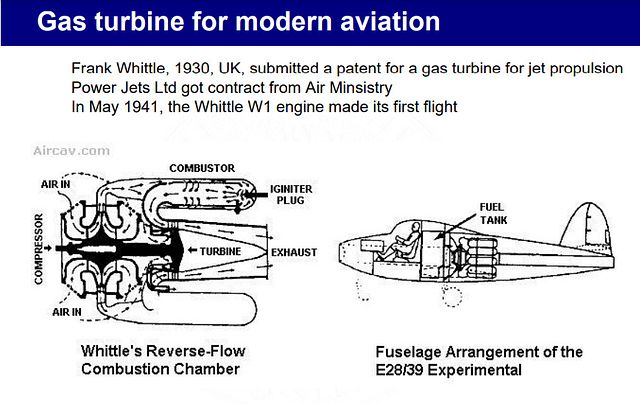
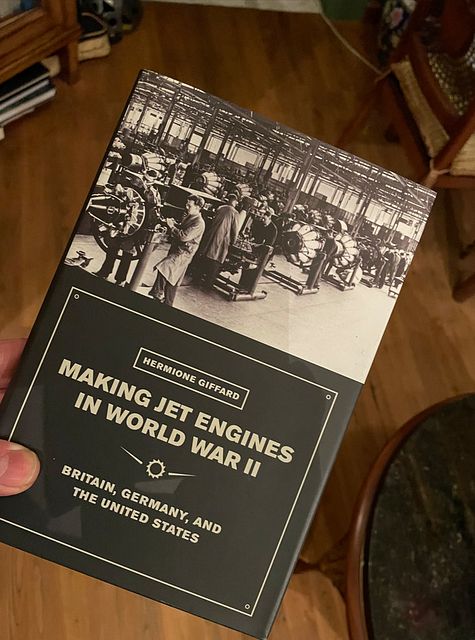
A highly recommended book on early jet engines btw is Hermione Giffard's Making Jet Engines in World War 2:
And therein it is detailed, amongst others, that subsequent designers right away dispensed with reverse flow combustion:
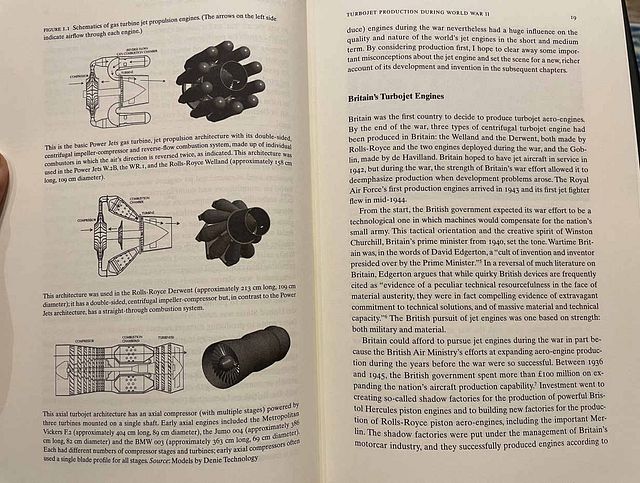
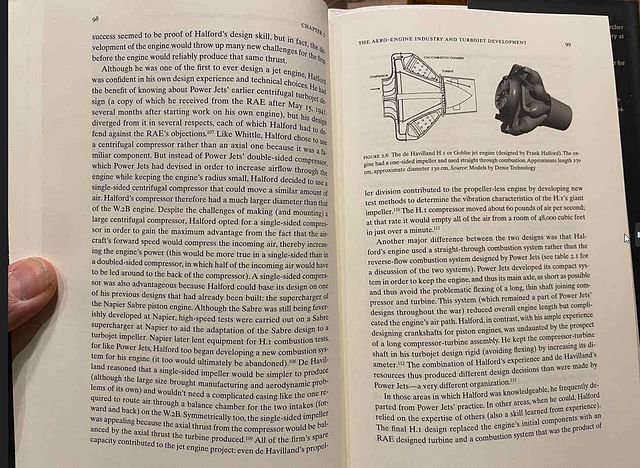
A very noteworthy desing was the Halford H1, designed by the legendary Frank Halford (father of the Napier Sabre), and which was a short while later renamed the de Havilland Goblin:
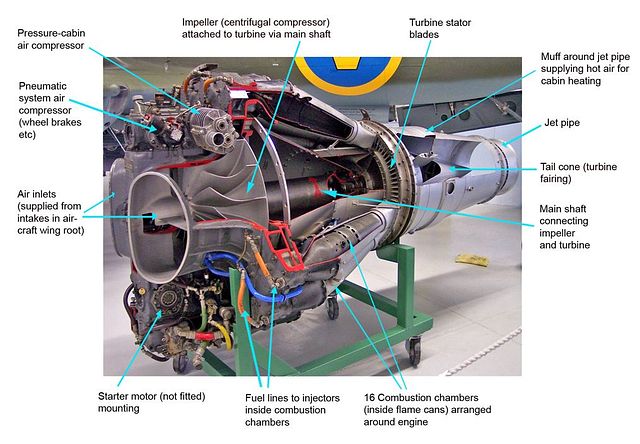
It was such a brilliant design from the start that, although it was conceived in 1941, its basic form remained unchanged until 1954, by which time it had evolved to the Mk. 35 export version. Pictured is the de Havilland Goblin II, which powered the de Havilland Vampire:
MFBB.
The Whittle W.1X, which in April 1941 powered the first UK jet, the Gloster E.28/39:
Whittle was a tremendous genius allright, and yet I cannot fathom why he stubbornly clung to reverse flow combustion? How could a man who engineered such a groundbreaking novelty keep incorporating this feature which instantly 'feels' wrong even for the less engineer-minded? It's clear that the penalty of it is thrust loss, and this for a powerplant in its infancy, which de facto was already weak in output to begin with: its maximum thrust was a mere 850 lbf (3.8 kN) at 16,500 rpm.
A highly recommended book on early jet engines btw is Hermione Giffard's Making Jet Engines in World War 2:
And therein it is detailed, amongst others, that subsequent designers right away dispensed with reverse flow combustion:
A very noteworthy desing was the Halford H1, designed by the legendary Frank Halford (father of the Napier Sabre), and which was a short while later renamed the de Havilland Goblin:
It was such a brilliant design from the start that, although it was conceived in 1941, its basic form remained unchanged until 1954, by which time it had evolved to the Mk. 35 export version. Pictured is the de Havilland Goblin II, which powered the de Havilland Vampire:
MFBB.
Subscribe to:
Comments (Atom)