Showing posts with label Travel. Show all posts

Tuesday, October 03, 2023

GREAT WALKS: YOKE, ILL BELL, FROSWICK AND TROUTBECK IN THE LAKE DISTRICT.

Something to battle the negativity, this marvellous account of an early Spring walk in the Lake District:


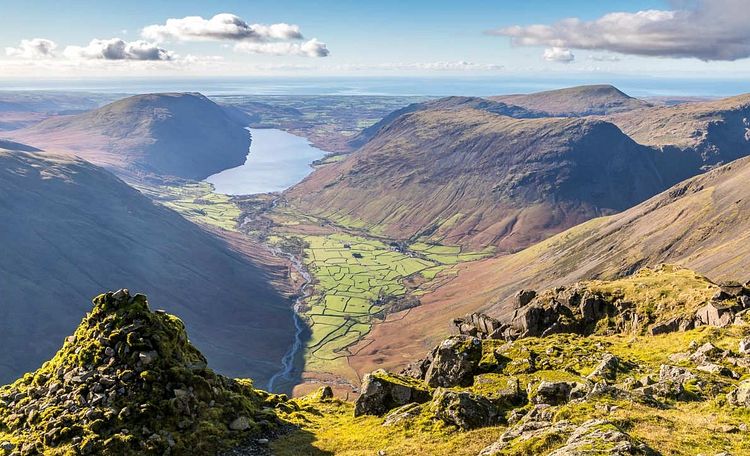
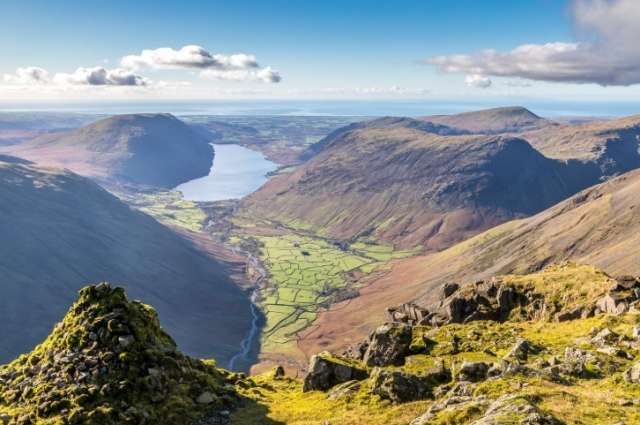
I can sympathize. I have vacationed in that glorious piece of real estate five times. But to be sure, the video deals with the southeast, a corner I have yet to discover. I am more familiar with the West, where, e.g., from the top of Great Gable you are rewarded with this sight:


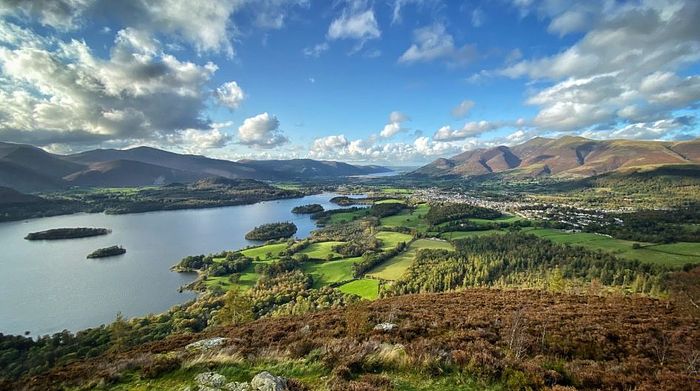
... or the North, where Keswick rests between Derwentwater and the Skiddaw range:


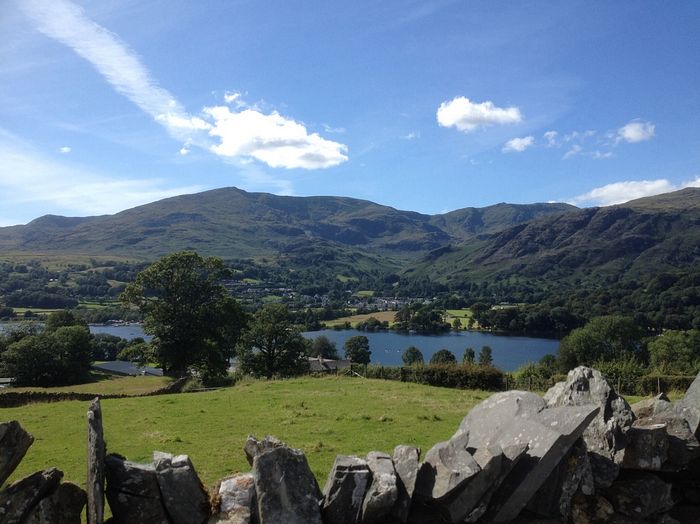
... or the South, with the Coniston Old Man looms over its namesake village:


I climbed the Coniston Old Man in 2015, Blencathra in 2020, and Skiddaw and Great Gable both in 2021. And I'm a happier man for it! If you don't know the Lake District yet, go and discover it!


MFBB.

Sunday, October 03, 2021

RECOMMENDED VIDEO: ARTHUR WILLIAMS' 'FLYING ACROSS BRITAIN'.

Arthur Williams is a former Royal Marine who lost the use of his legs in an accident, took up flying, and is now a successful TV reporter! To get a taste of his work, watch this fascinating video:


As Winston once said: "Never, never, never give up!".


MFBB.

Thursday, October 11, 2018

RECOMMENDED VIDEOS: HIKING UP THE GREAT GABLE.

One can't let him or herself be cast down by too much negativity. It's been a bit too much lately, world is going bonkers. So my mind wandered off to more interesting realms - for me at least: hiking up some nice hilltop for instance.

One of these is the Great Gable in the west of the Lake District, Cumbria, UK. At 899 m (2,949 ft) it is not yet a Munro; in these parts, they call 'em Marilyns.

To be sure, I never went up Great Gable although I definitely intend to do so one day, hopefully sooner than later. Closest I came was in 2013 when I went up the parent peak, Scafell Pike, which at 978 m, or 3,209 ft, passes the 3,000 ft mark making it a Munro.

I recently discovered the British Mountaineering Club is compiling nice short videos detailing hikes up Munros, Marilyns and the likes. Here's the one describing the climb up the Great Gable:


Here's the view from Westmorland Cairn, almost on top of the Great Gable:


So named after two brothers who erected it in 1876 to mark what they claimed was the finest view in the whole of the Lake District. On a sunny day, or even a half-sunny, it's hard to disagree.


In the distance you can see Wast Water, which reportedly is England's deepest body of water.


Can't wait to get back there.


MFBB.

Friday, August 10, 2018

BACK IN BUSINESS.

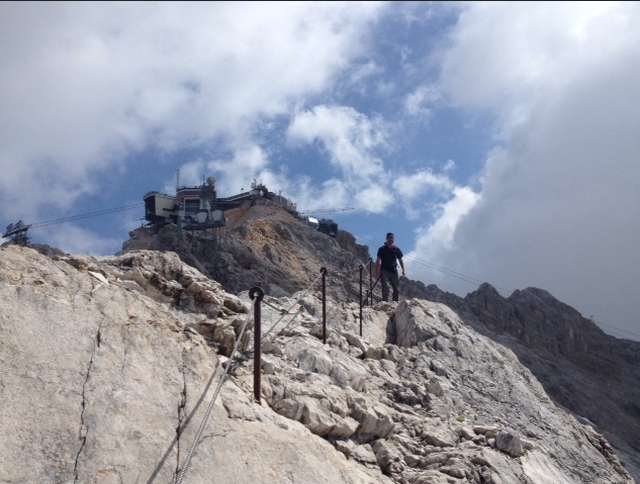
As you may have guessed, I was away on vacation with the family, though not for the full three weeks since the radio silence. I consider myself lucky that once again, we had a great time with lots of fun and exciting new sights and sounds. Summer vacation 2018 took me first solo to Bavaria where I climbed Germany's highest, the Zugspitze (2962m). I took the pic below on final approach.


I got there by way of the Reintalroute, which is the easiest one. Easiest one, not counting of course the ascent by cable car, haha. Indeed, the summit of the Zugspitze is a bit of a circus, with scores of tourists coming up without breaking a sweat, to then gobble down bratwurst in the eateries on top, spend their euros on silly tourist stuff in gift shops etc. To be sure, I took the cable car back down, because I figured that if I took the same way back I'd never make it to my hotel before midnight. Indeed, the day before I hiked from Garmisch-Partenkirchen via the Bockhuette and the Reintalangerhuette to the Knorrhuette (ca. 2,050m), where I stayed for the night. I had originally planned to then push right thru to the summit in the morning, take a few pics and get back the same way; but the trek from Knorrhuette to summit took me 4 hours, and it was around eleven when I finally got there. It wasn't doable to get back down to the Knorrhuette and all the way back from there to GP in the remaining daytime. So I took the easy way down. Even so, once at the bottom of the valley, near the Eibsee, I still had to hike an estimated 18 (?) kloms back to the hotel. Anyway... it was fun, exciting, tough at times, and above all beautiful Bavaria was gloriously baking in the sun with a magnificently blue canopy over it.


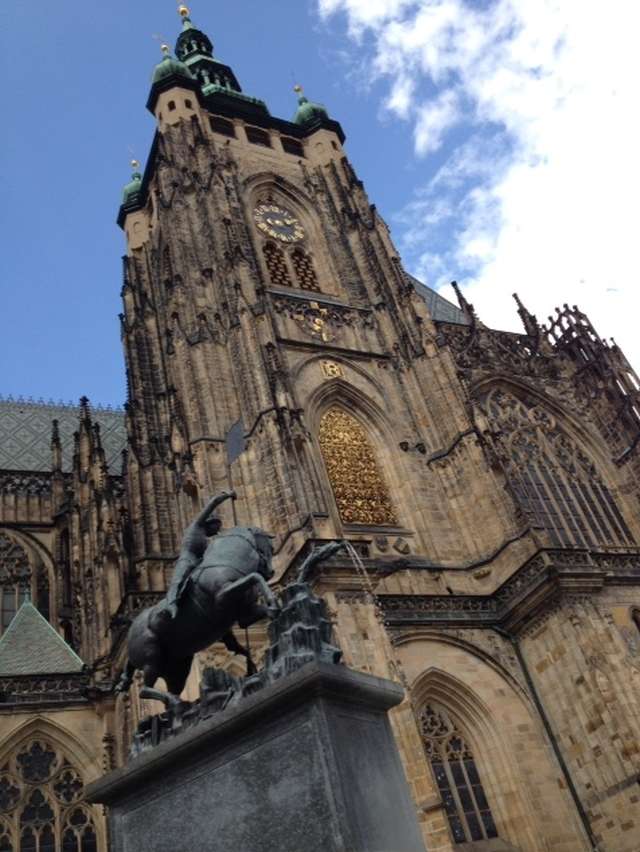
I hurried back to Belgovakia, did a couple of last minute chores I hadn't been able to finish, then packed the family in the good ole Outlaw Wagon which has carried us safe and sound to so many places, from Achill Island to Niedzica and from Geiranger to Lago Maggiore. And over Nuremberg we reached Prague. Now, Prague was a revelation and a shock. Can't remember if I ever saw so many palaces on so few square kloms. It was... breathtaking, and after only one day the family was in serious danger of Cultural Overkill. This is Saint Vitus Cathedral, the top attraction of Hradcany Palace, but my pitiful photo does not do right at all to the beauty and glory of Prague's Crown:


You will have to go see Prague yourself, and trust me, you won't regret it!


Then it was off via Brno and then through Slovakia to Poland's Tatra Mountains, more precisely Zakopane, where I had booked a mountain hut for a week.

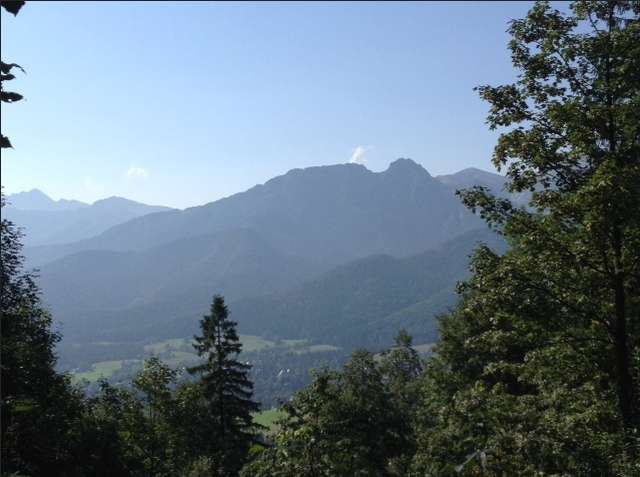
Below the view from our cottage, Chata Stacha on Mount Gubawovka in Zakopane. The silhouette of the distinctive mountain you see there, the Giewont, can, with some imagination, be perceived as that of a sleeping guy, and indeed, Zakopanians refer to Giewont as 'the sleeping Knight'. 'Knight', cause the guy they have in mind is an ancient Polish King, Boleslaw the Brave.


I went up Giewont too. It's only 1894m, and it gives no problems from whatever direction you approach it. Only the last 100m or so pose a bit of a challenge, as the summit is a butte with steep sides you have to negotiate using chains fastened in the rock walls. After Giewont I hiked up the Kondracka Kopa (2005m), why not? It's just crossing the saddle between the two and then up about 250m over a decent path. Look at The Sleeping Knight's head (the part with the cloud plume is his breast, the indentation his throat, the summit his head), between it and the tree leaves to the right is the saddle and the featureless summit of Kondracka Kopa.

It was all over far too soon, and it's a damn pity time is as short in supply here as sane people, cause there's so much else I'd like to elaborate on - Cracow comes to mind. But alas. Anyway, on our last but one day we drove from Zakopane over Zywiec (famous for its beer) and Bielsko Biala to Karpacz, which like Zakopane is a bit of a mountain resort. Only thing is, the Tatras at Z-Town have alpine allures, while the mountains behind Karpacz are far lower and gentler, even though they are called the Giant Mountains. Highest among them is the Sniezka, the summit of which Poland shares with the Czech Republic. As it happens, the Sniezka, at 1,603 meters, is Czechia's highest. On the summit there's a postmodern conflagration of UFO like disks from the communist era:


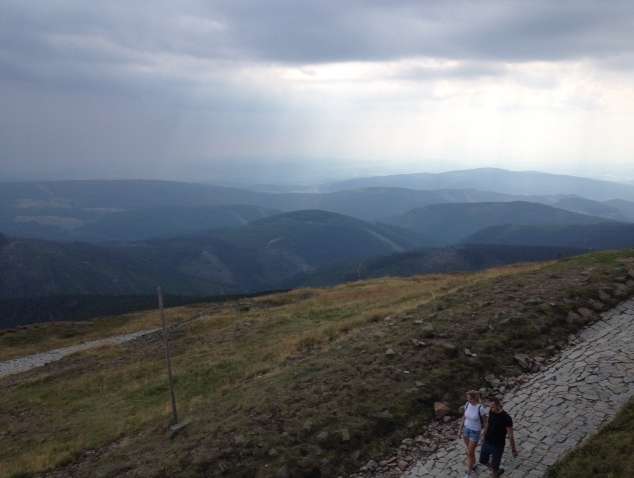
And this is what the gentle mountains on both sides of the Czech/Slovak border look like:


I'm not a great photographer and I still got an old iPhone4, so these pics prolly don't excite wow feelings towards Central Europe, but trust me, the place is more than worth a decent vacation. So many things to see and do yet, but you won't hear me complainin' - it was oooookay.


Nite.


MFBB.


Tuesday, March 06, 2018

RECOMMENDED VIDEO: "A TRIP DOWN MARKET STREET" (1906) BY THE MILES BROTHERS.

The Miles brothers: Harry, Herbert, Joseph, and Earle, were film and cinema pioneers in San Francisco. They are best known for "A trip down Market Street", a 12-minute film shot from a cable car conductor's POV. I stumbled upon it following a LiveScience link that's got info on footage from the SF Earthquake of 1906. Fate and good fortune intervened for this gem so that today, we can get a glimpse of what traffic and life was like then in the bustling metropolis. Because it is now assumed that the filmreel was sent by train to New York the night before the earthquake struck, and among the 28,000 buildings it destroyed was the one housing the Miles Brothers' studio!


For me, this Trip clip is also a trip down memory lane, cause in 1995, almost 90 years after the devastating earthquake, I walked myself down Market Street. That summer, I was going to travel the length of the US's West Coast up northwards starting from Frisco with a small international group, and, having arrived two days before them, I found myself with nothing to do but reconnoitre the area. I was staying in the Ramada Hotel on Market Street; walked to its northern end. I also remember strolling over Union Square. Anyway, on Google Earth I checked out how the Ramada was doing these days, and I found out it's now Hotel Whitcomb.


Ah... memories!!!


MFBB.

Sunday, November 26, 2017

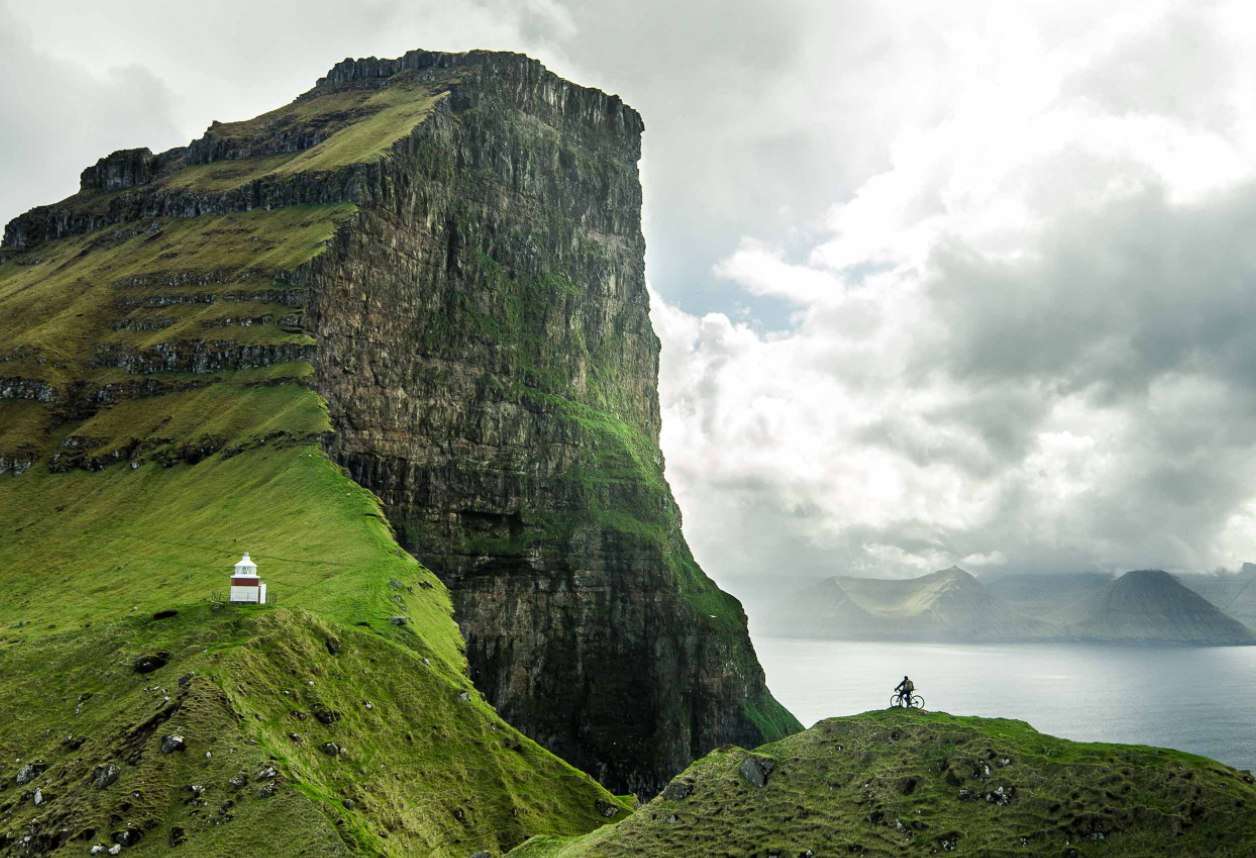
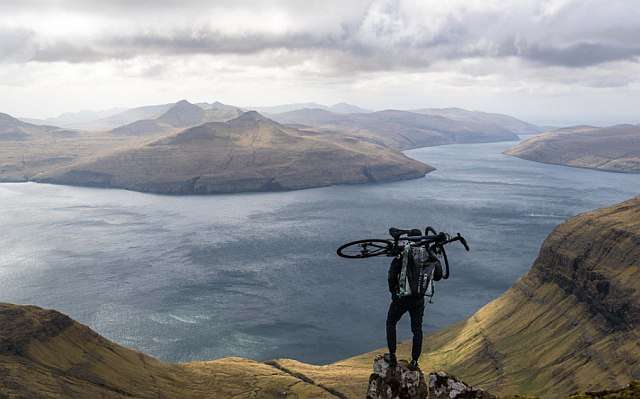
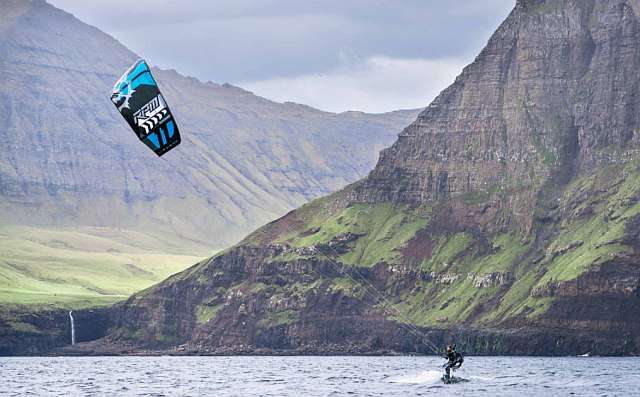
THE FAROE ISLANDS BY BIKE, KITE AND KAYAK.

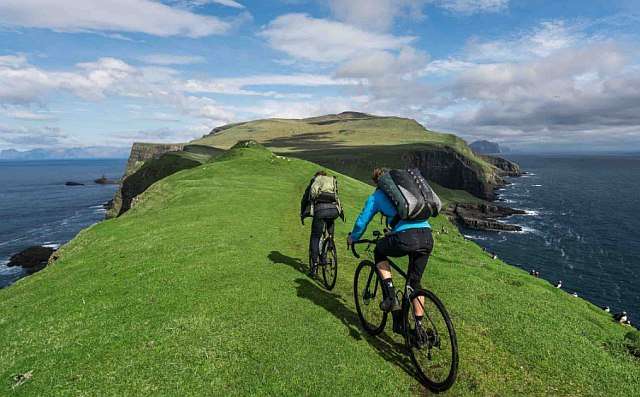
You gotta ab-so-lu-te-ly check out these guys' site, their mini-docus on their bike rides in exotic locations are awesome. Their latest one is about their trip in the Faroe Islands, an archipelago in the North Atlantic consisting of some 18 islands, home to around 50,000 people.

Here's a video of their exploits:


Some stills, all of them courtesy NorthSouth of course:


Breathtaking! But if you feel tempted to go there yourself, as I do, be sure to go in summer. The pics above were shot in June. Guess it's a bit less hospitable in December.

But one day I gotta go there. That's for sure.


MFBB.

Friday, August 12, 2016

RIO DE JANEIRO: AN AMAZING WALK ON THE STATUE OF CHRIST THE REDEEMER.

A video from Brazil, but nothing to do with the Olympics: a couple of technicians apparently used to great heights perform some maintenance tasks on lightning rods along the statue of Christ The Redeemer's arms:


The statue of Christ the Redeemer (in Portuguese: Cristo Redentor) was built between 1922 and 1931 on top of the 700-metre Corcovado mountain, and for its construction reinforced concrete covered with soapstone (steatite, a metamorphic rock rich in magnesium) was used. The Polish-French designer Paul Landowski chose for an Art Deco style, but the head is the work of the Romanian sculptor Gheorghe Leonida. Actual construction was by the engineering duo Heitor da Silva Costa and Albert Caquot, a French national. The statue of Christ The Redeemer weighs 635 metric tons and has a height of 30 metres (98 ft), not counting the 8-metre (26 ft) pedestal. Its arms stretch 28 metres (92 ft) wide.

Hat tip my uncle R.


MFBB.

Sunday, May 29, 2016

EASTER HOLIDAY IN SOUTH WEST ENGLAND.

 photo calais_ferry_zpsxsbxcdqo.jpg

- All over the last summer, autumn and winter I had read about the migrants making a terrible nuisance of themselves near the Eurotunnel entrance, so I figured that for our Easter holiday to the south of England this year round, it might be safer to take the ferry Calais-Dover instead. And since there's no backflow, I also reckoned that taking the Eurotunnel to get back to France would pose no problems. So the plan was, France to the UK: the P&O Ferry. UK back to France: Eurotunnel.

The photo shows us approaching Calais port with the ferry terminals. Notice the barbed wire to keep migrants from climbing over the fences and disrupting the traffic. At regular intervals there were police vans with officers on guard. Welcome to European holidays in 2016!

Except that we did not board a ferry to go to England after all.

At the check-in terminals, they told us the storm in the Channel was so bad, Dover Harbour was closed. Earliest departure was scheduled for three pm, which meant waiting for four hours and ruining our afternoon schedule. Eurotunnel apparently cooperating with P&O Ferries however, they offered us the possibility to trade in our ferry tickets for Le Shuttle tickets for the same price, if only we took the risk to not be able to board the train immediately.

We took our chances and to our surprise, fifteen minutes later - the Chunnel entrance is right to the west of Calais, as opposed to the ferry terminals which are right to the east - we were waved through to the Le Shuttle loading platforms right away.

Half an hour later we were in Folkestone!


 photo folkestone_beach_2016_zpsuhac63q1.jpg

There was a stiff breeze and rough water (for landlubbers) but imho no waves that warranted closing a harbour.


 photo jane-austens_huis_zpsyhtvbxp1.jpg

We had booked three nights at the Imperial Hotel in Torquay, and one night in the Shore View Hotel in Eastbourne. When we left Folkestone there remained an estimated five hours of driving to Torquay, and it was only 1pm local time or so, so I figured there was sufficient time to visit two places - even if it had to be in a hurry. Place No. 1 was the house in Chawton where Jane Austen had spent the final eight years of her life. Jane Austen (1775-1817) is a quintessential British Romanticism writer and a contemporary of literary giants like William Wordsworth, Samuel Coleridge and Lord Byron. She wrote but a small number of books, and by the time she settled in Chawton she had written two of her best known masterpieces in draft form already: Sense and Sensibility and Pride and Prejudice. Before publishing them, she may have revised them here. Completely new works written in Chawton were Mansfield Park, Emma and Persuasion. A bit to my surprise I also discovered, upon coming across several naval displays, that two of Jane Austen's brothers made it Admiral in the Royal Navy: Sir Francis Austen became Admiral of the fleet and Charles Austen reached the rank of Rear Admiral.


O'er here at DowneastBlog, we have touched on the subject before. In 2009, that is. Pride and Prejudice is perhaps Austen's best known work, a novel of manners first published in 1813 and destined to become on of the most successful novels in English literature, with over 20 million copies sold to date. There have been several film and TV adaptations, of which the 2005 version, directed by Joe Wright and starring Keira Knightley as Elizabeth Bennet and Matthew McFadyen as Mr Darcy, is possibly the best so far. Here is what I wrote at the time, and this is the soundtrack exerpt 'The Living Sculptures at Pemberley':


 photo winchester_cathedral_zpsjnntmgjk.jpg

From Chawton it was but a short hop to Winchester, which boasts a magnificent gothic cathedral. What English gothic cathedrals lack in height compared to their continental counterparts they make up in length, and indeed Winchester Cathedral, dedicated to the Holy Trinity, has the longest nave and greatest overall length of any Gothic cathedral in Europe. Work began in 1079, and the consecration took place in 1093 already, but for centuries there would be alterations and additions.


 photo Interior_Winchester_Cathedral_zpsmhttvszj.jpg

View of the nave looking eastwards towards the choir. Under William of Wykeham (1367–1404) the nave, until then in Romanesque style, was recased in Caen stone and remodelled in the Perpendicular style, the third phase in English Gothic Architecture, with an emphasis on vertical lines...


 photo roof_winchester_cathedral_zpsbrgcthaj.jpg

... The ceiling is spectacularly embellished by those vertical lines converging into an intricate pattern: Winchester Cathedral's vault is a veritable poem in stone!


 photo torquay_zpsgornlosn.jpg

After that it was off to Torquay, focal point of the English Riviera. That's not exaggerated: temperatures are said to be the highest in the UK (although I would wager the Scilly Islands are still warmer) and there are palm trees galore. This town of around 65,000 was also home to Agatha Christie, and around the harbour there's a so-called Agatha Christie Mile, a walk with successive plaques and a bust highlighting specific events in her life and work.


 photo torquays_oldest_pub_zpsvzgoow9m.jpg

At night, I took strolls through Torquay. It was still March and somewhat chilly, but the town centre was not exactly deserted. One one of my walks I came across "Hole in the Wall", Torquay's oldest pub, established circa 1540. The text reads: "For hundreds of years Smugglers . Men of the Sea . Businessmen . Locals . Visitors alike have enjoyed drinking at the Hole in the Wall."


 photo Jurassic_coast_zps74xa83fb.jpg

On our second day, we visited Jurassic Coast, so called because there fossils dating from the Jurassic Epoch are supposedly omnipresent. Alas, for me the harvest was meagre... Pic taken in Charmouth, just east of Lyme Regis. Charmouth seems to be the place where you have the biggest chance to come up with decent fossils.


 photo golden_hind_zpsvufj6n5i.jpg

The day after, we intended to visit The Eden Project in Cornwall. History buff that I am - freak, rather - I could not resist stopping in nearby Brixham where I knew a replica of the Golden Hind was moored, Sir Francis Drake's flagship with which he circumnavigated the world between 1577 and 1580. He set sail with five ships and came back with only one. Originally it was called the Pelican, but while underway he rebaptised it in Golden Hind, to honor Sir Christopher Hatton, his patron, whose heraldic emblem contained a golden hind. It is hard to believe that Drake survived the perils of the world's oceans with this small galleon, which had a water displacement of a mere 100 tons!


 photo eden_project_zpsgl6p51ry.jpg

After a relatively smooth ride, apart from a huge traffic jam before and in Totnes, we arrived at The Eden Project, which is situated in a disused kaolinite quarry two kilometres from the town of Saint Blazy, just inside Cornwall. The Eden Project is the brainchild of a certain Tim Smit and consists mainly of two gigantic biomes in which vegetation typical for a Rainforest and the Mediterranean has been recreated. Indeed it is said that the largest of the two biomes contains the largest piece of Rainforest outside the Amazon! Apart from the biomes, there are substantial outdoor gardens including a walk back in time for Earth's vegetation, the "Core", a building for educational purposes, and a visitor centre.


 photo eden_project_inside_zpsyarb5y2s.jpg

What the Rainforest Biome looks like from the inside. The biomes' "shells" consist of a skeleton of tubular steel cladded with hexagongal (mostly) and pentagonal thermoplastic ETFE panels. ETFE stands for ethylene tetrafluoroethyle, a polymer. It was chosen because it maintains it's strength over a wide temperature range, is self-cleaning, and has a high melting temperature. Also, it's resistance to ultraviolet radiation means it will lose its transparency only after a very long time.


 photo Greenwayhouse1_zps2icwsmd2.jpg

On Thursday it was time to go back. The plan was to head back to Folkestone in two stages: Torquay-Eastbourne (you may recall we had booked one night there) and Eastbourne-Folkestone. WITH some serious sightseeing on the way of course. I calculated that we could make it to Eastbourne in the not too late evening AND visit both Greenway House and Stonehenge. Greenway House was the summertime residence of Agatha Christie. She once described it as "the loveliest place in the world" and on this glorious Spring morning it was hard to disagree!


 photo greenwayhouse2_zpsijb6nvsd.jpg

Greenway House, the magnificent summer residence of Agatha Chrisie and her second husband Max Mallowan, an archaeologist. They actually got to know each other in Iraq, where Mallowan was overseeing excavations.


 photo greenwayhouse_lawn_zps9hamkcd4.jpg

... This particularly sunny day made the splendid views on the river Dart and the surrounding hillsides all the more enjoyable...


 photo stonehenge_zpsxfimojjb.jpg

On heading back in the afternoon, we passed through Wiltshire, and of course we could not resist stopping at Stonehenge, some 13 kloms north of Salisbury. A lot had changed here since our last visit, which was during our honeymoon in 1999.


 photo stonehenge_detail_zpsbqfyhxhu.jpg

Most archaeologists agree that Stonehenge was built between 3000BC and 2000BC. Stonehenge is a wonderfully accurate cosmic clockwork. Sunset at the winter solstice, the shortest day of the year, is perfectly aligned with the axis composed by the "horseshoe" of the five central trilithons, the heel stone at the periphery, and the embanked avenue leading up to the site from the northeast. Similarly, this same axis is also perfectly aligned with the rays of the rising sun at summer solstice, the longest day of the year. Construction-wise, transporting, carving and finally arranging the five trilithons of three sarsen stones each, each stone weighing some 50-odd tons, must be considered a major technical feat for the time. The outer ring sarsens originally crowned by lintels are hardly less impressive. And placing the smallest bluestones can't have been a laughing matter either. Still... Brits may not like to hear this, but upon walking around the site, it struck me that for all Stonehenge's evidence of technological and cosmological marvels, Egypt's Great Pyramids, built in the same timeframe, dwarf this ancient project by many orders of magnitude.


 photo beachy_head_zpsg7izmyea.jpg

I always try to cram as much as possible in a day, and in 2014 we had such a wonderful time in and around Eastbourne, so I thought that before heading for Down House we could just as well make a slight detour and once again take in the view at Beachy Head, just west of Eastbourne...


 photo berwick_church_spring2016_zpspzbkbnxd.jpg

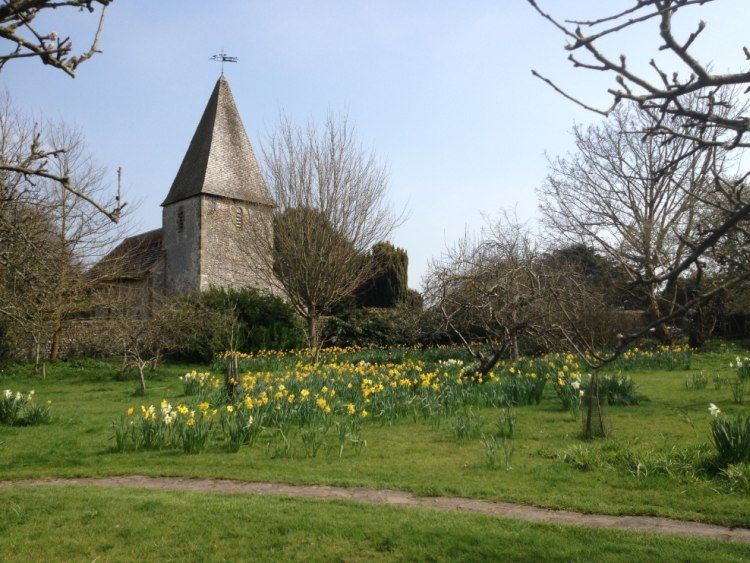
... and while in the neighborhood, why not stop in Berwick to check out again the beautiful murals in Berwick Church, painted in, IIRC, 1943 by the artist pair Vanessa Bell and Duncan Grant, prominent members of the Bloomsbury Group. This pic from outside the church was taken on a spectacular early Spring morning; you may recall the same view from one year ago when we visited the place in the early evening.


 photo darwin_study_zpsmxbumufm.jpg

Then it was off to Downe and Down House, the home of Charles Darwin, just SE of London. He wrote On the Origin of Species in this very study!


 photo down_house_zpspkewoyeb.jpg

View on Down House from the garden. Behind my back is a path that leads to Darwin's greenhouses, where he also conducted experiments. Both the house and garden are kept in immaculate condition.


 photo backtobelgium_zpsqvrz14zz.jpg

After this thoroughly satisfying visit - including a simple but decent lunch in the house's cafeteria - it was time to go back. In the evening we boarded Le Shuttle again at the Coquelles terminal, near Folkestone. A smooth 25-minute ride brought us back in Calais. Yet another great holiday in the UK!


MFBB.

Sunday, October 04, 2015

DAKUWAQA'S GARDEN: AMAZING UNDERWATER FOOTAGE FROM THE FIJI ISLANDS AND TONGA.

Watch this amazing underwater footage shot by Nick Hope around the Fiji Islands and Tonga. I know all those banners on my site can be a pain in the *ss, but there's no way I'm gonna dispense with my fancy Vlaams Belang logo or the sympathetic Dr. Kermit Gosnell. Click in the upper left corner so that you can see it directly under YouTube.

The title of the video, Dakuwaqa's Garden, refers to a god from Fijian mythology, more precisely the Shark-God. Fishermen worshipped him because he protected them at sea. Normally, you should see, in the lower right corner, fourth from the right, the CC button. If you press it you can find where the footage was shot and/or what species were being filmed at the time.


Fiji is an island state consisting of over 332 islands in Melanesia in the South Pacific, around 2,000 kilometers northeast of New Zealand. To the west is Vanuatu to the west, New Caledonia is to the southwest, Tonga is to the east, the Samoas and France's Wallis and Futuna to the northeast, and Tuvalu is to the north.

Of those 332 islands islands, only 110 are permanently inhabited, and 87 per cent of Fiji's population of around 860,000 love on the two main islands, Viti Levu and Vanua Levu. Suva, the capital and largest city, is on Viti Levu. Smaller urban centres are Nadi (tourism) or Lautoka (sugar cane industry).

Fiji boasts one of the most developed economies in the Pacific due to prodigious natural resources (forests, minerals, fish). Currently its main sources of income are tourism and sugar exports.

In case that, after having watched this video, you'd like to go there as well, here's a handy map with dive sites:


 photo fiji_dive_sites_zpsafcvqhz5.jpg


Marine ecologist and dive instructor Helen Sykes has some info on what to look for where:

a.) North & West of Viti Levu

The Coral Coast, Mamanuca & Yasawa Islands

The best for casual and relatively new divers: easy diving, very few currents, schools of small colourful fish, most sites are relatively shallow (best diving generally in less than 50 feet/ 15 metres of water).


b.) The Bigger Small Islands

Recommended for the more experienced divers who can handle currents and deeper diving at least some of the time: spectacular soft corals, pristine reef systems, and larger fish life.

Taveuni for soft corals, swarming fish, rare critters, and intact ecosystems.
Beqa for soft corals, rare critters, wrecks and shark feeding.
Kadavu for walls and passages, healthy hard corals, manta rays and sharks.
Coral & crinoids by Cat Halloway


c.) Central Waters

Some of the best and most varied diving in Fiji – most of these sites are quite far off shore. Mostly easy diving but many sites require careful planning due to tide dependent currents and depth.

Vatu-i-Ra Passage for spectacular walls, soft corals, schooling fish. Lomaiviti islands for passages with sharks, manta rays, and rare critters.

Southern Vanua Levu for walls and soft corals. Namena for absolutely everything concentrated into one package.


d.) Northern Vanua Levu

Cakaulevu (The Great Sea Reef –the third longest barrier reef in the world!)

Dramatic outer walls and passages.

Limited fish life in some areas, and outer waters can be rough. Inner reef mangrove islands have poor visibility but extensive fish life of interest to specialists and ecologists. Kia Island provides a good and sheltered bay to base while exploring.


e.) The Eastern Archipelago

Lau Islands: scattered islands with varied diving. Relatively easy conditions, but there are fewer well-known dive sites, so most is exploratory diving with some areas better than others.


Hat tip my oldest sister H.


MFBB.

Thursday, August 27, 2015

ANTARCTICA, THE FALKLAND ISLANDS, SVALBARD, LITTLE BEASTIES AND MUCH MORE.

Magnificent photography by Richard Sidey:


Hat tip my uncle R.


MFBB.

Sunday, April 12, 2015

EASTER HOLIDAY IN SOUTH ENGLAND PIC DUMP.

I suppose the following photos will make up for the less than prosaic title of this post. My wife and I being anglophiles, and her mom now having found the love of her life in Lodz, which is too far for a short spring break, it was quickly decided where to spend a meagre 4 days in the week following Easter. Especially since the Eurotunnel shuttles zip you under the Channel between Calais and Folkestone in a mere 35 minutes.

As per usual, not much time to flesh out this post, so the skimpiest text to accompany the pics will have to do.


History nut that I am, we paid a visit to Battle Abbey north of Hastings. It was here, in Battle, NOT in Hastings, that the famous battle between William The Conqueror from Normandy and the Anglosaxon king Harold was fought, if memory serves on October 14, 1066. Mind you, this is only the entrance gate to the Abbey, which the pope ordered William, who emerged as the victor, to build as a penance for the bloodshed.
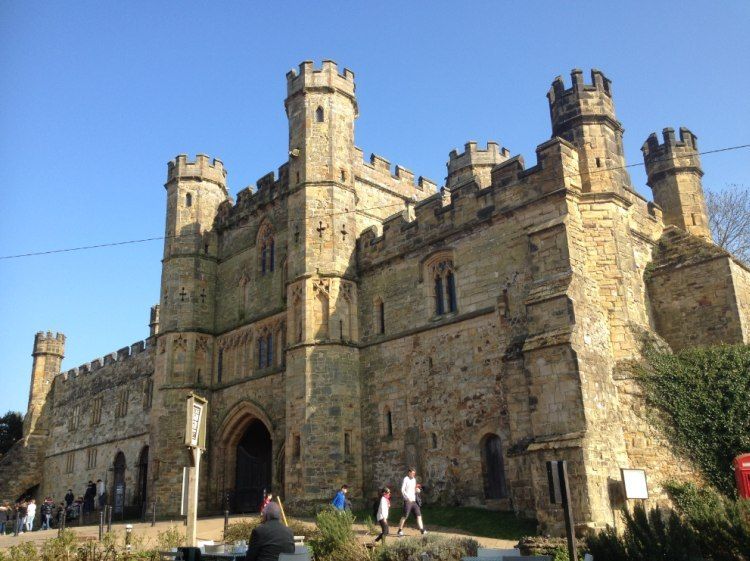
 photo ZE_Entrance_Battle_Abbey_zpsltuo6ikk.jpg


This is the battlefield, which presumably hasn't changed much since thaet fateful day. The English had the advantage of a higher up position, and at some point the Normans more than panicked. The plaque below explains how they tried to lure the English into descending the slope - with some success. But it wasn't until Harold was gravely wounded by an arrow in the eye that the English gave way. It's curious how we keep referring to the UK and the US as Anglosaxon countries, whereas it was the infusion of Norman culture and warrior ethos, itself having its roots in the Viking world, which gave birth to "the English-speaking peoples" as we know them.
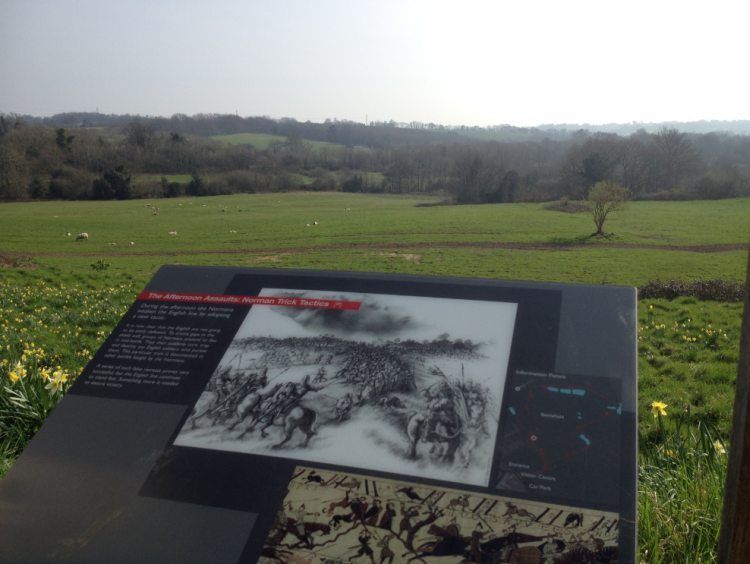
 photo ZE_Battlefield_1066_zpsgaolar95.jpg


Then it was off to Berwick Church, which we missed last year.
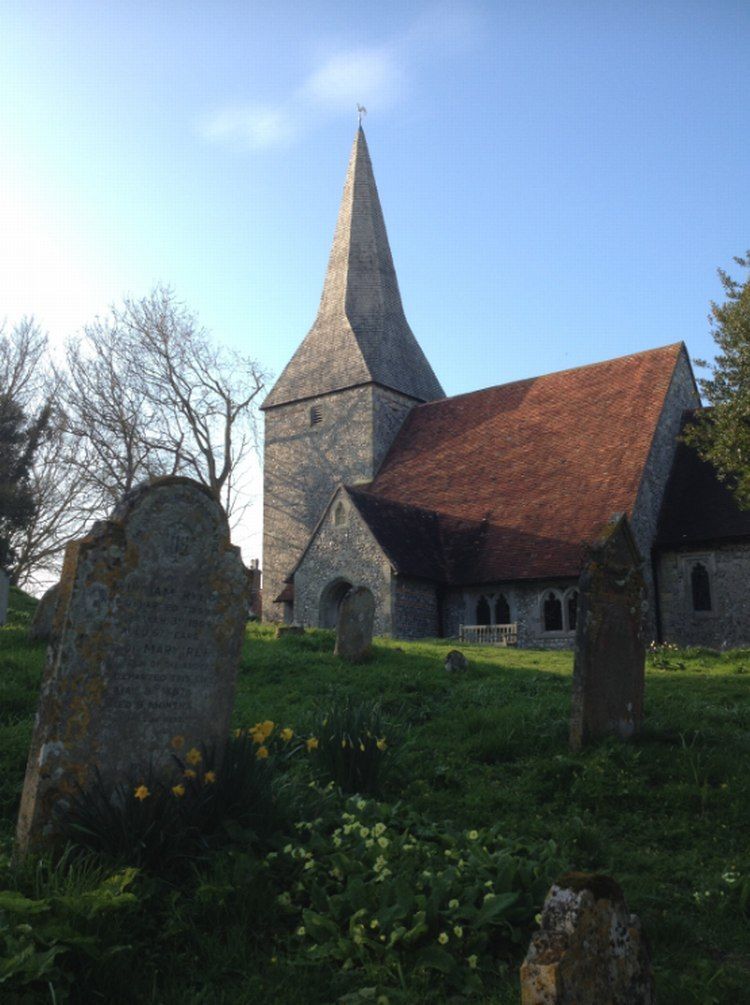
 photo ZE_Berwick_Church3_zpsk40hvngd.jpg


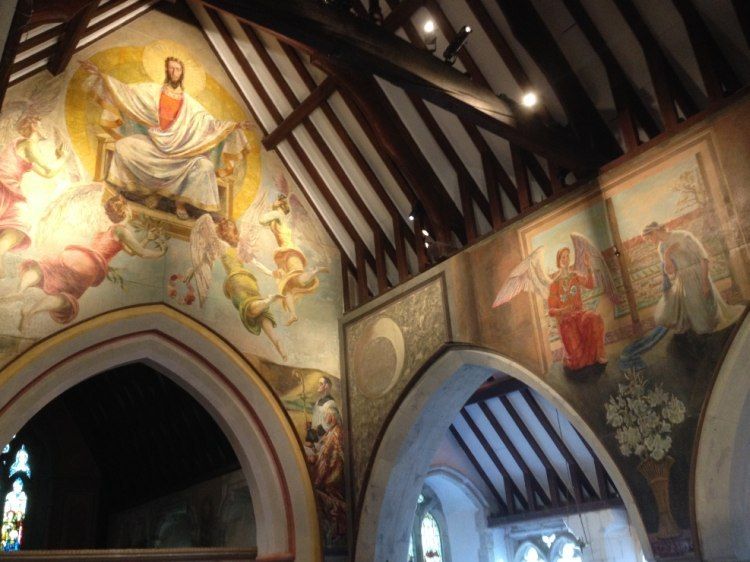
Berwick Church is special because Berwick parish asked the famous Bloomsbury artists, Vanessa Bell and Duncan Grant, to decorate its interior, this during the war years no less. World War II to be sure. Snapshot to the left...
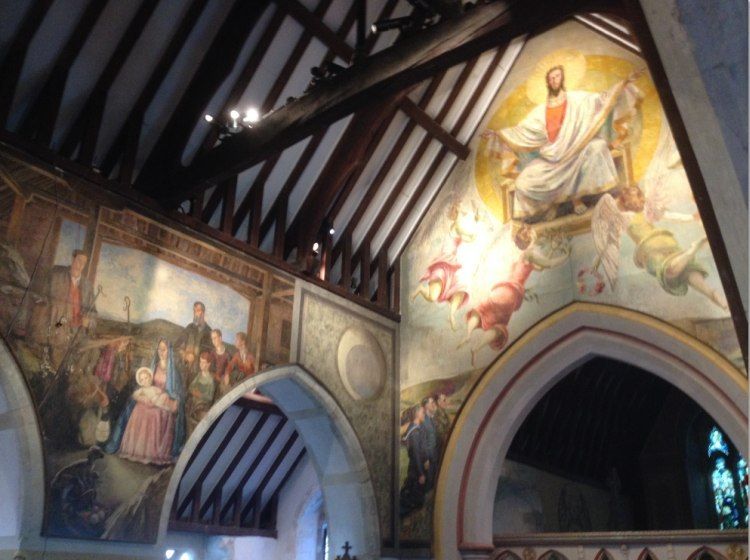
 photo ZE_Berwick_Church1_zpszuyr57kw.jpg


... and snapshot to the right...

 photo ZE_Berwick_Church2_zpslxlqqkuj.jpg


A celtic cross erected on a mound near the church commemmorates men of the parish who fell in the Great War.
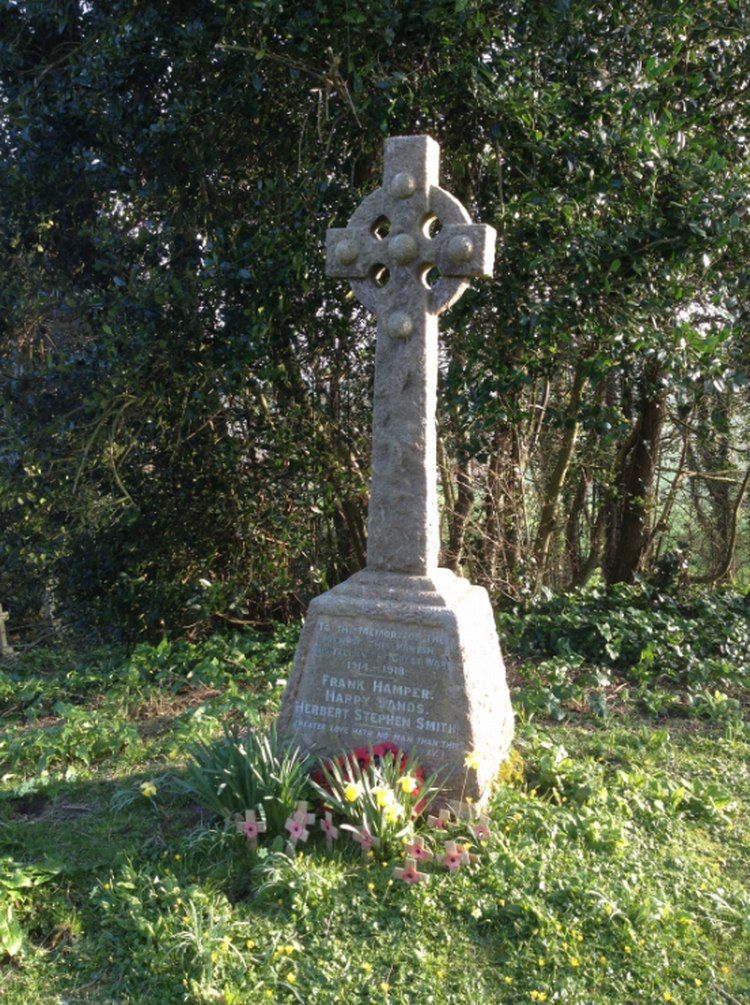
 photo ZE_Berwick_Church4_zpsoqlspbyy.jpg


Outside the Church, I took a photo of this typical South Downs landscape...
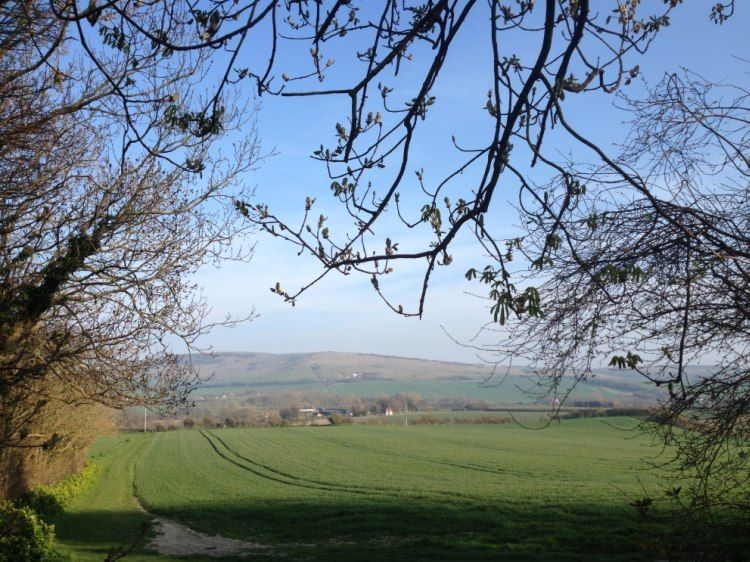
 photo ZE_South_Downs_zpst9wkmtj4.jpg


The next day, April 8, we walked on Brighton's beach, having booked a hotel in that still pleasant city. Brighton had two famous piers, but only the Palace Pier is still alive and kicking. West Pier, see pic, is nothing but a remnant of the structure anymore.
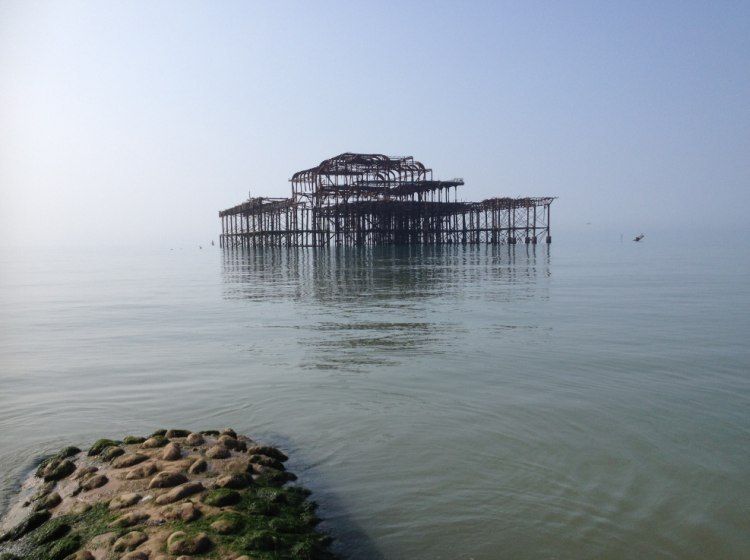
 photo ZE_Brighton_West_Pier_zpsniwqfa54.jpg


After that, it was off to Monk's House, which was the country retreat of Leonard and Virginia Woolf, writers belonging to the Bloomsbury Group. It's a very modest dwelling, and it has been turned into a small museum. Inside, basically everything is as it was when Leonard Woolf died in 1969. Virginia Woolf, who was Vanessa Bell's sister, and who suffered from mental illnesses and bouts of heavy depressions, had committed suicide by drowning herself in nearby river Ouse in 1941 already.
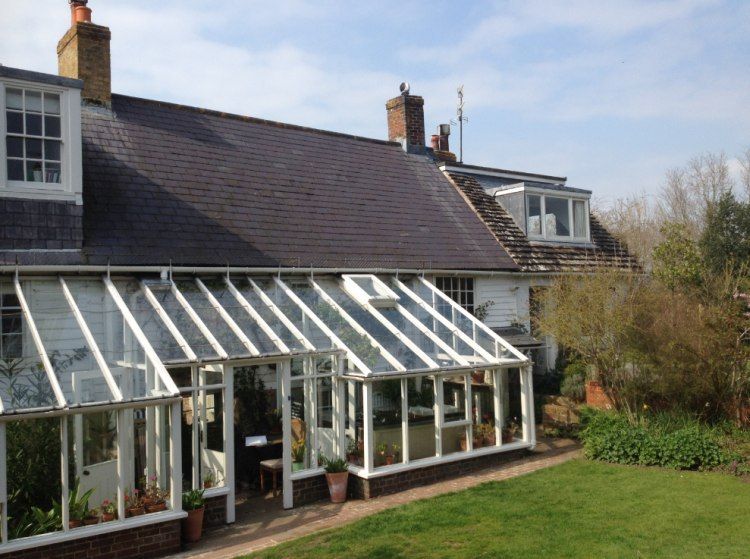
 photo ZE_MonksHouse_back_zps4zskwdlf.jpg


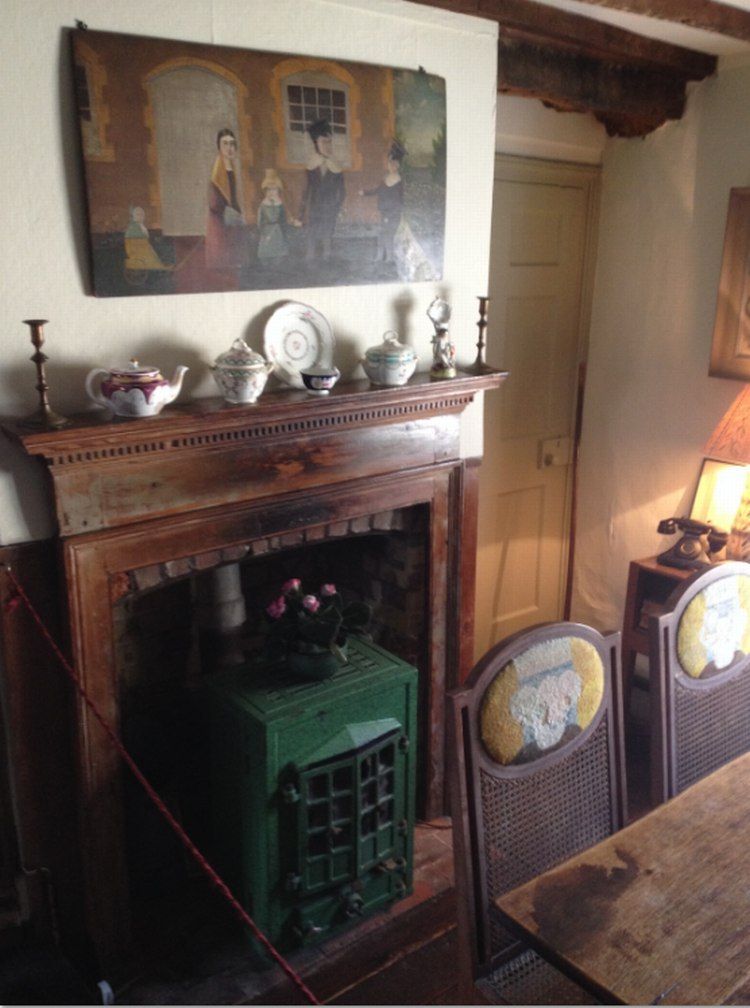
A pic of the dining room...

 photo ZE_MonksHouse_Interior_zpsll89tybj.jpg


... and of Virginia's sleeping room, which is in the extension you see to the extreme right of the house.
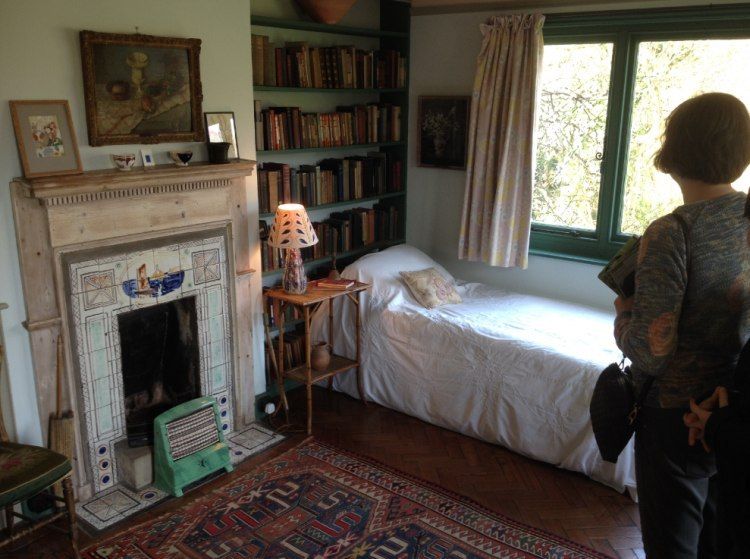
 photo ZE_MonksHouse_Virginia_sleepingroom_zpsuzcv826j.jpg


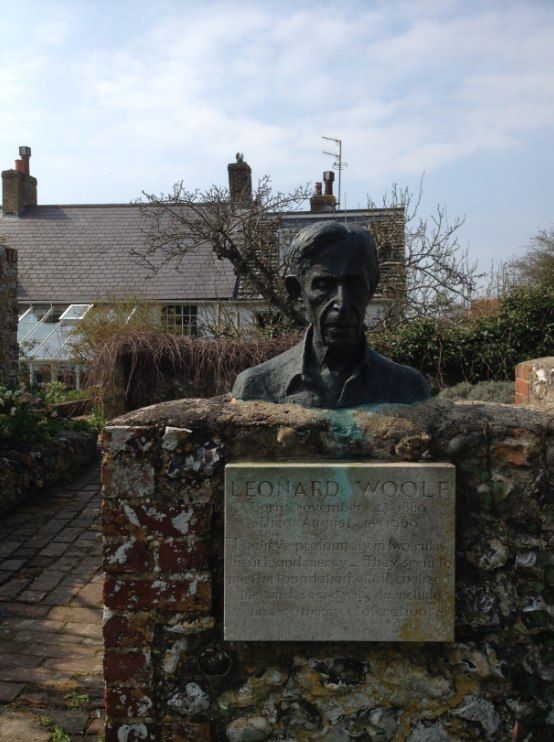
Leonard's bust in the garden...

 photo ZE_MonksHouse_Leonard_bust_zpszfqg3lve.jpg


... which was lovely...

 photo ZE_MonksHouse_garden1_zps5rjwqgip.jpg


Leaving Monk's House at about 3 pm, I figured there was more than enough time to check out Chanctonbury Ring, the remnants of an earthen ring fort, later Roman stronghold, on top of a hill 40 kloms or so distant and near the village of Washington. Legend has it that if you walk seven times counterclockwise around the Ring, you will summon the Devil, who will offer you a bowl of soup in exchange for your soul. Nope, I didn't try.
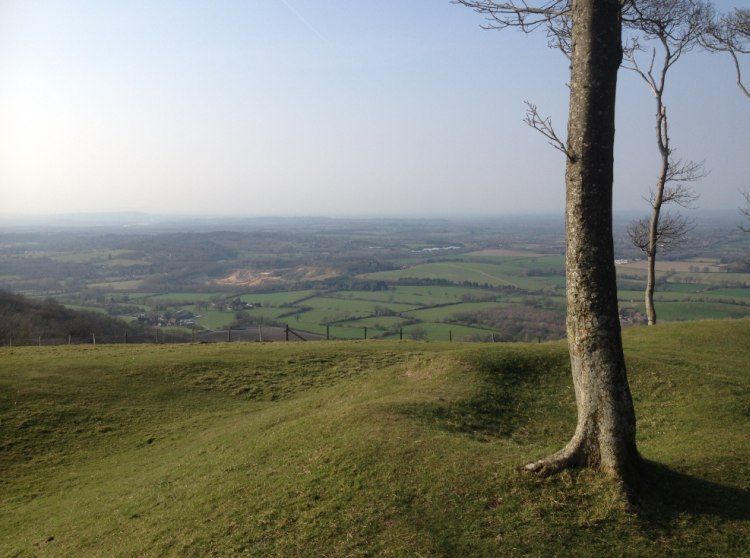
 photo ZE_Chanctonbury_Ring_zpsbj9m92ma.jpg


On Thursday, April 9, we visited Portsmouth Historic Dockyard. So much to see, so little time. Of all the things to pick from, I chose HMS Victory:
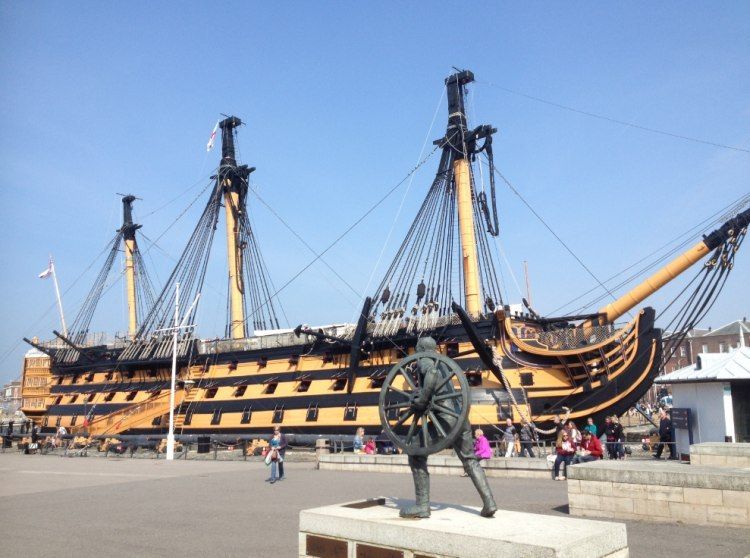
 photo ZE_HMSVictory_zpsb8kpnxhs.jpg


Victory's bow. See those anchors! Oldest commissioned warship in the world by the way!
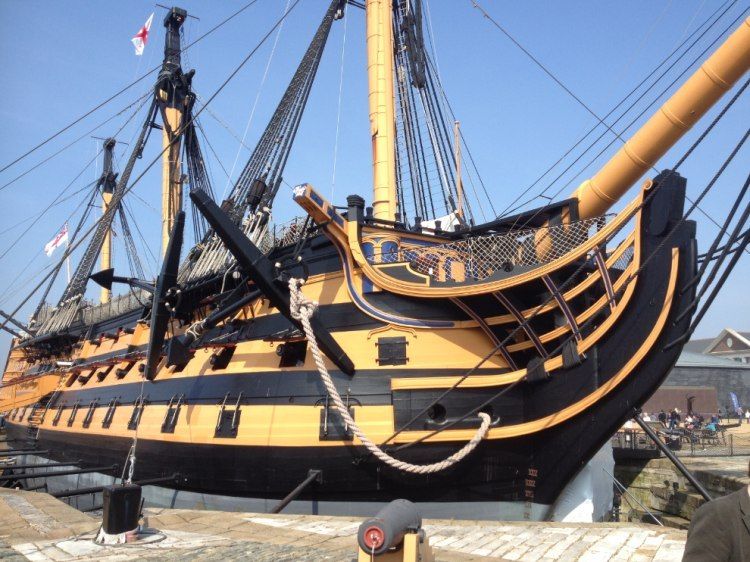
 photo ZE_Victory_bow_zpstmzduxir.jpg


HMS Victory's poo, erm, stern:

 photo ZE_HMS_Victory_poop_zpshzhn6uzz.jpg


The "sick bay". It was not exactly clear to me where those happening to be there in case a fight broke out were moved - notice the guns below the berths!
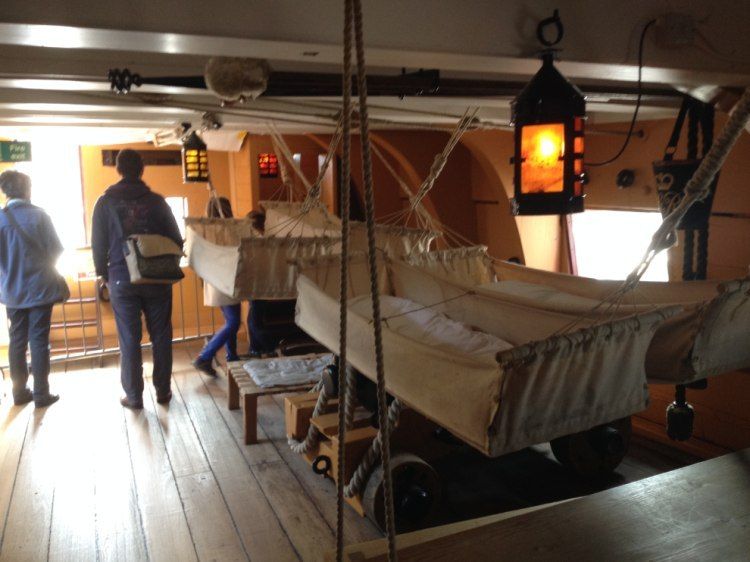
 photo ZE_Victory_sick_bay_zpspqbcx8hj.jpg


The place where Admiral Nelson was mortally hit by a sharpshooter sitting in some mast of the Redoutable (commanded by Captain Jean-Jacques Etienne Lucas).
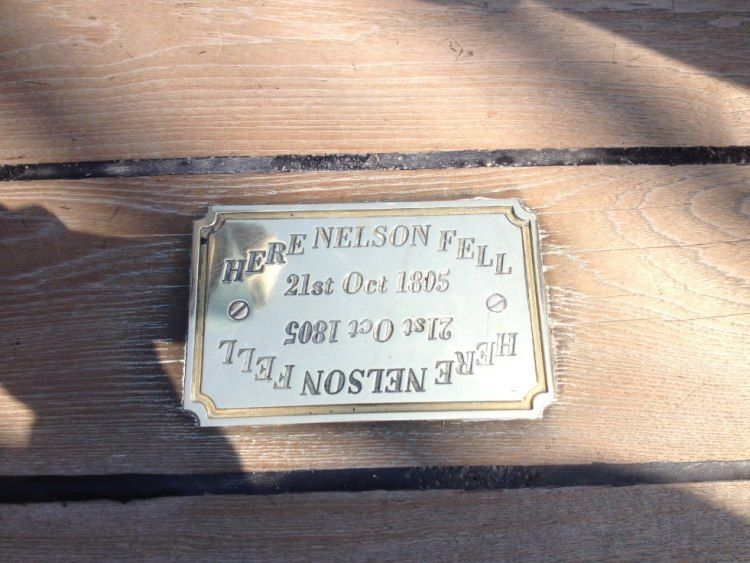
 photo ZE_Nelson_zpsos5kdydn.jpg


HMS Warrior. Together with her sister ship HMS Black Prince the Royal Navy's first armour-plated, ironclad warships. Commissioned in 1861.
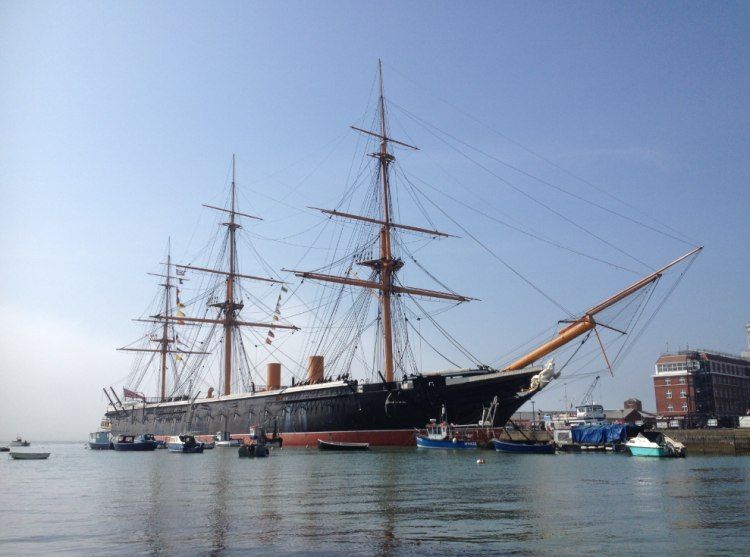
 photo ZE_HMSWarrior_zpstlgrzvbu.jpg


Spinnaker Tower, Portsmouth's 170-meter high landmark. Yup, those specks are people cleaning the thing.
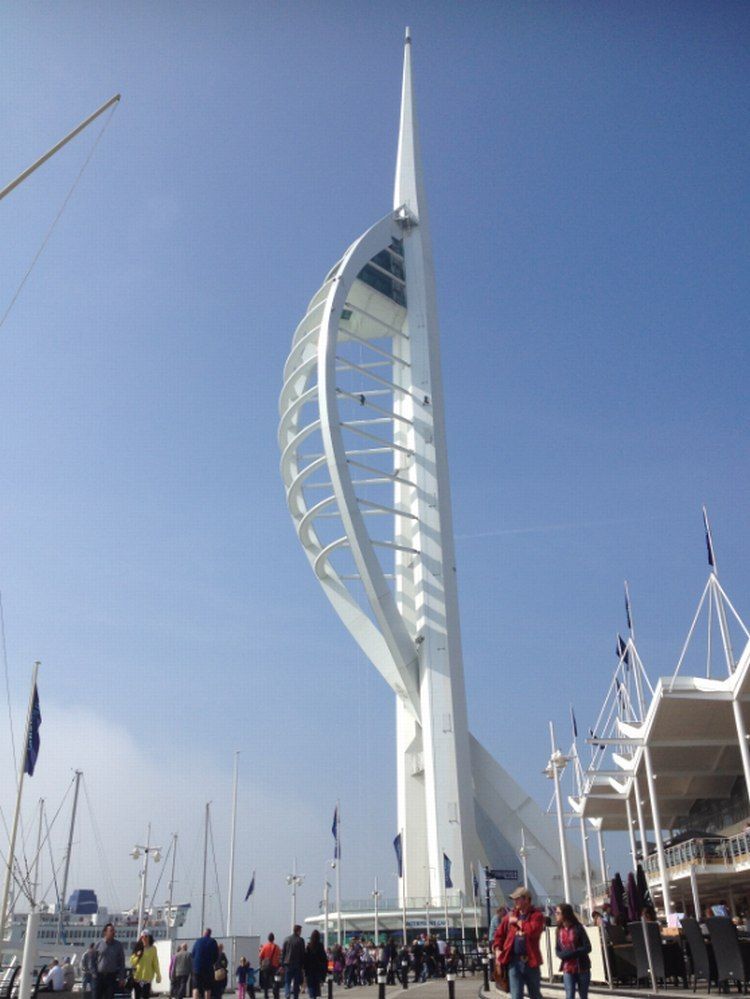
 photo ZE_Spinnaker_Tower_zpsqbdz4can.jpg


On Friday, April 10, we vistited the Royal Pavilion, George IV's outrageous but inimitable folly in Brighton.
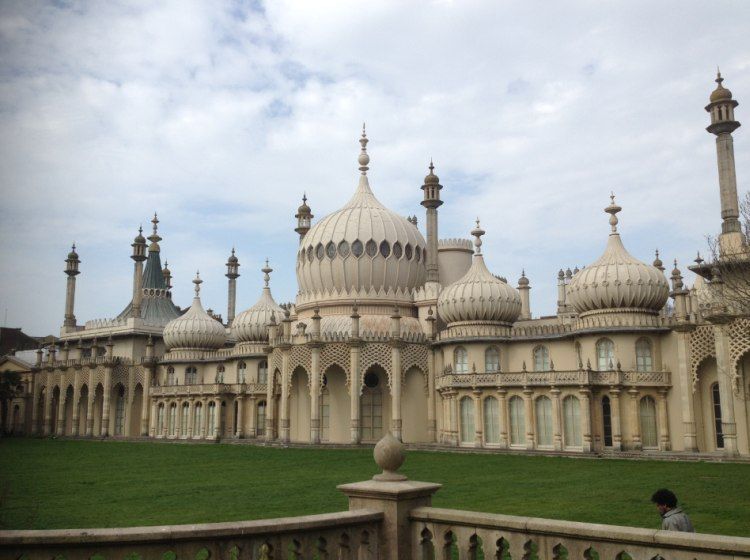
 photo ZE_Royal_Pavilion_zpsrrwemxby.jpg


When we left Brighton towards noon, I figured there was still time, before we boarded Le Shuttle in Folkestone for continental Europe, to visit Bateman's, Rudyard Kipling's house in Burwash in The Weald. It's a sturdy Jacobean mansion dating from 1634, and the National Trust keeps it in excellent condition.
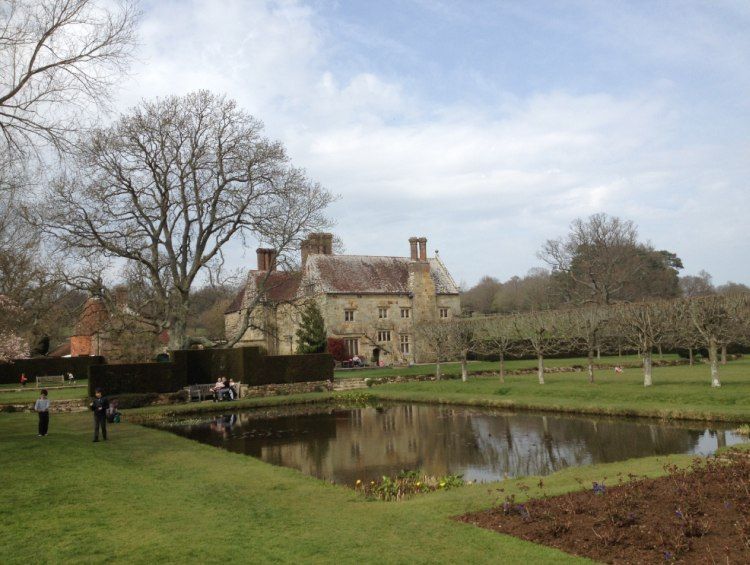
 photo ZE_Batemans_zpsebtpsrb6.jpg


And again back to Belgium, sad to say goodbye to the UK and Full British Breakfast. Unlike the Eurostar which carries passengers between Brussels/Paris and London through the same Channel Tunnel, "Le Shuttle" travels only between Cheriton near Folkestone, UK, and Coquelles, near Calais, France. This because its loading gauge, so large because of necessity, is bigger than either "ordinary" French or British railway gauges.
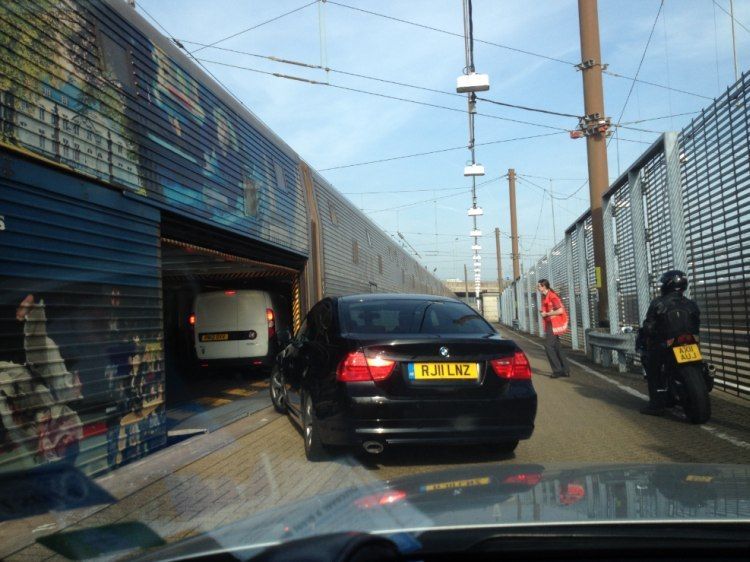

 photo ZE_backtobelgium_zps9wn1cizm.jpg


That's all for today. Nite.


MFBB.