Alfred de Breanski Sr. was a British landscape painter who made a name for himself with exquisite renderings of rural England, Scotland and Wales. Influenced by John Constable. He was born in 1852 in Greenwich, England, and went on to exhibit his works at the Royal Academy in London from 1872 until 1918.
Banks of Arrochar
The Borrowdale Pass from Derwent Water
As good as it is, imho not his best work yet, but I include it since it brings memories back from my all too short summer holiday in July in "the Heart of Borrowdale". I stayed in Scafell Hotell, whence I climbed Great Gable.
I'm very sorry for being AWOL for so long, but it's been a rather rough couple of months lately. Health is status quo though.
Copley was an Anglo-American painter, a Boston, Massachusetts native, who already had a well-established reputation in New England when he moved to England in 1774, never to return (not that he didn't want to). With the work below, "The Death of the Earl of Chatham" (1781, oil on canvas), he made his name as a history painter.
The Earl of Chatham was William Pitt The Elder, Prime Minister of Britain in the middle of the eighteenth century, and the architect of Britain's victory in the Seven Years War (1757-1763). Copley's paiting evokes the moment right after Pitt's collapse on 7 April 1778, during a debate in the House of Lords on the American War of Independence. The painting's title is a misnomer though, as Pitt died over a month later in his home in Hayes, Kent.
You can argue that these men did not fight for our freedom, that the US Army had no business in Iraq. I don't agree. For better or for worse, the US is the world's policeman. Personally, I think it's the former... I shiver at the thought that China would fulfill that role, e.g.
The US Armed Forces execute the strategy the government decides upon to 'act' as that policeman. Just like policemen sometimes die in the line of fire, it is inevitable that the chosen strategy, whether good or bad, will result in losses: KIA, WIA, MIA... The losses on that fateful day in 2006 involved a.o. Tucker, Menchaca and Babineau. Remember them and pray for them also. It's a given that their relatives and loved ones still suffer.
In the West, we have been told ad nauseam by our Moral Betters that Christianity is anti-Science.
Nothing is further from the truth, and as time goes by, more and more authors and historians discover the vast contributions made by the Christian faith to the exact sciences. A good book to start with re this topic is Freely's "Before Galileo".
The overview offered by The National Catholic Register's Angelo Stagnaro lists a number of individuals, both Men of the Cloth and catholic laymen, which may surprise you...
I have been keenly aware of the inroads leftist shenanigans have made into the US military, so the following woke nonsense should not have come as a surprise.
Except they did. "The Calling" is a series of five animations centering on the paths that led the following individuals to join the Army:
Let's check out the Emma animation. Watch and weep.
Holy shit. And I thought the 70s campaign "The Army wants to join you" was bad.
Per Senator Ted Cruz, a comparison between this woke madness and a Russian Army recruitment video:
Apart from the ludicrous, warm and fluffy non-content, there's something else that's striking in the 5 'The Calling' animations. Can you see it?
Because last time I checked, the US was still a majority White country, although granted, democrappic politicians are doing their damnedest best to end this sorry state of affairs ASAP.
Well, dunno if you noticed it or not, but the makers of 'The Calling' seem to have completely overlooked an interesting recruitment reservoir i.e. young White Caucasian males. Please out there, can someone tell 'em? BEHOLD however!!! Rumour has it that the grand majority of said males are still heterosexual, so if they belatedly realize there's still this as yet untapped manpower reservoir, they should proceed to enlist them with the utmost caution.
From the BBC documentary "When Britain ruled the skies", on the astounding performance of the British aeronautical industry in churning out breathtaking an innovative aircraft in the first decades of the Cold War:
The same theme is explored in Empire of the Clouds, an excellent book by James Hamilton-Paterson. Highly recommended!
OTD, or rather, On This Night in 1943, 19 Lancasters under the command of Wing Commander Guy Gibson took off from RAF Scampton to attack several Ruhr dams which were crucial for hydro-electric power. It was the beginning of Operation Chastise;
Check out this exerpt from the 1955 movie The Dambusters:
I am a firm believer in humanity as a multi-planet species. It is our destiny to explore new horizons. With the Red Planet being the obvious choice as the first stepping stone in that lofty endeavour, and humans setting foot on Mars now becoming increasingly likely within the next twenty years, the following video sheds some light on what the first three decades there might look like:
On Monday, May 2nd, at about 22.05, my father passed away after almost one month on Intensive Care.
He was 77. He had some little troubles typically connected with his age, but was otherwise a healthy person. Four days before he was admitted to the hospital, he participated in the annual dinner event of his 'copains' at the Institut Technique in Ath, and was by all accounts the healthiest and most able of the group. Four days later he was on Intensive Care, only to leave it when he was not among the living anymore....
"Yea, though I walk through the valley of the shadow of death, I will fear no evil: for Thou art with me; Thy rod and Thy staff they comfort me."
~ Psalm 23:4 ~
It's been ten years dad, but we think of you every single day.
Bad English with Time Stood Still. Album Backlash (1991).
Short lived glam metal band which formed in LA in 1987 around three former The Babys members, keyboardist Jonathan Cain, singer John Waite and bassist Ricky Phillips.
M83 with Midnight City. From the 2011 album Hurry Up, We're Dreaming.
French electronic band, formed in 1999 in Antibes. Currently based in LA.
"TAE Technologies, the California, USA-based fusion energy technology company, has announced that its proprietary beam-driven field-reversed configuration (FRC) plasma generator has produced stable plasma at over 50 million degrees Celsius. The milestone has helped the company raise USD280 million in additional funding.
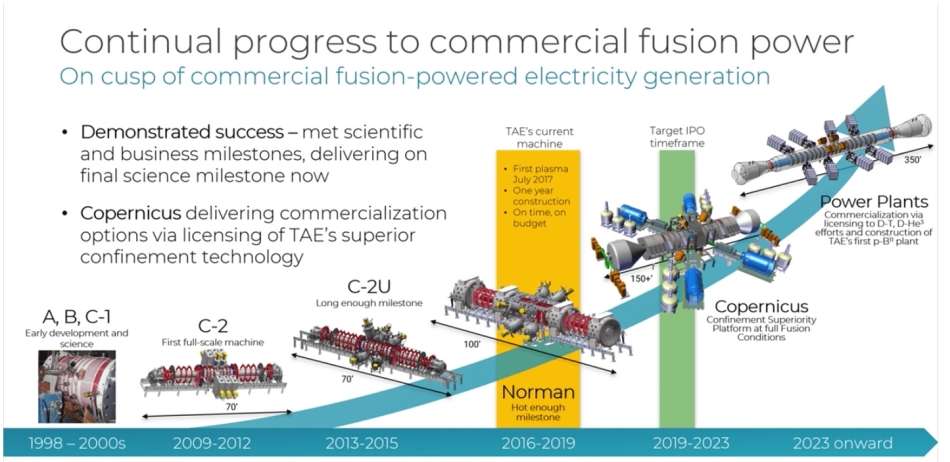
Norman - TAE's USD150 million National Laboratory-scale device named after company founder, the late Norman Rostoker - was unveiled in May 2017 and reached first plasma in June of that year. The device achieved the latest milestone as part of a "well-choreographed sequence of campaigns" consisting of over 25,000 fully-integrated fusion reactor core experiments. These experiments were optimised with the most advanced computing processes available, including machine learning from an ongoing collaboration with Google (which produced the Optometrist Algorithm) and processing power from the US Department of Energy's INCITE programme that leverages exascale-level computing.
Plasma must be hot enough to enable sufficiently forceful collisions to cause fusion and sustain itself long enough to harness the power at will. These are known as the 'hot enough' and 'long enough' milestone. TAE said it had proved the 'long enough' component in 2015, after more than 100,000 experiments. A year later, the company began building Norman, its fifth-generation device, to further test plasma temperature increases in pursuit of 'hot enough'.
TAE said Norman nearly doubled its intended goals over an 18-month testing regime and has now demonstrated consistent performance of reaching 50+ million degrees Celsius, replicated over many hundreds of testing cycles - all in a compact machine that has very attractive economics when scaled up to a full power plant. With this most recent milestone, TAE has now unlocked the 'hot enough' conditions needed to scale to a reactor level performance.
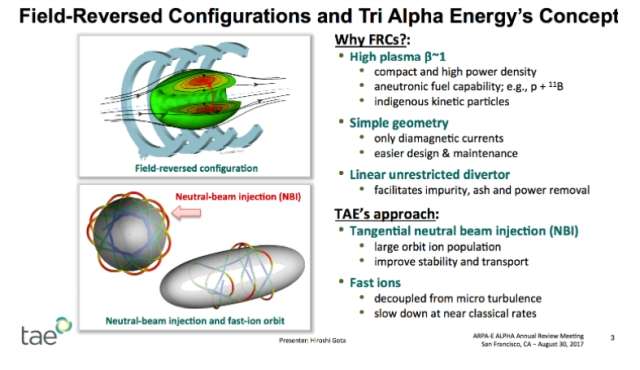
TAE's approach to fusion combines advanced accelerator and plasma physics, and uses abundant, non-radioactive hydrogenboron (p-B11) as a fuel source. The proprietary magnetic beam-driven FRC technology injects high-energy hydrogen atoms into the plasma to make the system more stable and better confined. This solution is compact and energy efficient, TAE says.
The company said the latest milestone "confirms a key differentiator of TAE's patented technology: a positive relationship between plasma confinement and reactor temperature, meaning that the company's compact linear configuration improves plasma confinement as temperatures rise. By generating such stable high-temperature plasmas, TAE has now validated that the company's unique approach can scale to the conditions necessary for an economically viable commercial fusion power plant by the end of the decade..."
A fusion reactor based on field-reversed configuration (FRC) confines the plasma within closed magnetic field lines, thus dispensing with a tokamak's central penetration. In an FRC fusion reactor, the plasma has the form of a self-stable torus, not unlike a smoke ring:
One thing is for certain, TAE Technologies is not lacking in ambition, nor confidence:
Do check out this short TAE video, featuring CEO Michl Binderbauer:
America with Sister Golden Hair. Album Hearts (1975).
America has the distinction of being a genuinely American band formed in the UK, in London to be precise (in 1970), since its founding members, Dewey Bunnell, Dan Peek and Gerry Beckley, were all sons of US Air Force personnel stationed at nearby RAF South Ruislip.
T. Rex with Hot Love. Released as a standalone single in 1971.
English glam rock band T-Rex, originally Tyrannosaurus Rex, was formed in 1967 by singer/songwriter and guitarist Marc Bolan and had its heyday between 1970 and 1973. Bolan died in a car crash in 1977, and because he was also T. Rex's sole composer and writer, it meant the end of the band.
Since the BLM virus has crossed the Atlantic, big (Western) European cities have had their share of mayhem caused by this scum. Yesterday, Saturday 13 March, it was Lièges turn:
Tame Impala with Borderline. From the album The Slow Rush (2020), although it had been released as a single in 2019.
Actually a one-man psycedelic music project around multi-instrumentalist Kevin Parker, although for live performances he's accompanied by for musicians, a.o. Jay Watson (synthesiser, vocals, guitar) and Cam Avery (bass guitar, vocals).
Hans Zimmer's Don't let me leave, Murph. From the soundtrack of the movie Interstellar (2014).
Seems to me, Zimmer only came to prominence after repeated collaboration with Christopher Nolan, but actually he has already composed music for about 150 movies!
Sorry for the light blogging. 2021 has been tough as nails so far. Still on chemo, every four weeks and no end in sight - the Doctor told me it's gonna be until the next outbreak, after which another therapy yet will be tried. Biz has also been very, very rough. But quitting ain't no option.
Good night. Tim, Jan, Koen, if you're reading this, my best to you!
As we speak, the fertility of autochton women in Belgium is hitting rock bottom. A couple of times in the past, I have published here scans of my old high school's quarterly bulletin, which invariably lists, on its last pages, the deceased and the newborns among alumni. For years the ratio was about 12/13/14 departed vs 2, 3 or 4 births.
In the latest bulletin, NO mention was made of births. Flemings, autochton Flemings at least, are a dying species.
The state broadcaster VRT, and extreme leftist bastion, is actually gloating over this prospect:
'More than a fifth of people in Flanders is now of foreign origin'.
Of course, immigration can be a good thing. But regardless of whether one does or does not like the changing appearance of our streets, the question must be asked as to what changes took place in the 'original' Fleming's psyche, changes of which the psychological ramifications apparently deter him from performing the quintessential, 'sustainable', 'to be or not to be' act: procreation.
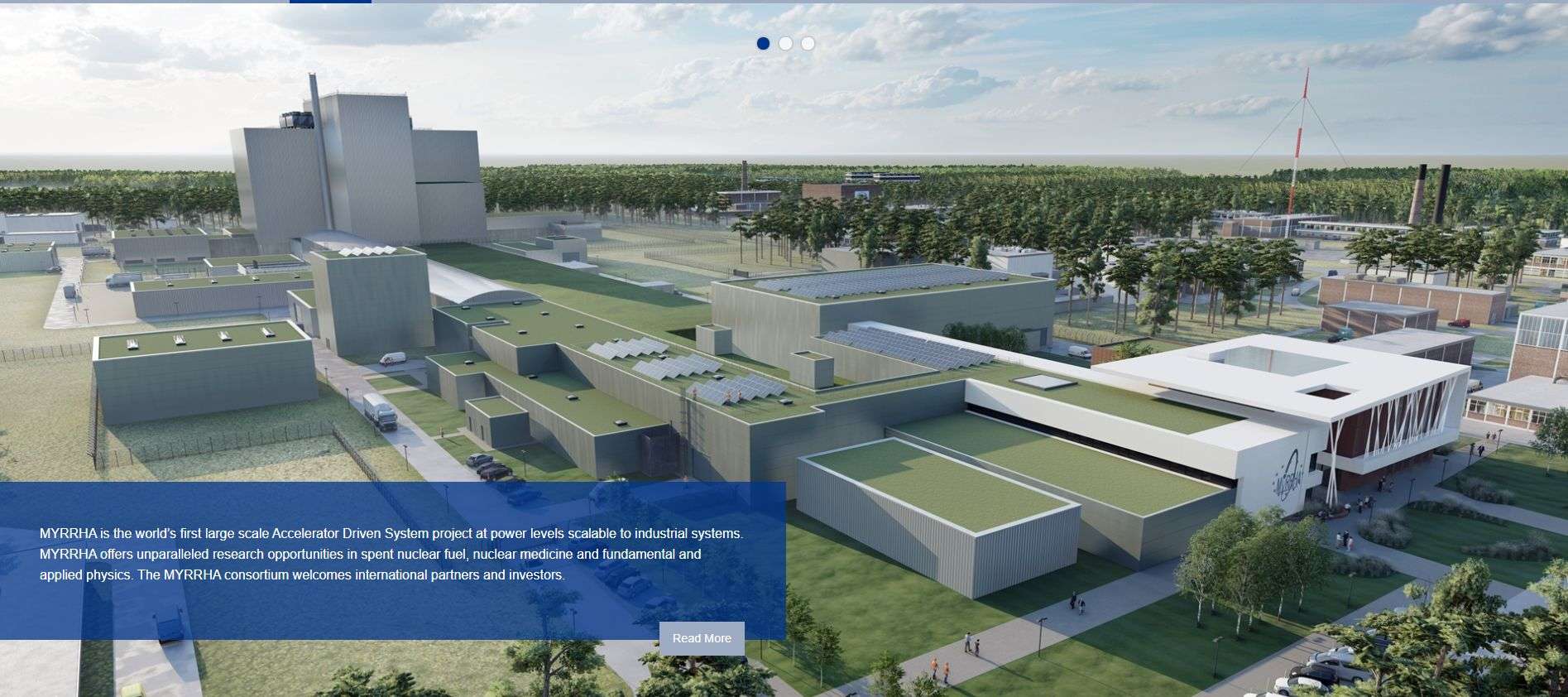
SCK•CEN (for Studiecentrum voor Kernenergie/Centre d'Étude de l'énergie Nucléaire) is Belgium's nuclear research centre, located in a wooded area near Mol in the province of Antwerp. SCK•CEN offers worldwide scientific and strategic support in the energy sector, space and medical fields. With regards to the latter, even though you have in all likelihood never heard of SCK/CEN, you have probably come into contact with it because it is among the top five players in the production of medical radio-isotopes (more than 25 per cent), which are used for medical imaging and cancer diagnosis/treatment.
SCK/CEN dates from 1952, and in the course of its history fielded four nuclear research reactors, of which three remain operational.
Soon, a new one will be added, but a completely different one: MYRRHA.
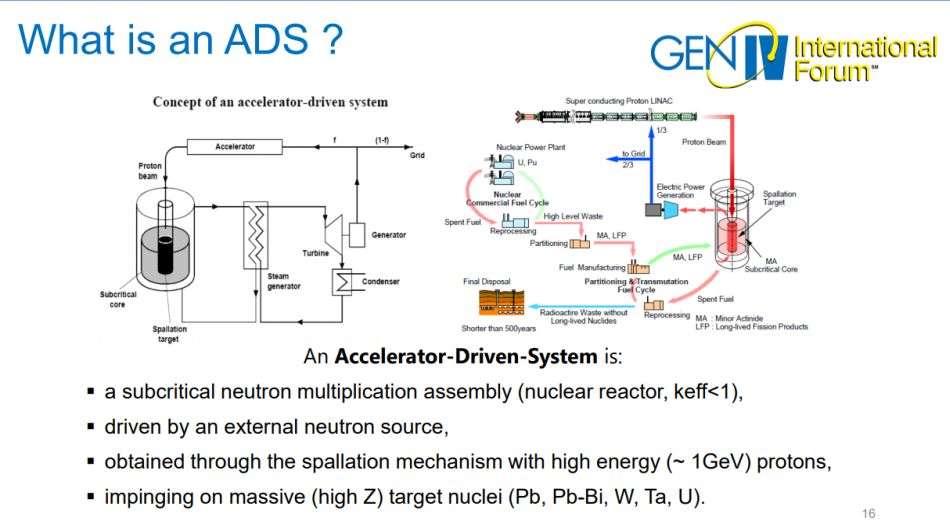
MYRRHA, which got the green light from the Belgian government on SEP 7, 2018 with a budget of € 1.6 bn, stands for Multi-purpose hYbrid Research Reactor for High-tech Applications. It will be the world’s first large scale Accelerator Driven System (ADS), consisting of a subcritical nuclear reactor driven by a high power linear accelerator (linac). Because of the subcritical concentration of fission material, the nuclear reaction is sustained by the particle accelerator only (this means that turning off the proton beam results in an immediate and safe halt of the nuclear reactions).
Before going into details re the MYRRHA reactor, first some quick recap on the kind of nuclear fission in thermal neutron reactors, which constitute the bulk of our nuclear powerplants. Namely fission of supercritical mass, i.e. fission material in which a nuclear reaction, once started, is self-sustaining. As the pic shows, a neutron penetrates a Uranium U-235 isotope, which absorbs it, thus leading to an isotope with a larger 'mass', U-236 (I assume you know that we are still talking about a uranium atom, as the number of protons remains the same):
U-236 is unstable and quickly falls apart in two lighter cores (often Krypton and Barium, but other combinations happen as well) PLUS two or three neutrons, which go on to bump into other U-235 atoms, thereby also causing them to split. The multiplication factor k, is defined as the number of neutrons in one generation divided by the number of neutrons in the preceding generation, and it is clear that if k is greater than 1, the chain reaction is indeed self-sustaining (supercritical): the neutron population will grow exponentially.
If k is less than 1, the chain reaction is subcritical, and the neutron population will exponentially decay - the nuclear chain reaction will stop in an of itself.
Every time a heavy uranium atom falls apart, an energy amount of roughly 200MeV is released. In practice this boils down to a kilogram of uranium-235 (U-235) yielding approximately three million times more energy than a kilogram of coal burned conventionally (7.2 × 10¹³ joules per kilogram of uranium-235 versus 2.4 × 10⁷ joules per kilogram of coal).
Now, to initiate nuclear fission in thermal neutron reactors, it usually suffices to place a so-called startup neutron source, e.g. Californium-252, in the reactor core loaded with fresh nuclear fuel, e.g. UO2 or MOX (for Mixed Oxides, meaning a mixture of UO2 and PuO2). The neutron flux in UO2 or MOX is in and of itself insufficient to trigger a nuclear reaction, but adding certain quantities of this startup neutron source will do the trick, and a smooth and reliable initiation of fission will take place.
It is completely different in the type of reactor that MYRRHA is about. First of all, in such a reactor, an "Accelerator Driven System', the nuclear fuel is subcritical, meaning that it cannot sustain a chain reaction itself. But secondly, the 'bombarding' neutrons do not generate from a 'startup neutron source' but originate instead through a mechanism called 'spallation'. The diagram below shows how a powerful proton beam is 'shot' in a 'spallation target' encapsulated by subcritical fuel:
The following pic offers some more specifics for SCK's ADS:
Now, Before we go any further with this, it's useful to illustrate the spallation phenomenon using an appropriate analogy, and what better analogy than spall in AFV's?
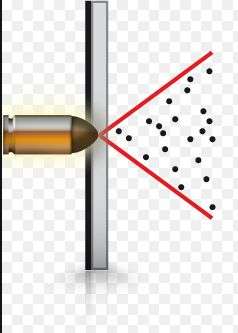
Even if a round does not penetrate an AFV's armour, it may cause tiny pieces, flakes etc to break free from the armour plate's other side - i.e., the AFV's interior - to break off the main body and go flying through the inside of the vehicle, thereby causing potentially serious injury to the crew. Particulary in WW1, with the techniques of producing decent armour plates still in their infancy, and no one yet thinking of installing spall liners, this was a serious problem, leading to the adoption of so-called splatter masks:
Now, imagine that instead of a shell striking an armour plate, a proton at nearly the speed of light slams into an atom:
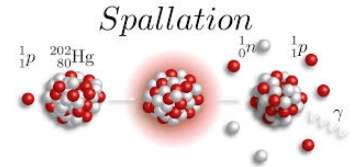
A particle beam consisting of protons at around 1 GeV is shot into a so-callad 'spallation target' consisting of mercury, tantalum, lead or another heavy metal. A 'cloud' of subatomic particles scatters, much like metal flakes and fragments are ejected upon impact of the shell in the example above. As protons too are dispersed, the element effectively becomes another one of lower atom number.
Although it's actually a bit more complicated than that, because...
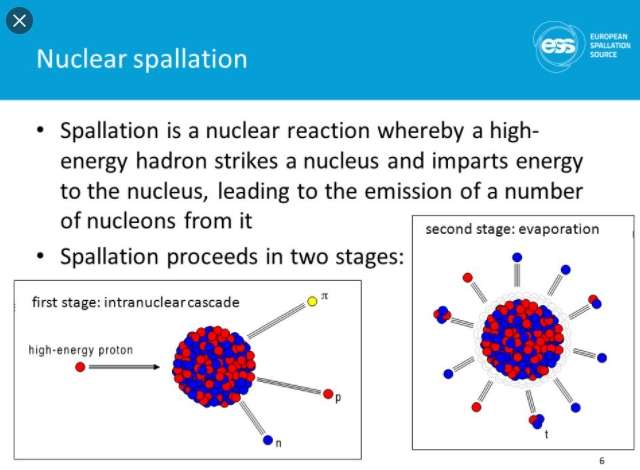
... spallation can best be imagined as a two-stage process. In the first stage, the high-enery proton reacts with nucleons-neutrons and protons-inside the nucleus. The reactions that follow cause an 'intranuclear cascade' of high-energy (greater than 20 MeV) protons, neutrons, and pions within the nucleus. During this intranuclear cascade, some of these energetic hadrons escape as secondary particles.
Others transfer their kinetic energy in the nucleus leaving it in an excited state. In the second stage (nuclear de-excitation), so-called evaporation takes place when the excited nucleus relaxes by emitting low-energy (less than 20 MeV) neutrons, protons, alpha particles, etc., with most of the particles being neutrons. The low-energy neutrons produced during evaporation are important in a spallation source because they can be moderated (reduced) to even lower energies for use as research probes. After evaporation, the nucleus that remains may be radioactive and may emit gamma rays.
Secondary high-energy particles produced during the intranuclear cascade move more or less in the same direction as that of the impacting proton and can collide with other nuclei in the target. The reactions that follow are a series of secondary spallation reactions that generate more secondary particles and low-energy neutrons.
To sum it up, spallation is a nuclear reaction in which a 'spallation target' (ST) is bombarded by very high-energy (> 50MeV) particles. The incident particles, such as protons, disintegrate the nuclei through inelastic nuclear reactions. The result is the emission of protons, α-particles, and mostly neutrons.
So how do neutrons originating from fission differ from those resulting from spallation? One difference is in the nuclear debris remaining after the reactions. But the most important difference between spallation and fission neutrons is the number released. The overall number of neutrons resulting from one fission event (about 2.5) is considerably less than that resulting from a spallation event, for about 13 neutrons for each incident proton may be released.
And this is where the concept of the Accelerator Driven System, or better, Accelerator Driven Subcriticial Reactor, in a recent past referred to as 'Energy Amplifier', comes into play. The idea is the brainchild of renowned nuclear scientist Carlo Rubbia, who proposed a nuclear reactor based on a proton cyclotron accelerator with a beam energy of 800 MeV to 1 GeV, and a target with thorium as fuel and lead as a coolant. Its advantages were and are manifold:
1.) "Subcritical" means that the reaction could not run away — if anything went wrong, the reaction would stop and the reactor would cool down.
2.) Thorium is an abundant element — at least much more than uranium — reducing strategic and political supply issues and eliminating costly and energy-intensive isotope separation. There is sufficient thorium to generate energy for at least several thousand years.
3.) This kind of reactor would produce very little plutonium, thus more "proliferation-resistant" than conventional nuclear power.
4.) The reactor offers the perspective of "consuming" plutonium, reducing the world stockpile of the very-long-lived element.
5.) Less long-lived radioactive waste is produced — the waste material would decay after 500 years to the radioactive level of coal ash.
6.) Building ADS reactors requires primarily an engineering effort, since the science behind the concept is established and more (fundamental) reseach is not needed.
7.) Power generation might be economical compared to current nuclear reactor designs if the total fuel cycle and decommissioning costs are considered.
8.) The design can work on a relatively small scale, and has the potential to load-follow by modulating the proton beam, making it more suitable for countries without a well-developed power grid system.
9.) Inherent safety and safe fuel transport can make the technology more suitable for developing countries as well as in densely populated areas.
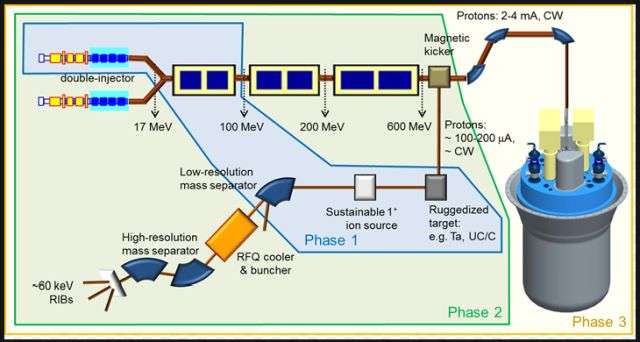
And here we come back to SCK's MYRRHA project, which will consist of four major components, to be constructed in three phases:
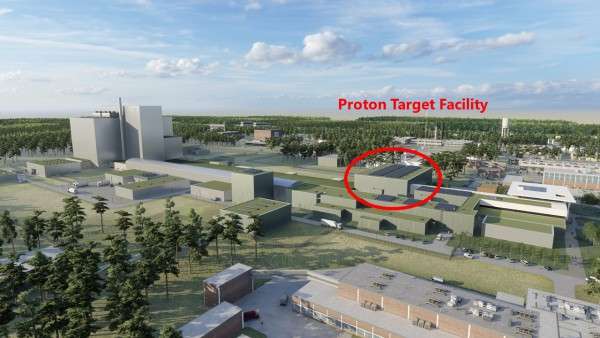
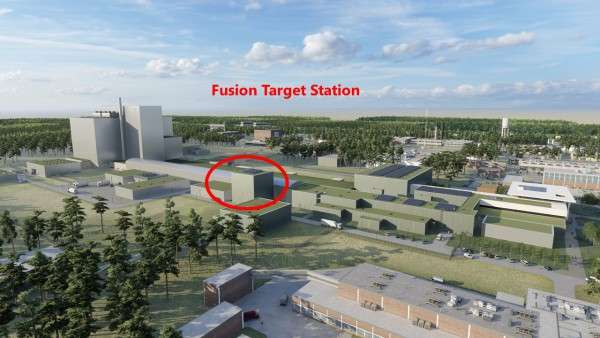
1.) Phase 1: design and construction of the first linac section (up to 100 MeV). Testing this section will show whether the linac is up to the operational reliability required to drive the reactor with a 600 MeV proton beam. Additionally, Phase 1 will also encompass the Proton Target Facility for the production of medical radioisotopes and for fundamental and applied research in physics as well as for material research. A third component is the Fusion Target Station, where materials for fusion reactors will be tested. This phase is scheduled for completion in 2026.
2.) Phase 2: extension of the 100 MeV linac to 600 MeV. This extension is required to drive the reactor. When completed, the linac will be approximately 400 m long. Phase 2 is scheduled for completion in 2033.
3.) Phase 3: construction of the reactor. The double wall, unpressurised pool-type vessel will accommodate all primary systems. The reactor is scheduled to be commissioned in 2036.
A.) THE LINEAR ACCELERATOR (LINAC).
A 400 m long linear accelerator (linac) will provide protons at an energy of 600 MeV to the reactor. In contrast to Rubbia's original proposal, a linear accelerator was selected due to its enhanced beam stability when compared with cyclotrons. Reliability as an essential performance goal for MYRRHA is reflected in the design of the linac, which boasts twin redundant 17 MeV injectors. The remaining part of the accelerator up to 600 MeV based on super-conducting radio-frequency modules is a common choice in view of optimised performance with high beam currents.
At the end of the linac, the 4 mA proton beam is injected into the reactor, generating a flux of fast neutrons through spallation. Simultaneously, protons are also fed to the multi-purpose Proton Target Facility and to the Fusion Target Station. Currently, the injector is being assembled and tested at the Cyclotron Resource Centre (CRC) at UCLouvain in Louvain-la-Neuve in Wallonia.
By and large, construction of the injectors and the first linac stage (up to 100MeV) constitues the first phase in the project, to be concluded by 2026. However, SCK being first and foremost a, nuclear research facility, Phase 1 will also incorporate building a Proton Target Facility for the production of medical radioisotopes and for fundamental and applied research in physics, as well as for material research.
B.) THE LEAD-BISMUTH EUTECTIC (LBE) COOLED REACTOR.
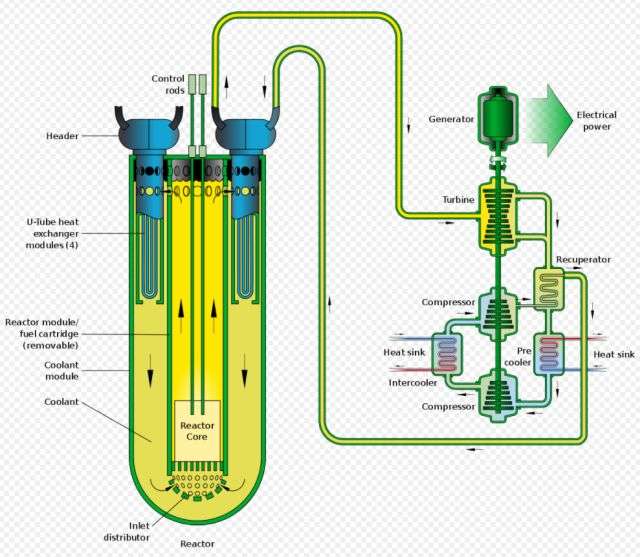
The MYRRHA reactor is so-called pool type, cooled by 7,800 tons of lead-bismuth eutectic (LBE). LBE is a eutectic alloy, meaning that it melts or solidifies at temperature lower than the melting point of any of the constituents (LBE consists of lead (44.5%) and bismuth (55.5%) and has a melting point of 123.5 °C (whereas pure lead melts at 327 °C and pure bismuth at 271 °C).
All primary systems are within the double walled 16 m high and 10 m wide reactorvessel:
It's a rather crowded pic, so to dinstinguish the LBE path as it is pumped down, picks up heat from the core, is pushed upwards again where it transfers its heat to water in the blue colored heat exchangers, this pic may help...
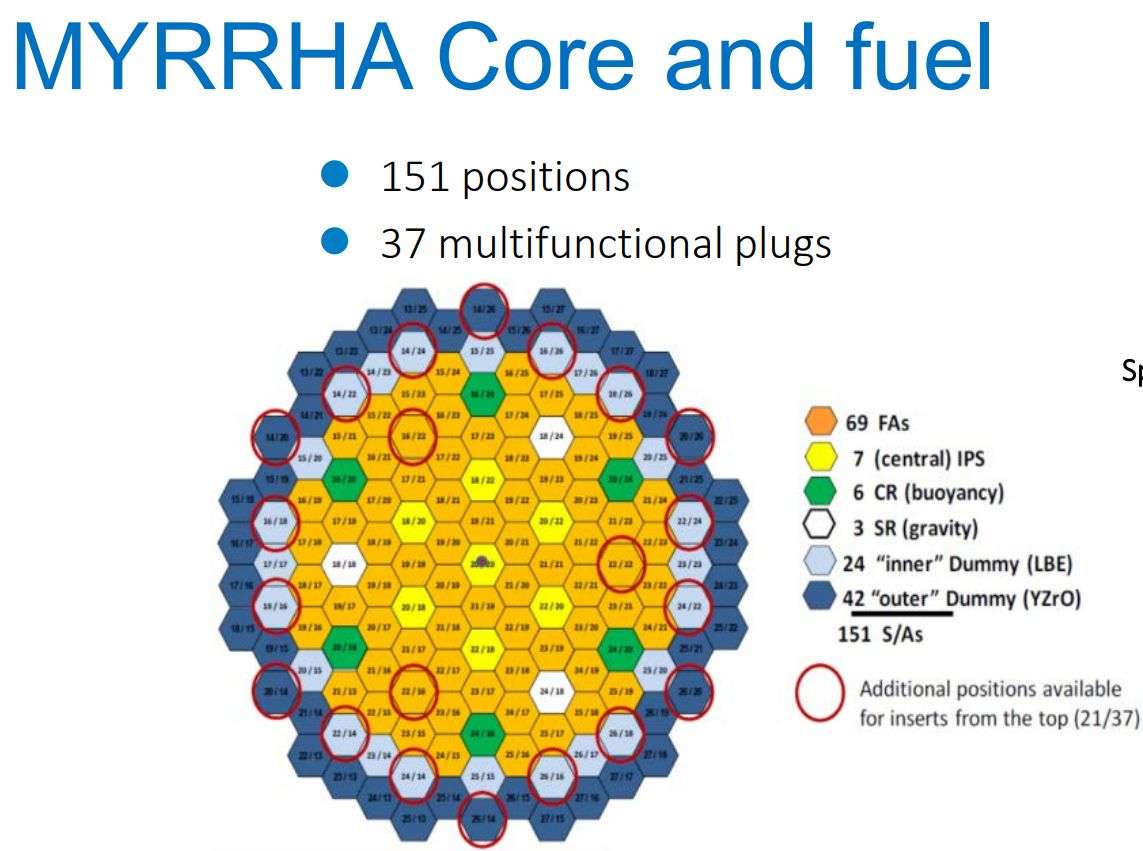
...while this schematic offers some more insight re the disposition of the actual core:
This is the proposed layout of the core (via a pdf by Prof. Dr. Hamid Aït Abderrahim, Director of MYRRHA and Deputy Director-General of SCK CEN).
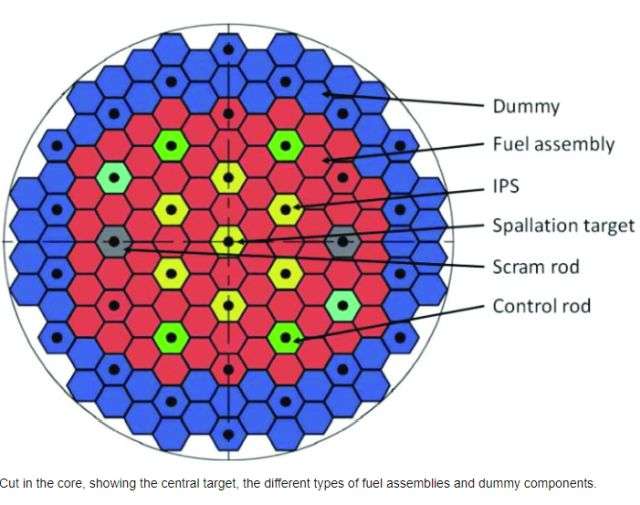
Some more detail re the layout is provided by this schematic, per Didier J. De Bruyn:
At the design's present state, the reactor core consists of mixed oxide (MOX) fuel pins, typical for fast reactors. The In-Pile test Sections (IPS), which will be located in dedicated fuel assembly (FA) positions, are larger in diameter giving more flexibility for experiments. Thirty seven positions can be occupied by IPSs or by the spallation target (the central one of the core in sub-critical configuration) or by control
and shutdown rods (in the core critical configuration). This gives a large flexibility in the choice of the more suitable position (neutron flux) for each experiment.
A final 3D-schematic of the core:
To cap it off, a list of the advantages offered by the use of LBE in the MYRRHA reactor:
* Wide operating temperature range: LBE has a relatively low melting point (125 ºC) when compared with its individual components (lead 327 ºC, bismuth 271 ºC), while it boils only above 1670 ºC.
* Excellent heat conductivity: LBE enables the reactor’s primary system to operate under normal pressure.
* Radiation shielding: LBE is an excellent radiation shield that blocks gamma radiation.
* Virtually transparent to neutrons: LBE is an ideal medium as spallation source inside the reactor where the linac’s proton beam is converted into neutrons required to
sustain the fission reaction.
* Fuel mix: LBE allows a wide variety of fuels to be used besides uranium 235 and 238, including mixed oxide (MOX) fuels. In particular, simulations indicate that linac driven, LBE cooled reactors may contain up to 30% of long-lived minor actinides, such as neptunium, americium and curium.
* LBE based reactors use far less nuclear fuel and produce far less nuclear waste.
By default, the MYRRHA reactor has a sub-critical design: it doesn’t contain enough fissile material to maintain the chain reaction (although it is capable to operate in a critical mode!). An additional safety factor is the reactor's passive cooling capacity: in case of electric failure, or when the linac is switched off and the reactor comes to an immediate stop, the cooling of the reactor is further guaranteed by the natural circulation of the LBE.
MYRRHA is projected to have a maximum output of 100 MWth (MW for thermal energy).
C.) THE PROTON TARGET FACILITY.
The Proton Target Facility (PTF) is a multi-purpose research infrastructure that will use up to 0.5 mA of the 100 MeV proton beam. It will ensure the production of radioisotopes and research into several fields. Radioisotopes, short for an element's radioactive isotopes, are essentially atoms that contain an unstable combination of neutrons and protons, or excess energy in their nucleus. They are used in the medical sector as radiopharmaceuticals for diagnostic or therapeutic ends, in industrial radiography, which uses a gamma source to conduct stress testing or check the integrity of welds (e.g. to test aeroplane jet engine turbines for structural integrity), and in scientific research, e.g. tracing the flow of contaminants in bilogical systems.
The PTF's "heart" is the Isotope Separation On-Line (ISOL) system, where a wide range of radioisotopes will be produced by nuclear reactions of the proton beam with the primary target material (a.o. ceramic materials containing uranium, thorium or tantalum). The ISOL-produced radioisotopes are extracred from the target in a delicate and technologically challenging task, involving lasers, electrostatic devices (quadrupoles and electrodes) and precisely tuned magnetic dipoles. Finally, one specific radioisotope with high purity will be transported to the laboratory for further manipulation. Radioisotope manipulation can range from a pure collection onto a foil (for medical isotope harvesting for instance) to trapping them in electromagnetic “bottles” and observing the radioactive decay in a very detailed manner.
The full PTF laboratory surrounding the primary target container will consist of:
* a facility for handling and temporary storage of the used primary targets,
* a mass separation room,
* a radiochemistry laboratory,
* a laboratory where various experimental setups for fundamental research can be installed.
The PTF will be available for national and international research groups.
D.) THE FUSION TARGET STATION.
Even though MYRRHA is a research reactor designed to test the feasibility of targeted proton beams to yield neutrons instead of relying on self-sustaining reactions, there's a part of MYRRHA dedicated to research on fusion instead of fission! The Fusion Target Station (FTS) is, indeed, a nuclear fusion oriented research infrastructure designed to handle a proton beam of 4 mA and 100 MeV to irradiate fusion materials.
According to the MYRRHA website, FTS consists of a flowing water containment separated from the vacuum by means of a thin metal window. By adjusting the position in the water tank, the proton beam energy can be fine-tuned to match irradiation conditions necessary to investigate fusion materials. The design will also enable the introduction of a water cooled spallation source that can generate a hybrid proton-neutron irradiation field. In normal people parlance: so the tiny proton beam that is tapped off the main beam will be used for proton irradiation, but a spallation source is also possible, and its resulting neutrons will provide the neutron irradiation part, hence the term 'hybrid proton-neutron irradiation field'.
MYRRHA: "Upon operational deployment, the FTS will be applied to investigate accumulated irradiation damage and/or to perform in-situ testing of materials exposed simultaneously to mechanical load and irradiation beam. Irradiated samples will be transferred to hot cell facilities at SCK CEN or elsewhere, where they can be thoroughly examined with state-of-art equipment. FTS exploitation focus will therefore be on screening perspective/innovative materials and assessment of irradiation-creep softening effects as well as diagnostic equipment validation."
For those interested, Neutron Irradiation of structural materials leads to a variety of atomic-size defects, which generally increase the strength (but can severely reduce ductility). A popular term is Defect-induced strengthening (or radiation hardening). More info here.
Simultaneously, Proton Irradiation has become a very valubale radiation damage tool. Proton Irradiation experiments can capture the effects of neutron irradiation on microstructure, microchemistry, and hardening. Further reading here.
The FTS facility will consist of the following elements:
* an irradiation module
* an instrumentation module
* a hot cell for transportation and sample reloading
* a dedicated testing laboratory in hot cells of Nuclear Material Science Institute
FTS, a research facility within a research facility so to say, will welcome research projects at both the national and international level, and will be tightly linked with European fusion research activities (EFDA/EUROfusion consortium).
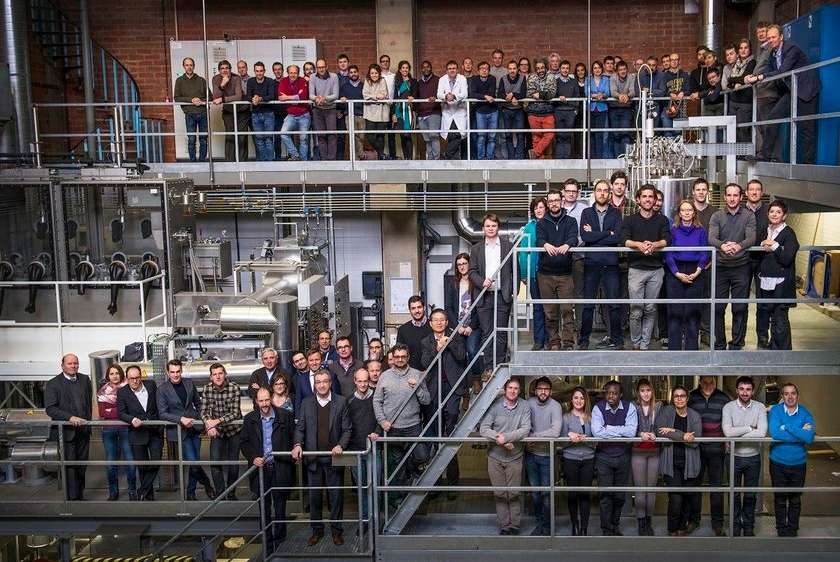
This post would not be complete without shedding some light on the crucial role of nuclear physicist Prof. Dr. Hamid Aït Abderrahim, an Algerian native nationalised Belgian, who is so to say MYRRHA's Godfather:
An immensely interesting pdf detailing a webinar by the Professor can be found here.
We wish Prof. Dr. Abderrahim and his team all the best for a successful conclusion of this groundbreaking project!
Under cover of the COVID lockdowns, President Lincoln’s statue was “hooded” and quietly removed yesterday in Boston, heralding the approaching New World Order. pic.twitter.com/HZE0iBYZaE
"Workers dismantled a statue of Abraham Lincoln in Boston Tuesday, after the city agreed with protesters who say the memorial is demeaning and lacks proper context. The statue depicts Lincoln holding his hand over a kneeling Black man — a figure modeled on Archer Alexander, the last man captured under the Fugitive Slave Act.
"We're pleased to have taken it down this morning," a spokesperson for Boston Mayor Marty Walsh said in a statement to NPR, noting that the decision followed two public hearings and a petition from artist Tory Bullock in which 12,000 people supported moving the statue."
I looked up Tory Bullock. He's an asshole. No surprise a weakling like Marty Walsh went along.
John Wilkes Booth, a firebreathing anti-abolitionist, blew President Lincoln's brains out because he couldn't bear the end of slavery. He... killed the man who unleashed a war across the continental USA to free slaves, a war which cost the lives of 600,000 Americans... more than any 'American' war before or since.
Today, the statue of Lincoln is being removed. These are insane times.
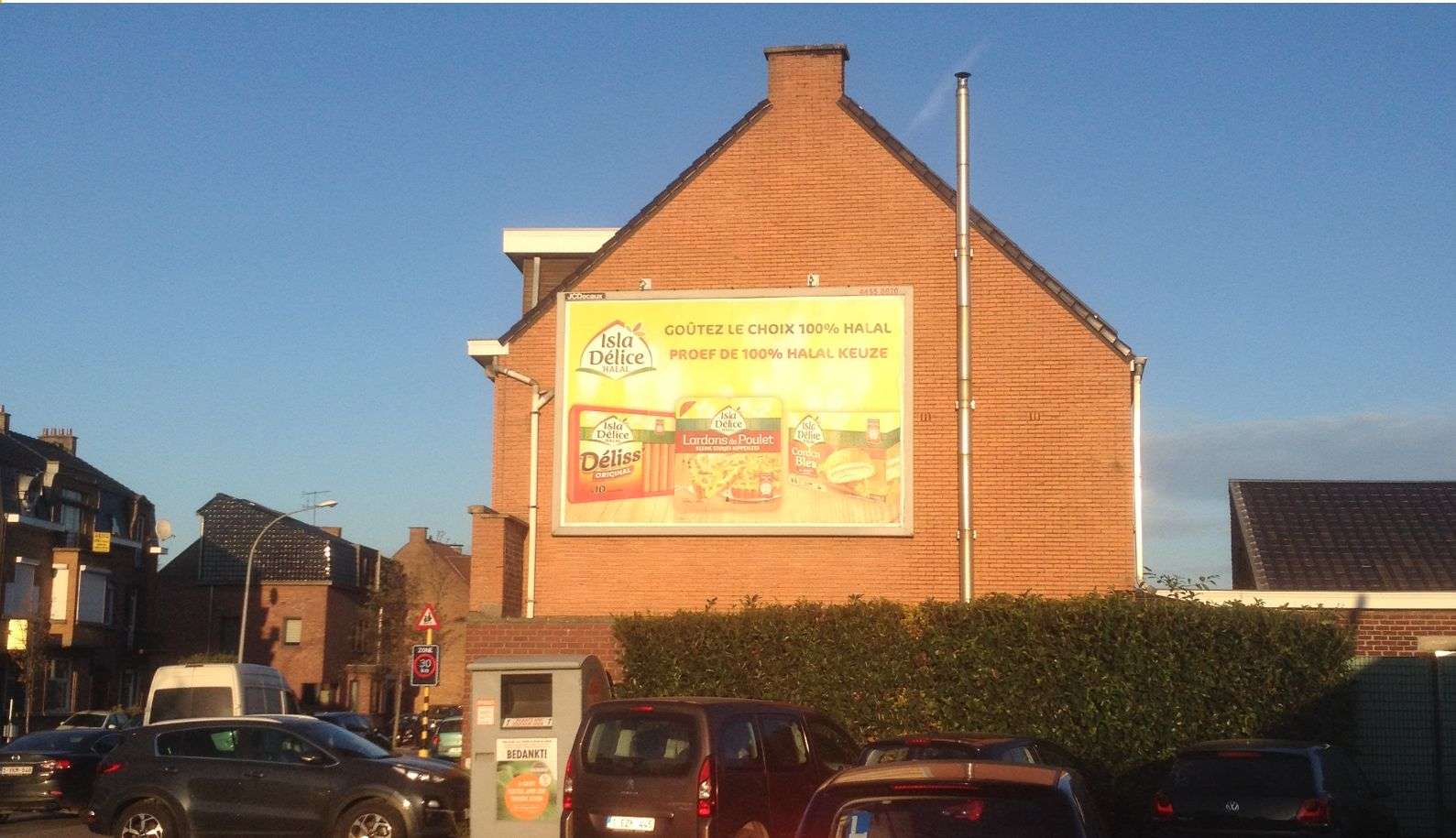
It won't end well. More than ever, autochton Belgians are in demographic free fall, while the presence of islam is making itself felt more day by day:
An ad placed by the thousands all across Flanders about one month ago, in Dutch AND French: "Goûtez le choix 100% halal - Proef de 100% halal keuze", or "Taste the 100 per cent halal choice".
Islam is cancer, and it is metastizing all across the planet. Non-muslims will pay a very high price for not stopping it when they still could.
DowneastBlog wishes all its readers of good will a Merry Christmas!!!
The Adoration of the Kings, By Gerard David (ca 1460-1523)
There is an awful lot of misery in the world, and you may want to pray for two groups in particular, namely Mozambique's Christians (of whom around 50 were beheaded by Islamic State-affliliated groups last month), and their Nigerian brethren and sisters, who suffer terribly under attacks by muslim Fulani terrorists.
And even though their plight far surpasses that of those hapless truckers stuck in the UK, you may also want to save a prayer or two for them. They have barely water, food or sanitary provisions. What a sad Xmas:
Vanavond hef ik het glas op onze helden van de weg. Door weer en wind, vaak weken weg van thuis. Door Brexit zitten er zo veel vanavond alleen in hun camion.
Alles wat je vanavond eet en drinkt, komt uit een vrachtwagen. Laten we dat maar niet vergeten.
Tame Impala with Patience. Released as a single in 2019.
Tame Impala is the Perth,Australia born project (2007) of multi-instrumentalist Kevin Parker, who writes, performs, records and produces all the "band"'s music. For tours he is accompanied by Dominic Simper (guitar, synthesiser), Cam Avery (bass guitar, vocals), Jay Watson (synthesiser, vocals, guitar) and Julien Barbagallo (drums, vocals).
Grateful Dead with Box of Rain. From the 1970 album American Beauty.
The Grateful Dead formed in 1965 in Palo Alto, California. Founding members were Jerry Garcia (lead guitar, vocals), Bob Weir (rhythm guitar, vocals), Ron "Pigpen" McKernan (keyboards, harmonica, vocals), Phil Lesh (bass, vocals), and Bill Kreutzmann (drums).
A great man has left us. Dr. Walter E. Williams, George Mason University economics professor and syndicated columnist passed away at the age of 84 on DEC 2, 2020.
"He was the author of over 150 publications which have appeared in scholarly journals such as Economic Inquiry, American Economic Review, Georgia Law Review, Journal of Labor Economics, Social Science Quarterly, and Cornell Journal of Law and Public Policy and popular publications such as Newsweek, Ideas on Liberty, National Review, Reader's Digest, Cato Journal, and Policy Review. He authored ten books: America: A Minority Viewpoint, The State Against Blacks, which was later made into the PBS documentary "Good Intentions," All It Takes Is Guts, South Africa's War Against Capitalism, which was later revised for South African publication, Do the Right Thing: The People's Economist Speaks, More Liberty Means Less Government, Liberty vs. the Tyranny of Socialism, Up From The Projects: An Autobiography, Race and Economics: How Much Can Be Blamed On Discrimination? and American Contempt for Liberty."
Rest in peace and God Blesss, Dr. Williams. You will be sorely missed.
Heinrich Vogeler (December 12, 1872 – June 14, 1942) was a German painter, designer, architect, and teacher, associated with the Düsseldorf school of painting. After WW1 he became politically involved, joining the KPD, the German Communist Party, around 1920. With his second wife he emigrated to the USSR in 1931. Upon Germany's invasion in 1941, he was, despite his communist credentials, deemed a security threat. He died in a collective farm in Kazachstan in 1942.
Last Monday, November 23, my cousin Chris died. He got to be 82. Today was his funeral.
About three weeks ago he landed in hospital after suffering a stroke, which left him paralysed to one side. Even before the stroke not in stellar condition, he contracted Covid-19 while in hospital. A swallowing problem, no doubt aggravated by loss of coordination due to the stroke, led to saliva entering his lungs, which in turn caused pneumonia. Chris did not have a chance. Less than two weeks after entering hospital, his body gave up.
Perhaps worst of all, due to stringent corona regulations, neither his wife nor close family members were allowed to see him during his time in hospital. Only in his last hours, when hospital staff sensed death was imminent, was Chris' spouse allowed at his bedside - when he was already in a coma. Chris died lonely and miserable, deprived of the consolation his partner and soulmate could have offered him in his last moments.
Other corona regulations stipulate that funeral attendance cannot exceed 15 persons, which meant that only the closest family circle of the deceased can attend. It was a decent enough Mass, and this is one of the musical works that were played, Beethovens Mondscheinsonate:
The only good thing about today was that the weather was decent, so that after Mass we were able to follow the hearse on foot to the cemetery and at least have our minds lifted somewhat by bright sun and azure sky.
I regret that I was not able to greet the body one last time - another consequence of the corona regulations. I regret that Chris' mortal remains were cremated - but if that was his wish, or his wife's, so be it.
With my cousin's passing, yet another huge character from my childhood days disappears, after my father in 2011, and my uncle, my father's brother, in 2018. Chris, thank you from the bottom of my heart for all that you have meant for me.
"Yea, though I walk through the valley of the shadow of death, I will fear no evil: for Thou art with me; Thy rod and Thy staff they comfort me."
~ Psalm 23:4 ~
God Bless. And let us also pray for his wife A., 23 year his junior. By all accounts, it was a happy marriage, and A. is heartbroken.
Thoroughly underrated British landscape artist whose works have a whiff of Edward Hopper in them. Apart from landscapes, favorite subjects were also canals, so much so that he earned himself the nickname "Canaletto of the Canals". The quasi total absence of people and the exhausted colors lend an eerie, almost post-apocalyptic quality to his paintings.
The Surrey Canal, Camberwell (1935).
The House by the Canal (1945).
A Country Path
The backs of houses, Harley Street, London (1925).
"There is beauty to be found in everything, you only have to search for it; a gasometer can make as beautiful a picture as a palace on the Grand Canal, Venice. It simply depends on the artist's vision." ~Algernon Newton
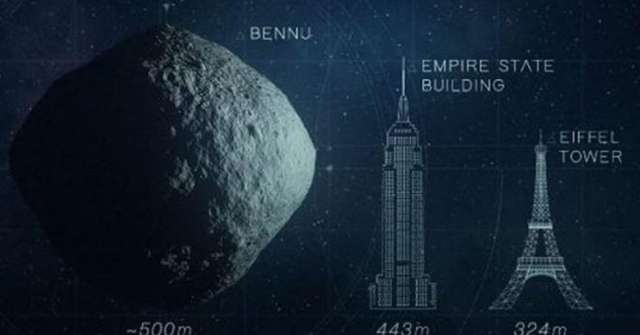
Space history was written last week when OSIRIS-REx, third planetary scout in the New Frontiers programme (after Juno exploring Jupiter and New Horizons checking Pluto), collected a regolith sample on asteroid belt inhabitant 101955 Bennu. Given the abundance of asteroid candidates, why this one? For starters, it's 'close', sometimes even cutting inside Earth's orbit. It's not rotating too fast, making it far easier to touch down and grab up some dust. And it's a C-type asteroid, in which the C stands for carbonaceous, meaning they are relatively pristine time and space travellers from long passed aeons - Bennu may even contain material from before the Solar System's existence. A more comprehensive list of why Bennu was so sexy can be found here.
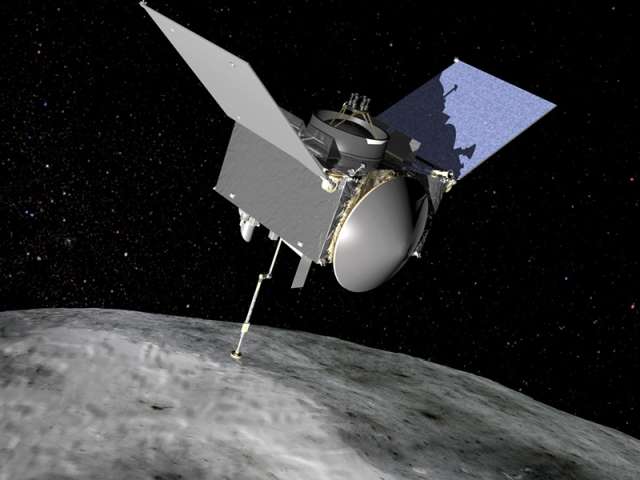
OSIRIS-REx (Origins, Spectral Interpretation, Resource Identification, Security, Regolith Explorer) is a NASA asteroid-study and sample-return spacecraft, launched from Cape Canaveral in SEP 2016 on top of an Atlas V rocket. Some specs:
* Dimensions: Length 2.4 m (7 ft 10 in), width 2.4 m (7 ft 10 in), height 3.15 m (10.3 ft)
* Width with solar arrays deployed: 6.17 m (20.2 ft)
* Power: Two solar arrays generate 1226 to 3000 watts, depending on the spacecraft's distance from the Sun. Energy is stored in Li-ion batteries.
* Propulsion system: Based on a hydrazine monopropellant system developed for the Mars Reconnaissance Orbiter, carrying 1,230 kg (2,710 lb) of propellant and helium.
* The sample-return capsule will reenter the Earth's atmosphere for a parachute assisted landing. The capsule with encased samples will be retrieved from Earth's surface and studied, as was done with the Stardust mission.
And here is the iconic moment of OSIRIS sampling Bennu's surface. What's utterly amazing is the distance from Earth at which this happened, some 320 million kilometers. Or, as the distance from Earth to Sun is about 150 million kilometers, or 1 Astronomical Unit, this tiny human-made spacecraft did what it was supposed to do at more than 2 AU! As radio signals to steer the craft would take too long - 15 minutes - to reach it, the entire process was fully automatic.
Also via Twitter:
"Maybe one more time - it's just so cool. I must have watched it about a hundred times last night." - @OSIRISREx principal investigator Dante Lauretta of @UArizonaLPL reveals the first images from the spacecraft's TAG of asteroid Bennu yesterday. #ToBennuAndBackpic.twitter.com/DqTtOA2pwg
In order to get a relevant sample, OSIRIS-REx had to collect at least 60 grams. If the first attempt's yield at the designated "touch and go spot", dubbed 'Nightingale', was less, a second attempt at another spot was scheduled. However, it turned out that was not necessary:
OSISRIS-REx will now return to Earth and its precious cargo is expected to be available for study somewhere in 2023. That's... a thrilling prospect. As Bennu is over 4.5 billion years old, it means that humanity will be able to study material which already existed from before... the creation of our own Solar System!
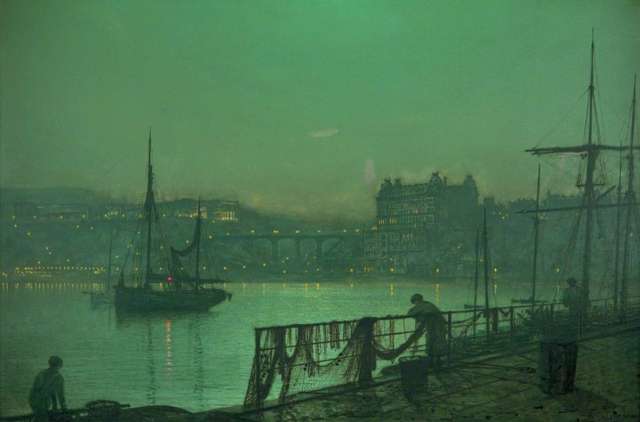
John Atkinson Grimshaw (6 September 1836 – 13 October 1893) was an English Victorian-era romanticist indebted to some extent to the Pre-Rafaelits. The 'Painter of Moonlight' is best known for his nocturnal scenes of urban landscapes.
The Chill of Autumn (1881).
Scarborough Lights (1877).
Good night, have a good start of the week tomorrow.
Kate Bush with Cloudbusting. Album Hounds of Love (1985).
The video, by Terry Gilliam no less and featuring Donald Sutherland, was shot on Dragon Hill, a hillock in the Vale of the White Horse, Oxfordshire. Actually the Uffington White Horse, which my wife and I visited during our honeymoon in 1999, is only a little bit further up.
Lenny Kravitz with I'll be waiting. From the 2008 album It is Time for a Love Revolution.
I suppose I'm not alone when I say that Kravitz first caught my attention on MTV with Let Love Rule. In 1989 that was. Jesus how time flies.
"A teacher was beheaded on a street near Paris on Friday afternoon after hosting a class discussion with secondary school students about cartoons of Islam's Prophet Muhammad.
The suspected killer, who was armed with a knife and a plastic pellet gun, was later shot dead by officers in a nearby town, police said.
French authorities have launched an anti-terror investigation.
President Emmanuel Macron called it an "assassination" and an "Islamist terrorist attack".
The victim, a history and geography teacher, was decapitated near a school in the commune of Conflans Saint-Honorine, northwest of the French capital, at around 5pm local time.
Police told the AFP agency that the teacher had shown cartoons depicting the prophet to his class.
His alleged attacker was reported to be 18 years old, of Chechen origin and born in Moscow.
Officials said he was shot dead in the neighbouring town of Éragny after he acted in a threatening manner and failed to respond to an order to put down his weapons.
President Macron visited the Bois d'Aulne school and met the history teacher's colleagues on Friday evening.
He said afterwards: "One of our citizens was assassinated tonight because he was a teacher, because he taught students about the liberty of expression, the liberty to believe or not to believe.
"Our countryman was the victim of a cowardly attack. The victim of an Islamist terrorist attack."
He added the attack should not divide France because, he said, that is what the extremists want.
The incident came as the French government works on a bill to address Islamist radicals who authorities claim are creating a "parallel society outside the values of the French Republic"..."
The teacher, Samuel P. was by all accounts a decent and well liked citizen, who taught history and geography in a high school in Bois d'Aulne. The perpetrator is one Aboulakh A., 18 years old, of Chechen origin, born in Moscow, and residing in Yvelines.
Count on the scoundrels in politics and media to downplay the islamic angle and find arguments to rationalize this umpteenth horrific islamic murderfest. It wouldn't surprise me if the initial 'shocked' reactions give way, two days hence, to 'he shouldn't have provoked it'.
Meanwhile, all of the ummah is rejoicing, and muslims, in particular in the West, are doubtlessly feting Aboulakh's defense of Ole Mo's 'dignity'. But perhaps worst of all is that the murder is also a dire warning to anyone who still toys with the idea of showing motoons. Anyone contemplating it will think twice again. And so, the dark curtain of islamization is slowly but irressistibly lowered over the West.
 Banks of Arrochar
 The Borrowdale Pass from Derwent Water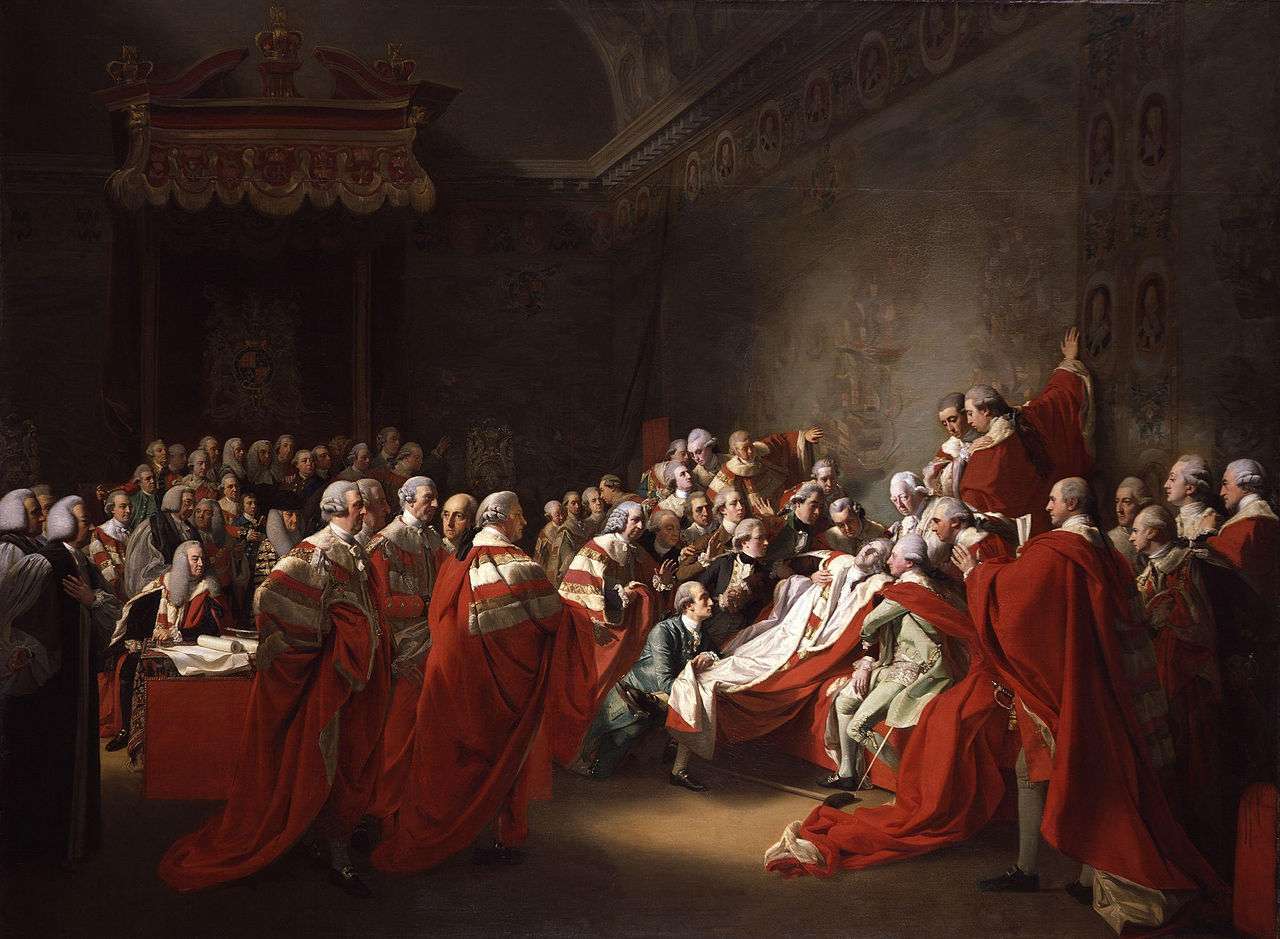






 The new necklace (1910).
 The figurine (1921).








 The Adoration of the Kings, By Gerard David (ca 1460-1523)
 Fruehling (Spring)
 Sommerabend (Summer Evening)
 The Surrey Canal, Camberwell (1935).
 The House by the Canal (1945).
 A Country Path
 The backs of houses, Harley Street, London (1925).