 Once upon a time there was a small, shy boy with far too big glasses who screwed up completely in sports, blew math and got scared shitless by females. By and large, it was books which got him through this quagmire, and one of the authors whose works he devoured was a noble French gentleman, alas long deceased. That boy was your servant, and that gentleman was Jules Gabriel Verne, the Father of Modern Science Fiction. Among the books that left the deepest impression on me were Michael Strogoff (1876), Twenty Thousand Leagues under the Sea (1870), Journey to the Center of the Earth (1864), and especially From the Earth to the Moon (1865). Recalling how fascinating - and credible - Verne's fiction still was more than a century after it was written, one wonders how the sheer novelty of these fantastic stories must have been received, and perceived, in the author's days. And what made him do it? What inspired him? After all, this son to an attorney who was born in the busy western French port of Nantes in 1828, wrote about space exploration when the first flight of an aeroplane was still a half century away. He predicted gas-powered automobiles, skyscrapers built of glass and steel, high-speed trains, helicopters and even the Internet (a worldwide "telegraphic" communications network) while very little, if anything, hinted at the advent of these technological wonders. The accuracy of his predictions sometimes reached an uncanny level, such as when NASA chose to launch its rockets from Cape Canaveral, 130 miles from the supposed building site (Tampa Town)of the Supergun in Verne's lunar voyage novel. Not to mention that the Apollo 11 capsule came down only miles from where the manned bullet landed in the book. The power of Verne's imagination reverberates through the decades, leading to the US Navy baptising its first nuclear submarine after Captain Nemo's Nautilus from Twenty Thousand Leagues under the Sea, contemporary authors borrowing from his ideas (e.g. James Rollins in his novel Subterranean, 1999), providing inspiration for famous 20th-century explorers and scientists, like William Beebe, Admiral Byrd, Robert Goddard...
... and ESA, the European Space Agency, naming its first-ever genuine spacecraft the Jules Verne. Indeed, on March 9, 2008, a powerful Ariane V rocket lifted the 20.7 tonne ATV-001, as it has been coded (with ATV standing for Automated Transfer Vehicle), into space from ESA's launch base in Kourou, French Guyana, with a heavy payload of propellant, water, air and supplies for the ISS. To be sure, ATV's are unmanned cargo resupply spacecraft, but unlike lab modules like Columbus, which are incapable of independent movement, an ATV, once in orbit, can perform all the tasks - and more - of typical manned spacecraft. Given that it was the first of its series, the Jules Verne first underwent three weeks of testing before it began its rendezvous operations with the ISS, to which it finally docked on 3 April. The following video, albeit from the hacks over at the Biased Broadcasting Company, is well worth watching:
 The ATVs, of which the development cost an estimated 1.35 billion EUR, are not only designed to supply the International Space Station (ISS). Another important feature is their ability to, if necessary, boost the station into a higher orbit. Four more have been ordered already, to be used until 2015, with an option for a further two. The small number implies that the ATV's are meant to complement, not subsitute, the existing Russian-made Progress spacecraft, of which it has three times the capacity. Like a Progress, an ATV carries both bulk liquids and relatively fragile freight, stored in a pressurized shirt sleeve environment in a cargo section so that astronauts can have access to it without having to put on a spacesuit. Docking to the ISS is done using two videometers and two telegoniometers built by Sodern, an EADS subsidiary. Additional (actually redundant) monitoring data is provided by a Russian-made antenna originaly designed for the Ukranian-built Kurs, an automatic docking system comparable to those used on the Progress ships and the Soyuz manned ferries. A camera mounted on the ISS's Zvezda module provides visual imagery.
Some more technical data about the ATV's: each one weighs 20.7 tonnes at launch, of which the cargo comprises 8 tonnes in various distribution schemes: up to 5.5 tonnes of dry goods like supplies, scientific payload etc), up to 840 kilograms (1,900 lb) of water, up to 100 kilograms (220 lb) of gas (nitrogen, oxygen, air) and up to 4.7 tonnes (10,000 lb) of propellant for re-boost manoeuvring and refueling the ISS. The propellant for re-boost is monomethylhydrazine (MMH, also used in the Space Shuttle) and N2O4 oxidizer. "Re-boost" in this context is the ATV's capacity to "push" the entire ISS to a higher orbit since its course gradually lowers because of atmospheric drag, even at such an altitude (!). Contrary to what one would generally assume, re-boosting is not really "pushing higher up" but an indirect process, by enhancing the ISS's speed. The resulting higher centrifugal force ensures that the orbital altitude enhances. Even when "getting higher up" is not immediately necessary to avoid "falling down", the feature enables the ISS to get out of the way of the orbital paths of space debris, of which there is more every year. On April 25, the Jules Verne pushed the 280-ton ISS 4.7 kilometers higher up in a re-boost maneuver that took 13 minutes. To this end the ATV accelerated the ISS's speed from 7,700 meters per second with just 2.67 meters per second... but it sufficed, and only two of the ATV's four main engines were needed. Re-boost manoeuvres have to be carried out periodically (about once a month) and until now this was done using that brave little workhorse of the Russians, the Progress. Actually a Progress M1, an update of the Progress M, which is in itself a descendant of the famous Soyuz spacecraft. Below you find a comparison between an ATV and the Apollo and Progress spaceships respectively.

And here is a magnificent pic (courtesy of Wikipedia, just like the drawing above) of the ISS. Visible "on top" is the ATV, coupled to Zvezda. Zvezda, meaning "star", was the first fully Russian ISS contribution, and an early "building block" (actually the third one, in July 2000). It houses some of the ISS's lifes support systems as well as living quarters for two crew members. Original Russian info on Zvezda here.

(to be continued)
MFBB
 May 20, 2008 -- DO we still have troops in Iraq? Is there still a conflict over there? If you rely on the so-called mainstream media, you may have difficulty answering those questions these days. As Iraqi and Coalition forces pile up one success after another, Iraq has magically vanished from the headlines. Want a real "inconvenient truth?" Progress in Iraq is powerful and accelerating.
 In early March 2008, Belgian newspapers broke the news that Abdelkader Belliraj (photo), a dangerous terrorist with dual Belgian/Moroccan citizenship, had been arrested in Morocco on February 18 on charges of involvement in an islamist terror circle. The group had links to other islamist and/or terrorist groups such as Moroccan Chabiba Islamiya (Islamic Youth), Moroccan Revolutionary Islamic Movement, the Mujahidine Movement in Morocco, Al Haraka Min Ajli Al Umma (Movement for the Ummah) etc etc. What has this all to do with Belgium? Simple.
  Anderlecht, Brussels, January 2, 2006. Willy Roobaert (52), having missed the last tram from the Hallepoort to the Beurs (Brussels Stock Exchange), asks and gets a lift from four youths in a black Opel Kadett. The "youths" are Khalid Hamui (23), Bilal Bouquersa (21), Ridouan Hmidou Lamarti (20) and Mohamed El Hakkouni (23), four Moroccans with Belgian passports. Great is Mr. Roobaert's surprise when the Opel doesn't stop at the Beurs, but instead continues towards an open field near the Navezstraat. There they take his money and his cell phone and ask for his credit card's pin code. When Mr. Roobaert refuses, blows start to fall.
  On December 4, 2007, three criminals entered a house in Lot, a small community just southwest of Brussels, with the aim of obtaining the keys of a light lorry which they thought belonged to the proprietor of the house. The pepetrators gravely wounded the latter with two bullets in the stomach and one in the leg, but in the meantime an alert neighbour had alarmed the police. Just as a police vehicle stopped in front of the house,
  Amsterdam, April 28, 2008. City Councilor for the PvdA (Partij van de Arbeid, one of the two socialist Dutch parties) Yman Mahrach, of Moroccan descent, publicly states that her party should not press too much for a "moderate" islam.
  Moroccan youths and hooligans, but especially the former category, destroyed bus stalls, damaged cars and busted shop windows. There was a hail of stones, beer bottles and even fences. The police deployed watercannons, horse charges and even pepper spray. Filip Van Laenen from The Brussels Journal notes the following:
  From the Vlaams Belang online magazine, March 29, 2003:
 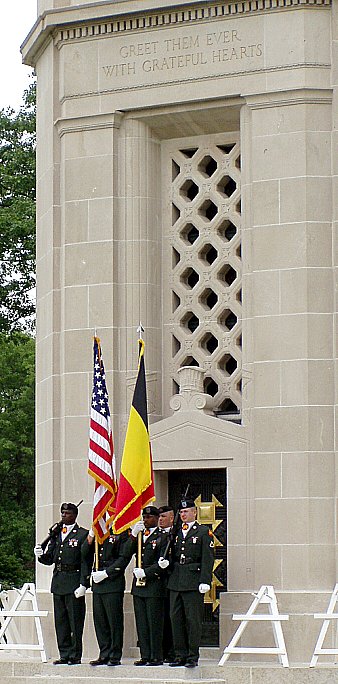 May 25, 2008. Memorial Day ceremony at Flanders Field American Cemetery, Waregem, Belgium. This was my first visit to the cemetery, the final resting place of 368 servicemen who died in World War I, and the smallest US cemetery in Belgium (the other ones are the Ardennes America Cemetery in Neuville-en-Condroz and the Cemetery Henri-Chapelle in Hombourg). Flanders Field AMC is basically a rectangular field covering 6.2 acres, with the white stone chapel you see on the photo in the centre. A curtain of trees and shrubbery effectively shields the place from the traffic on the adjacent roads and the activities on the industrial estate lying no more than a few hundred yards away, and lends it a solemn, tranquil and graceful atmosphere. The graves are neatly arranged on four sides, with paths leading between them towards circular retreats with stone benches and urns at three of the corners of the cemetery.
  The following video presents a short tour of Flanders Field American Cemetery's landscaped grounds and the architecture and interior of the chapel:


 Tom apparently had ample occasion to see the IDF and meet with some of its members, see the picca (more
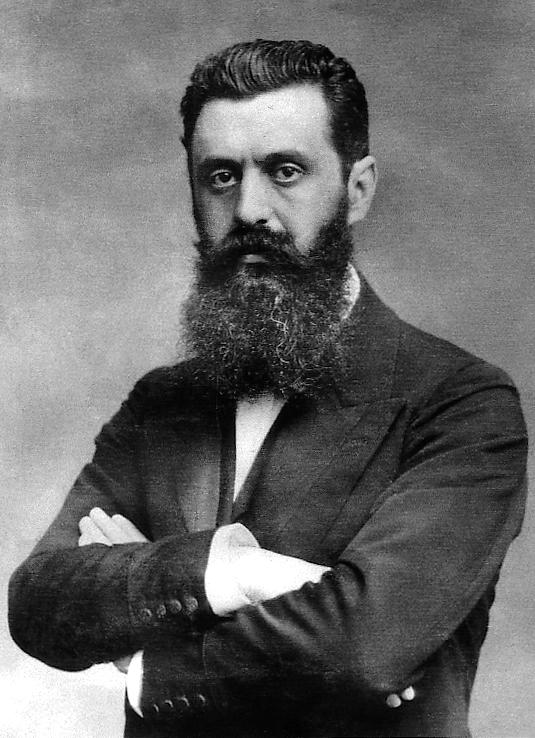 Then, in 1860,
  From then on, developments followed quickly. In 1917 the Balfour Declaration, issued by then British Foreign Secretary Arthur James Balfour, stated that the British government "viewed favourably" the creation in Palestine of "a national home for the Jewish people" on the condition that "nothing shall be done which may prejudice the civil and religious rights of existing non-Jewish communities in Palestine" or "the rights and political status enjoyed by Jews in any other country." A few years later, after the Allied victory, Great Britain fittingly assumed responsibility for Palestine (formerly part of the Ottoman Empire) with a mandate from the League of Nations, and the Jewish National Home for the first time became an ever more realistic concept. Needless to say, the return of many mostly European Jews to their ancient homeland was not welcomed by the Arab tribes who had lived all those times in the area between the Mediterranean Sea and the Jordan river. The interbellum saw several massacres against the Jews, and not just the newcomers. Few of those who claim that the immigrants took the land of the Arabs (in fact they paid for it - and some of it was even conquered by the Jewish Legion which assisted the British in World War I), do not acknowledge, willingly or unwillingly, that the infamous Hebron Massacre of 1929, which claimed the lives of 67 Jews and saw such horrible atrocities as the beheading of babies or the castration of old rabbis, was aimed at an existing Jewish community which had been there since before the birth of Christ. Other massacres took place in Safed, Tel Aviv, Motza and Kfar Uriyah. More Jewish lives still would be claimed in the
  The left side of the map to the right shows the areas allocated to the Jews in purple, and those of the Arabs in green. Notice that most of the Jewish part was the barren Negev desert, and that the parts reserved for the Arabs were far larger than today's equivalents the Gaza Strip and the West Bank. The 1947 "Gaza Strip" was thrice as large and L-shaped, and its counterpart the "West Bank" was twice as big as today. The key region for the Jews was a narrow slice of land, barely 15 kilometers wide and containing Tel Aviv and Haifa, along the Mediterranean.


 As I have stated on these pages before, this is not a racist site. We do not oppose a Black becoming President of the United States. But when that day comes, it should be someone of great intellectual and moral stature, someone who is steadfast in his opinions and cautious but decisive in his actions, and someone who is a great manager of people. Plus, it wouldn't hurt if he had a certain gravitas and an aura of statemanship around him. In my opinion, Senator Obama has nothing of this all. And the environment in which he was bred - which produced him, so to say, is the one of the endlessly repeated lies in spite of all the evidence. Back in the sixties or even the seventies, less critical people could still be forgiven for buying the self-flagellating, self-marginalizing rhetoric of the Left. Today, there is no excuse anymore to offer the wrong reasons for the obvious problems of the black community, which deserves far better than the condescending, quintessentially racist-in-itself attitudes of liberals. No more affirmative action, but Self-Empowerment. No more blaming on the others, but introspection. No more lax or autodestructive lifestyles, but sound conservative family values. No more teen pregnancies, but math courses. And no more being content with the crumbles of welfare agencies, but making big money with your own business. THAT is the path the Black Community should follow, and not the dead ender of a spoiled brat groomed to be a poster boy for an ideology which failed decades ago.
 On April 2, 2008 the


 In a tragic twist of fate, just the day before, Dennis Van Uhm's father, Peter Van Uhm (52), formerly a Lieutenant General commanding the Dutch land forces,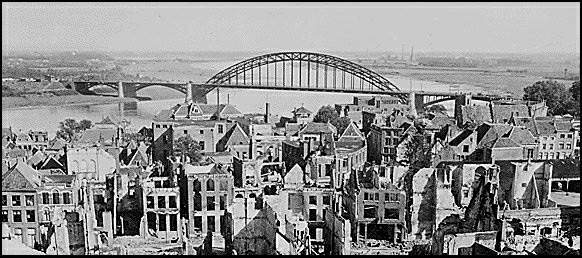


 A recurring theme in Waterhouses subjects is the character of


