
Which is what Outlaw and the wife did last weekend, a bit unplanned since looking for Mission:Impossible III and finding all dvd copies rented already. So we picked "Tristan & Isolde" by Kevin Reynolds, and never regretted it. It's not a tearjerker like Titanic, and its combat scenes are a far cry from Troy. It doesn't have the historical accuracy of Barry Lyndon, nor will it glue you to your seat the way Lord Of The Rings does. But almost as soon as we flicked off the dvd player, our appreciation started to grow.
The film is a loose adaptation of an old Celtic legend of which the origins can be traced back to either Irish or Welsh folk tales, and of which the story proliferated practically all across Europe, whence the multitude of versions. One of the best medieval authors to put the legend in crafty prose was the German poet Gottfried von Strassburg (died c. 1210). His Tristan is considered - together with Wolfram von Eschenbach's Parzival and the Nibelungenlied - as emblematic cornerstones of the great romantic narratives of the German Middle Ages.
The film's storyline follows the version whereby Tristan (James Franco) is a young Cornish knight (Cornish, from Cornwall, a region in the southwest of England) adopted by King Marke (Rufus Sewell) after a battle with the Irish invaders. The timeframe Tristan and Isolde takes us back to is (very) early medieval, say around 600 AD. The Roman Empire perished 200 years earlier and unity is lost among the various English tribes, which weakens them so that they cannot withstand repeated Irish invasions. In the course of a battle in which Tristan successfully repels an Irish raid and kills the enemy commander Morold, principal warlord of the Irish King Donnchadh (David Patrick O'Hara), Tristan himself is mortally wounded. According to Cornish custom his body is posed for dead on a boat and delivered to the sea. However, the currents take the boat across the Irish Sea and it is King Donnchadh's daughter, Isolde (Sophia Myles) who discovers it and its precious cargo, still clinging to life by a thread. Isolde then carefully nurses Tristan back to life in a hidden alcove on the seashore with the silent knowledge of her servant maid Brangnae (Bronagh Gallagher). Because she doesn't want to reveal her identity to Tristan, nominally still an enemy warrior, upon asked her name she gives that one of her servant. By the time Tristan has regained his strenght again, the two have totally fallen in love, but then the boat's wreck is discovered by Donnchadh's men who now suspect an English knight is around. Sick with fear for her father's reaction, Isolde, who was promised as wife to Morold, urges Tristan to regain the sea and sail back to England, and thus happens.
 The consternation in King Marke's camp upon seeing their hero returned from the dead quickly makes place for joy, but the young knight can't forget his Irish heartthrob. One day, King Marke receives a rather incongruous - given the state of war with Ireland - invitation from King Donnchadh for a tournament to be held at Donnchadh's residence, supposedly to herald a new era of cooperation. The price will be Donnchadh's daughter, Princess Isolde. Tristan, not knowing Isolde is actually his savior, volunteers to be King Marke's champion, who is a widower and to whom he feels indebted for having been adopted as an orphan. As could be expected, Tristan wins this tournament, and only then recognizes that he has won his lover for his Lord. Back in England, after King Marke's marriage to Isolde, the two try at first to suppress their emotions but soon see each other again secretly. Word of their affair spreads, and eventually reaches Donnchadh through Wictred, a renegade English knight who envies Markes' kingly rule. The two craft a plan whereby during a visit of the Irish Court to Marke, the latter will be publicly humiliated through disclosure of Tristan and Isolde's affair, and Donnchadh reckons that then is the time to dispose of a weakened Marke and replace him with the more trustworthy Wictred.
Thus happens. Marke, upon finding out he has been cheated on throws the two lovers in jail but it's too late: a number of his men, judging him a fool, have changed allegiance and Donnchadh's troops overrun Marke's stronghold. At the last moment Marke learns of the circumstances under which his first knight met his young wife, and forgives them. Even though Tristan and Isolde are set free and allowed to go wherever they wish, Tristan, not wanting to be remembered as a man who brought down a kingdom through a love affair, throws his weight into battle and narrowly tips the balance by killing Wictred. Although he himself is mortally wounded, the rest of Marke's men take courage and finally beat the Irish.
From then on Marke will oversee the ascent of a strong and unified English kingdom, undisturbed by Irish invasions. His young wife however, beside herself with sorrow over Tristan's death, fades away. So sorry, there's no happy end.
 By and large I found Tristan & Isolde quite entertaining. It was also the third movie I saw with Kevin Reynolds as director, after Fandango (1985) and The Beast (1988), and I'd say that Reynolds lacks just that little bit that would make him a real powerplayer among directors. It's not that his productivity is low; Kubrick's was lower. But there seems to be lacking some drive. Either he chooses mostly mediocre scripts, e.g. Robin Hood: Prince of Thieves (1991), or he isn't a tyrant enough on the set. Possibly a bit too much intimacy too (especially in Fandango). And then there's the fact Reynolds seems to have trouble finding budgets with clout to finance his films - you can see that Tristan & Isolde is really, really low budget. Not surprisingly perhaps, since the only time he really did oversee a huge project, Waterworld (1995), it flopped terribly. That said, Tristan... gets the green light from yours truly, not in the least because of the fine acting. Both James Franco (who was also in both Spidermans) and Sophia Myles (Underworld) glow in their roles - watch out for those two - and Rufus Sewell too plays a very plausible King Marke. The producer of Tristan and Isolde is Ridley Scott (Gladiator, Kingdom of Heaven).
 To dwell a little longer on Reynolds' curriculum, the one movie that really, really left a lasting impression on me was The Beast (1988), which came out here in Europe as The Beast of War. It tells the story of a Soviet tank crew who, after having destroyed an Afghan village in 1981, get lost in a dead-end valley and are chased by mujahideen. Not surprisingly, Reynolds too calls The Beast his best film. I saw it first in 1989 IIRC at the International Film Festival of Ghent, and back then it was really trendsetting as far as combat scenes go, if you discount Platoon (Platoon was very good for combat scenes and general atmosphere, but I absolutely disliked the pathetical way Willem Dafoe went down as well as the PC message that "the enemy was inside us"). Actually, I'm surprised that The Beast received comparatively little praise since all of it - crew, director, story, special effects - were top notch. After the performance, I walked into the lobby of Decascoop, Gents main movie theatre, and bumped into Mr. Reynolds, a guy from Decascoop and George Dzundza, who plays the bad sergeant Daskal, the tank commander. Dzundza, who I believe is from Georgian origin (that's Georgia in the Caucasus, not in the Bible Belt) is a chap who also played in Michael Cimino's The Deer Hunter. I was able to exchange a few words with Mr. Dzundza about the tank which is more or less a star too in the movie, the way the F-14 Tomcat was a star in Top Gun. As a tank geek, I don't like it when directors fail to come up with "correct" tanks in depicting historical battles, think Patton tanks for Tigers in movies about the Ardennes Offensive. But the T-55 in The Beast was goddam real. I asked Mr. Dzundza how on earth they had managed to get a genuine Russian tank at their disposal (remember, it was still the Cold War) and it turned out it was a Syrian army tank captured by the IDF. For the tank nutters among you, see the poster to the left. The gap between the first and second wheel identifies it as a T-55, not a T-62. I read somewhere that Russian tank designers put in that space to allow for easily making a tank with a blasted track roadborne again in case spare tracks were missing. The idea was that the crew would simply omit "the missing links" and drape the remaining track along the shorter wheelbase.
OK, enough about adultery in the Middle Ages and Soviet Cold War era tanks.

Sorry, I can't help it. Like The Beast, The Beauty also seems to have made a lasting impression on me. Sophia Myles, you are a sight for sore eyes.
MFBB.
P.S.: it's useless to try to warn Mrs. Outlaw. She's computerphobic and doesn't even want an email account.
P.S.S.: for the ladies among you, sorry, but as long as there are no female staffers here at DowneastBlog (Kerry where are youuuuuuuu????), don't count on hulk pics anytime soon.


 While it is clear that the violence has in fact continued unabated throughout the year, especially since last month it seems to have gained momentum, with the French Interior Ministry claiming a total of
  From my perspective in Belgium, Frances northern neighbour, one thing is very obvious, apart from the scale of the troubles of course. That is the TOTAL BLACKOUT in the Belgian Regime Media. One would think that with nearly 32,000 cars burned and 3,000 police officers wounded, it would be frontpage news and/or news item no°1 on TV. After all, Paris is barely 3 hours driving from Brussels. And yet... nothing. Nada. Niks. Nichts. Rien. Could it be that Belgian MSM received secret instructions from the powers that be to broadcast nothing that could smash the wonderful multicultural Utopia to smithereens? Especially around election time? It could be. In fact, it would not surprise me in the least. Belgium is, like France, a country where the Left is entrenched in power to an extent unthinkable in the US. There simply is no alternative viewpoint save from blogs. Unfortunately, despite all the bruhaha about the impact of blogs on the media landscape, fact is that blogs ultimately reach relatively few people. And so it is with sadness and horror that people who get a glimpse of reality, like yours truly, view the march of the ignorant masses towards doom. There are going to be presidential elections come next spring. The main candidate for the French Parti Socialiste is a woman, 53-year old Ségolène Royal. Tens of thousands of French Police Officers may be besieged each and every day, resulting in an everyday average of 14 wounded ones, but Madame Royal, more aware of the grave danger posed by capitalism and free markets, was quoted on October 13 as:

 In Flanders's big cities, like Antwerp and Ghent, there was a either a status quo (the former) or a slight drawback (the latter). The same phenomenon could be observed in smaller cities with a huge immigrant population, like Mechelen. But especially Antwerp was the focus of national - and international - media attention, since it is the place where the VB originated and since it was considered the main battleground where the VB's strongman Filip De Winter (not the party chief, that's Frank Van Hecke) would challenge the sitting socialist mayor Patrick Janssens. Before October 8, De Winter had indicated he hoped to reach 35% of the vote in Antwerp (in 2000, the party got 33% of the vote). It turned out the VB won "only" 33.5%... while the socialists jumped from 16% to 35%!

 And so it is with sadness that I see the current developments. The Left, traitors as they have always been when faced with bullies, do not even hide anymore that they are after the immigrant votes NOT because they care so much to reach out for them. It is about power, nothing less. Stayin in power. How do you stay in power when your traditional electorate dumps you? Simple: you usher in newcomers, give them rights, pamper them with free housing and positive discrimination and the only thing you ask in return is that their vote. It works. We see it in Rotterdam, Amsterdam and Leiden. We see it in Antwerp, Gent and Brussels. We see it in Londen, Leeds and Birmingham. What we are seeing is that instead of us implanting Middle-Easterners in European economy, it's them implanting Middle-Eastern economy in Europe. Still, Europe can kid itself it's on a par with the US and Japan. But in twenty years? That magnificent Mercedes 280E you buy today is still the work of bright German engineers. But their hairs are silver, and their heirs increasingly scarce. I don't like to say it, but Europe obviously cannot count on Moroccan or Algerian engineers. Twenty years ago I was an engineering student in Gent. In my seven years of study, during which I held class with possibly three hundred different individuals, I have known only two muslim colleagues. The first one did not even make it past his first year. The second was indeed very intelligent and a computer whiz kid. But all in all, one has to conclude that so far, the muslim community among us has shown a spectacular ability to not contribute technical novelties in what is supposed to be the space age.
 In the 308 communes of Flanders, the northern, Dutch-speaking part of Belgium, 4,648,649 people will head to the ballot box. Together, they will elect 7,350 town council members as well as 411 provincial council members, out of 31,906 candidates. For those of you who are interested in such matters, if you follow
 One week ago, in an effort reminiscent of the 2003 Rock The Vote Tour performed by a Moooooooooooo-ron in the U.S.AAAAAA---, Tom Barman, a Flemish "rocker" as red as Che Guevara is dead, orchestrated the so-called


 For at least three consecutive nights there has been heavy rioting in the Marollen, an old neighborhood near the Palais de Justice in the centre of Brussels. At this moment, Thursday night, things seem to have calmed down but the incidents show once again that every European community with a fair number of North African, read muslim immigrants, is a potential powderkeg needing very little to go off, see also the
 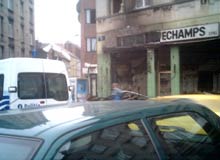 On Monday night 25/26 September tens of Moroccan youths (I know, actually they are Belgian youths but since the authorities keep referring to Vlaams Belang voters as SS Einsatzgruppen, shit, why not play the game) ventured out in the Marollen,
  Apparently having become smarter, the representatives of the Brussels City Council this time made no rendez-vous to listen to the youth's grievances come Wednesday evening. And goddam right they were, for as far as I know, apart from the usual innocent passers-by stone-pelting, café-burning, carglass-busting,
 That is why Mr. Reinfeldt in his bid for PM decided to take a different course than his predecessor Bo Lundgren, held responsible for the Moderates' disastrous 2002 showing, and instead of hammerring upon less taxes and regulation chose to emphasize small pro-business adjustments and a soft approach for reforming social security. In fact Reinfeldt did not rock the boat and even beat the Social Democrats on their own turf. Personally, I have reluctantly come to agree that this is the best way for rightist parties to regain power in Europe. A series of small incremental steps intended to streamline social security and in the process regularly confront the electorate with the (necessary) fait accompli. Reform is needed, but it has to be done stealth mode so as not to lose control again to the socialists at the first occasion. Using this technique, Germans are right now getting slowly accustomed to the knowledge they will have to work till 67. If a rightwing party would trumpet that out loud, it would be kicked out in no time.
 Some quick country facts: Sweden's consolidation as a nation happened fairly early for European states, namely in the 12th Century, and perhaps not coincidentally with the Christianization of the country. In 1389, Norway, Sweden and Denmark formed one unity under one monarch through the Union of Kalmar, but in 1521 King Gustav I of the House Vasa broke with that union and laid the foundations of the Sweden as we know it today. In the 16th and 17th centuries Sweden was despite its small population of approximately 2 million, one of Europes superpowers, and its most famous characters from that era are Gustavus II Adolfus who fought (and died) in the Thirty-Year War, and Charles XII who famously invaded Peter The Great's Russia but in the end was utterly defeated at Poltava in 1708.
 In the 19th century, the two most relevant socio-economic phenomena to occur in Sweden were massive emigration to the US (an estimated 1 million between 1850 and 1910) and industrializaton (from 1870 on). In the 20th century, Sweden managed to stay neutral in both world wars, and after that latter conflict acquired worldwide fame with quality automotive and aeronautical products. During the Cold War it remained nonaligned, and it only joined the European Union in 1995. Today, Sweden, with capital Stockholm, has a population of app. 9,060,000, which on a surface of 449,964 sq km (173,732 sq miles) still translates in a very low (average) population density for European standards. In 2005, its GDP was estimated at $268 billion. The colours of the Swedish flag are yellow and blue. If you look closely, you can discern a woman on the photo. Rumor has it that one in every two Swedes is a woman. Before you pack your coffers for Stockholm, keep in mind that


