Sunday, July 23, 2006

AFGHAN CUP: HOLLAND 18 - TALIBAN 0

As some of you may know, the presence of non-US NATO troops in Afghanistan is gradually making itself more felt, and this fall the number of those NATO troops will be numerically almost equal to that of US troops. The two forces have different agendas however. The NATO troops operate within the ISAF framework (International Security and Assistance Force), and as the name implies, are more involved in providing a security umbrella for reconstruction "behind the frontlines", while the US troops operating under Operation Enduring Freedom are for the most part exclusively involved with fighting terrorism.

ISAF's area of operations will be expanded to include six additional provinces: Day Kundi, Helmand, Kandahar , Nimroz, Uruzgan and Zabul. Four Regional Commands will be established at Mazar-e Sharif (ISAF Region North), Herat (ISAF Region West), Kandahar (ISAF Region South) and Kabul (Central), and an additional four ISAF Provincial Reconstruction Teams (PRTs) will be created in the Helmand, Kandahar, Uruzgan and Zabul provinces. To achieve these goals, ISAF, currently at a modest strenght of 9,000 (provided by 36 countries, including 10 non-NATO ones) will be increased by up to 6,000 personnel bringing the total number to approximately 15,000, which is, numerically at least, on a par with US troop strength.

However, as NATO/ISAF widens its scope, chances are that its troops will see more actual fighting. It seems that lately I was a bit too sceptical about the Dutch fighting qualities, since over the previous months, far from the cameras, the Dutch contingent got quite its share of fighting, with a provisional climax during a ten-day operation concluded just one week ago and of which we now have some more details.

Dutch Apache in AfghanistanThe 1,500 strong Dutch military presence in Afghanistan is mostly concentrated in Uruzgan province, and one of their bases is Camp Holland near Tarin Kowt, the province's capital. Camp Holland, home to some 455 Dutch troops, is scheduled to become the base camp for a Dutch Army-led reconstruction mission, due to start on August 1, 2006 (another camp will be set up in Reh Dawod, also in Uruzgan). Ten kilometers (six miles) north of Tarin Kowt lies the Baluchi Valley, and over the past weeks the Dutch noticed a buildup of Taliban fighters in this valley. Since the valley and its surrounding hills constitute a good fire base for missiles directed against the camp it was decided to remove the growing threat. On or around July 10 Operation Baluchi took off, with Dutch commandos supported by armoured vehicles and for air support their own Apache helicopters and F-16s (the Dutch still have 4 F-16 fighters in AF). 18 Taliban were killed while the Dutch suffered no casualties. The Dutch thus continue to have good luck, since over the past few months, in smaller skirmishes, they killed dozens of Taliban while suffering no losses themselves. After the cleanup, Afghan National Police took possession of the valley to prevent it being retaken by the Taliban.

On July 21, in The Hague, The Netherlands, Gen. Dick Berlijn, commander of the Dutch Armed Forces, provided some background to the Dutch involvement in AF in general and Operation Baluchi in particular.

Ge. Dick Berlijn"If we had not done something then our soldiers could have come under fire and the construction of our camp could have been hindered," Gen. Dick Berlijn, commander of the Dutch armed forces, told reporters in The Hague. Berlijn said the Taliban fighters were massing on terrain on both sides of the Baluchi Valley, about 6 miles north of where Dutch troops are building Camp Holland, which will be their base for a reconstruction mission due to start Aug. 1. "The Baluchi Valley is a strategic position and in the end we decided that if we did not do something about it, it would be a major threat for us," he said. Berlijn said the Dutch mission was carried out independently of a U.S.-led coalition mission in the same region, but added that Dutch and coalition forces coordinated closely. He declined to give any details of the U.S.-led operations. According to Berlijn, his country already has more than 1,500 troops in the country and said that number could rise to around 2,000 before settling back to the 1,400-strong force approved by parliament. In recent months, Dutch troops have killed dozens of Taliban and other enemy fighters without suffering any fatalities.


Back here in Holland, creeps such as Jan Marijnissen, the leader of the Socialistische Partij (SP) and one of those fancy euroweenie full-fledged lunatics in the mold of Zapatero, may equal Islamic terrorism with Dutch resistance against the Nazis:

"During World War II, Dutch people thwarted nazi Germany's destruction machine by blowing up town halls, because this was where the Jews were registered. Things are not all that different in the Middle East. Islamic fundamentalism, including the terrorist wing, is a reaction to Israel's occupation of Palestine, to America's presence in the Middle East and to the West's support of undemocratic regimes in the Middle East."


... but the actions of the Dutch Commandos in the Baluchi Valley prove that the spirit of a nation which once was truly a world power, is not completely extinct yet.


MFBB.

Friday, July 21, 2006

JULY 21 - BELGIAN INDEPENDENCE DAY.

Belgium is a weird country.

Actually Belgian Independence Day should be October 4th, since on October 4th, 1830, Independence was formally declared by the provisional government (known as Voorlopig Bewind in Flemish and Gouvernment Provisoire in French).

However, since Europe at the time was still trying to find out if a monarchy wasn't such a bad state form after all - Europes first experiment with a republic, France, had caused quite some headaches - these provisional rulers opted for a Constitutional Monarchy. Only problem: they couldn't find a King yet. Only one year later, on July 21, 1831, Leopold of Saxe-Cobourg, shipped over from England, would be crowned King of the Belgians in Brussels. And thus, even though at his accession to the throne his country was already 10 months old, the day he assumed control as Leopold I would become Belgian National Holiday.

I wish I could provide some more info on these early days and the events that led to Belgian Independence. Unfortunately, I'm rather short on time. So I'll try to keep it brief and to the point.

In 1815 Napoleon was beaten at Waterloo. At the Congress of Vienna the then European superpowers had already decided (before the actual battle) to amalgamate the Low Countries - what is now known as Holland, Belgium and Luxembourg - in the Dutch Kingdom under Willem I of Oranje (the Dutch Royals are from the House of Oranje/Nassau, wherein Orange is a place in France where they were once exiled and Nassau is a place in Germany where the very first Willem, known in Anglosaxon countries as William the Silent, was from).

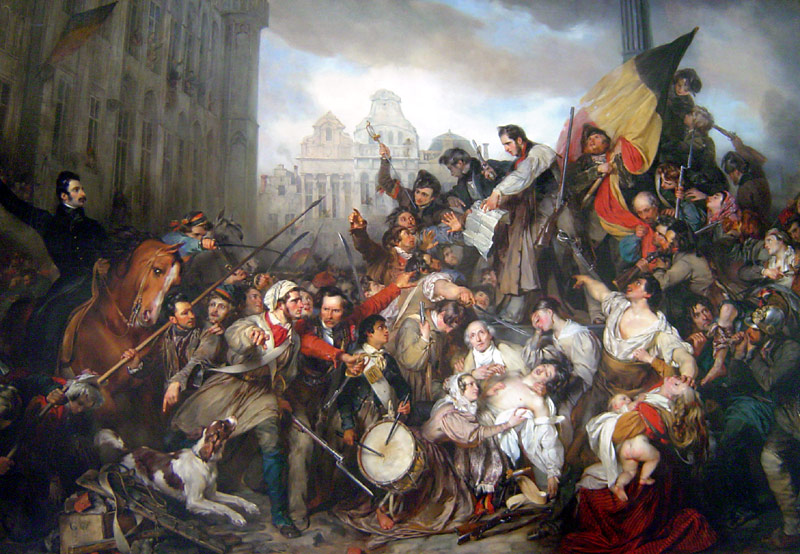
Belgian Revolution 1830

For 15 years, from 1815 to 1830, a Dutch King was thus ruling over Flemings and Walloons (as well as over the Luxembourgers). And here's the thing. Willem was some kind of Enlightened Despot, but the fact that he never gave the "Belgians" equal rights, granted no press freedom, and introduced a couple of nasty, authoritarian measures made that he never "ticked" in the southern part of his Kingdom. Add to that the general animosity among the Walloons, who at the time possessed way more industrial backbone than the Dutch themselves, plus the fact that they had to accept Dutch as official language - the horror - and you have the ingredients of an uprising. It came on August 25, 1830, after riots broke out in Brussels at the end of a popular Royal Theater play called "La muette de Portici". Although the Orange-true Civil Guard managed briefly to restore some order, word got out, and riots ensued, in other places such as Liège, Verviers, Huy, Namur, Mons and Leuven. To try to cool down the situation, King Willem sent one son, Crown Prince Willem, to Brussels to negotiate. However, he also sent a second son, Frederik, Commander of the Royal Army, with a force of 6,000 to Vilvoorde, a place 10 kloms north of Brussels. The latter act was generally seen as a provocation by the protesters. As the tensions grew, the soon-to-be Belgians got reinforcements from Liège and free corps were raised.

By the 23rd of September King Willem had had enough and he ordered Frederik with his army, in the meantime 12,000 strong, into Brussels to show who was boss. The free corps were able to canalize the anger of the masses - who suffered from high unemployment - towards the royal troops, and a genuine battle unfolded in the heart of Brussels, the Warande Park. If you ever visit Brussels, that's the park right between the Royal Palace and Parliament (and if you ever fly over the center of Brussels, you will notice there's a gigantic freemason compass in the park, a legacy of the Austrian architect Bartholomeus Zinner). Anyway, for four days the battle raged in and around the park. The "Dutch" had cannons, but the "Belgians" threw anything they could lay their hands on from the rooftops. Musket fire was everywhere, and soon there were hundreds of dead and wounded on both sides. The beautiful painting by Gustaaf Wappers, see above, is a romanticized depiction of the death of a "Belgian" and the general uproar during those hectic days (it is a painting much in line with the Delacroix painting of the French Revolution. You know what I'm talking about - the painting with the stout woman with the gun and the bare knockers). In the night of September 26 to 27, the Royal Army had had enough and it left Brussels, marching back to Vilvoorde. During the fight, a provisonal government had formed - the Voorlopig Bewind/Gouvernement Provisoire - comprising a.o. strong characters such as Louis de Potter, from Brugge, and Charles Rogier, from Liège. Belgium's "Founding Fathers" are on the drawing below, a popular period litho. On October 4th, this Provisional Government declared Belgian Independence. Quite remarkable, already on November 10 elections were held, resulting in a National Congress, which formalized the independence of the new little state from the North Sea to the Ardennes. The search for a King could begin.

Belgian Revolution 1830

MFBB.

Monday, July 17, 2006

HEY, CAN'T YOU AIM A LI'L BETTER???????

Before you all think MFBB has become a sissy, no, nee, non, nein and njet! I'm all for blasting Hizballah to kingdom come and reducing that fuckface Nasrallah to a smoldering heap of fat and bones. And if that's not clear enough, I AM in favor of disproportionate response. They kill an IDF soldier, kill 100 of 'em lousybeard good-for-nothing dumb-as-a-backdoor fanatical Quran-thumping A-holes. But not in this way. Close to 200 dead in Lebanon, and the (overwhelming) majority of them simple Lebanese citizens? NOT good, imho. I can't fail but notice the difference between the USAF going out of their way to avoid civilian casualties when conducting bombing operations in Iraq and/or Afghanistan, and apologizing at length and offering "blood-money" after the (sadly, inevitable) collateral damage does occur, and the IAF blasting half Beirut to smithereens without (from my POV at last) critically hurting Hizballah.

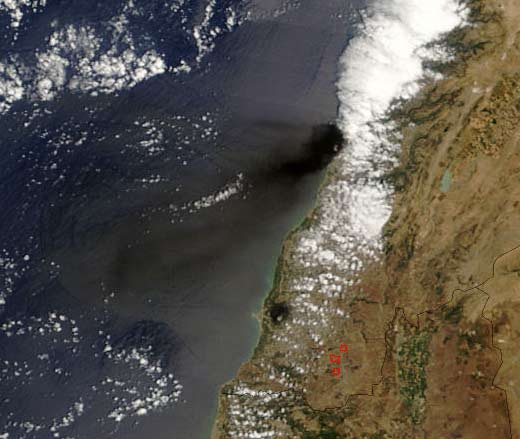
Lebanon - MODIS photo ca. July 14, 2006Consider the satellite photo of Lebanon to the left, taken this weekend by NASA's MODIS Rapid Response System. For the geeks, unlike Google Earth, MODIS provides real-time satellite pics via two birds, Aqua and Terra, which orbit in such a way that every location on the planet can be photographed at least once a day during daytime. On the downside (when comparing the images with GE high-res ones) is the low resolution, every pixel being a square of 250 x 250 m. Credit for this photo goes to fellow Belgian/Flemish blogger Luc Van Braekel, thanks Luc! Now, what you see is a big black cloud of smoke over Beirut, presumably coming from destroyed oil tanks of the al-Jieh electricity plant, and a smaller one more south - I assume that one's over Tyre. Yes, I know, burning oil tanks look much more dramatic than a destroyed missile site, which we couldn't see anyway on a photo like this one, but I can't help to think that a lot of ordnance is being released where it shouldn't. I am still taking into account that from my safe vantage point my estimation may just be that of an armchair general. OK. But what to think then of Michael Totten's post of July 15? For those who don't know Totten yet, he's a self-proclaimed "Liberal Hawk", is travelling the Middle East extensively (I have no idea how he manages to finance his exploits) and he considers Lebanon his second home. I've been following this guy for some 2 1/2 years now, and I think he knows damn well what he's talking about. This is how he reacted to the IAF air raids:

I sympathize one hundred percent with what Israel is trying to do here. But they aren't going about it the right way, and they're punishing far too many of the wrong people. Lord knows I could be wrong, and the situation is rapidly changing, but at this particular moment it looks bad for Israel, bad for Lebanon, bad for the United States, good for Syria, and good for Iran.

.....

What should the Israelis have done instead? They should have treated Hezbollahland as a country, which it basically is, and attacked it. They should have treated Lebanon as a separate country, which it basically is, and left it alone. Mainstream Lebanese have no problem when Israel hammers Hezbollah in its little enclave. Somebody has to do it, and it cannot be them. If you want to embolden Lebanese to work with Israelis against Hezbollah, or at least move in to Hezbollah's bombed out positions, don't attack all of Lebanon.

Israel should not have bombed Central Beirut, which was almost monolithically anti-Hezbollah. They should not have bombed my old neighborhood, which was almost monolithically anti-Hezbollah. They should not have bombed the Maronite city of Jounieh, which was not merely anti-Hezbollah but also somewhat pro-Israel.


To underscore Totten's point, here's a small BBC item about a raid on the port of Abdeh, in the extreme north of Lebanon just 6 kloms south of the border with Syria. Yeah, I know, it's from the British Bullshit Company. Still...

Israel has extended its air campaign to northernmost Lebanon, killing at least 14 people, including nine soldiers, in the port of Abdeh near Tripoli.... The Israeli military said it had been targeting radar stations in Abdeh because they were used by Hezbollah to hit an Israeli ship on Friday, the Associated Press news agency reported.


Targeting Hizballah radar stations (do these mongoloid fuckers know how to operate radars?????) sounds like a good sport to me, but killing nine soldiers of a military the Israelis EXPECT to disarm Hizballah does not. Not content with Totten and the Beeb yet, I decided to peek at some Lebanese sites. Here's a snippet from Lebanese Political Journal, which proclaims it's the top-notch blog for Lebanese politics. At first glance, it didn't strike me as suffering from BDS or whatever other symptom of leftwing diseases:

A school in Tyre filled with refugees was bombed. The number of casualities is not specified.... The plastic factory in Tyre, the paper factory in Ouzai, and a soap factory have all be destroyed.


Finally, while wandering 'round the net I came across an explanation from Op-For, some kind of strategy page, which seems to offer a valid explanation for Israels strategy:

What we are witnessing in southern Lebanon is concurrent with actions designed to prep a battlefield for the insertion of ground forces. So far, Israel has relied on its dominance in sea and air forces to isolate Hezbollah, rather than focusing their brunt of their superior forces on actual enemy positions. By blockading the coast, neutralizing Beruit's airport, and damaging roads and bridges into and out of Lebanon, the IDF has cut off Hezbollah's supply routes by land, sea, and air, and blocked all lines of escape.

........

The end result is a battlespace that traps the now ill-equipped enemy force, the deal environment for Israel to crush Hezbollah forces. I think that in the coming days, we will see a sizable Israeli ground incursion into southern Lebanon, a campaign designed to exploit the favorable conditions that Israel has created for itself. I have the feeling that once that invasion comes, Hezbollah's ability to launch rocket attacks into Israel proper will be severly reduced, if not eliminated.


Hm, that's one explanation indeed. However, I for one am reluctant to accept the idea of the IDF once again rolling into southern Lebanon. I rather tend to think that the inexperienced Olmert and Peretz (Israeli Defense Minister) felt that after the collapse of their Gaza strategy (Olmert was one of the architects of the 2005 Gaza pullout), be it due to Paleostinian Dumbness, they should show they're not the wussies their enemies seem to think they are. The very near future will tell if the IAF has just been softening up Lebanon for a ground offensive. However: whether poised to roll in, as Op-For claims, or lashing out wildly without knowing how best to respond, like I tend to think, still doesn't justify indiscreminate bombing.

USS Liberty wreckAgain, before accusing me of talking like a softy, don't forget it wouldn't be the first time Israel acts like a trigger-happy Rambo on steroids. In the 1967 Six-Day War the American Naval Monitoring ship USS Liberty was attacked first by Israeli jets, then by Israeli motor torpedo boats. The final tally was 34 US sailors dead and 174 wounded. Later on the Israeli military said it thought the Liberty was the Egyptian Navy vessel El-Quseir. To this day there's an awful controversy going on about the whole case, with on one side the Israelis sticking to their version - a tragic mistake - and on the other side the survivors of the attack, who claim it was deliberately done. The combined air and sea assault left the USS Liberty a smoldering wreck pocked with 800 rocket and torpedo holes, see pic, taken from the USS Liberty website. Personally, I hope and pray it was a mistake. I couldn't bear the thought it was not, and I fail to see what advantage it could have gotten the Israelis. But if it was a mistake, the case of the USS Liberty shows that in the Israeli Armed Forces it's sometimes shoot first, ask questions later.

I'm just a dumb Belgian taxpayer who had better done some more biz paperwork this evening, but if I'm permitted to give the IAF some advice it would be that in the broad area between carpet bombing and surgical strikes they should try to move more towards the latter.


MFBB.

P.S.: CDR Salamander, if you're out there - you are a naval guy. I'd be interested to hear your take on the Liberty affair.

Wednesday, July 12, 2006

TERMINATE SOCIALISM FIRST.

The first and foremost threat facing the western world is not al-Qaeda. It is Leftism. We find ourselves in a crisis because we have generally submitted to the belief that somehow, the West is responsible for everything that goes wrong on this planet. We must rediscover what made us great. As a telling example of what happens when the Left gets too strong, I give you Wallonia, the southern part of my country Belgium, where by and large the leftist banner is carried by the European variant, called socialism. The following post is a continuation of "Ten Years on and nothing has changed".

----------------------------------

The two horrible crimes involving abuse and murder of infants have another thing in common: both tragedies happened in Wallonia. Now, while Flanders is definitely not free from crime and children disappear here too, never to be found again, I'd wager the sheer horror of the 1996/2006 dramas could only be produced in Wallonia. Why would that be?

Locomotive Le Belge, from the Ateliers John CockerillIn the 19th century Wallonia, the southern part of Belgium, was a key focal point in the European Industrial Revolution. It was in Seraing near Liège, in the Meuse valley, that the Englishman John Cockerill in 1817 established his steel factories, which in time would produce not only sheeted metal but also sophisticated products such as textile machinery, steam engines, locomotives, railways, ironclad gunboats for Russia and mail boats for the Dover(UK)-Ostend trajectory. Early FN posterAn interesting synergy occurred when the new steel technologies met the age-old weaponmaking facilities in the Meuse valley, especially those at Herstal, just northwest of Liège, and the result was the Fabrique Nationale (FN), which would primarily produce infantry weapons, although from the poster you can see that in the very beginning FN also made cycles and automobiles. By the mid-19th century, Wallonia not only had very important textile and steel factories, it also had the raw materials to keep them running. Huge coal mining facilities emerged in much of Wallonia, but primarily in the west, around the old cities of Mons (the "Borinage") and Charleroi. So important was coal for this latter region that it became known as "Le Pays Noir" - the Black Country.

It is not surprising that in an area where armies of workers laid the foundations of Belgium as an industrial nation, syndicalism soon emerged. No doubt were its goals at that time noble, and its influence necessary, for the living circumstances of factory and mining personnel were more often than not appalling. But in the first half of the twentieth century, these unions grew into organizations which weighed increasingly, through their mother party and through their ability to paralyze the country with strikes, onto polticial decisionmaking.

As the twentieth century progressed, the influence of Wallonia as a key contributor to the Belgian GDP quickly waned. In both world wars the industry was either dismantled by the Germans or made to work for the German war machine, in which case it became a legitimate target for the Allied bombing campaign. The post WWII era saw a Flanders eager to catch up (it had been primarily an agricultural contributor until then) which was not burdenened by old habits, and without powerful unions able to impose their rules to politicans and captains of industry alike. By the sixties, Flanders was in full swing and Wallonia nearly constantly paralyzed by strikes, which resulted from massive layoffs in increasingly obsolete heavy industry and exhausted coal mines.

Logo Parti SocialisteWhat remained strong however in Wallonia was the socialist party PS (Parti Socialiste), which originated in 1885 as the Parti Ouvrier Belge, or P.O.B., and its affiliated union, nowadays called the FGTB. And over a period of fifty years, since the end of WWII, these two organizations would increasingly entrench themselves in Belgian politics, buying votes for either welfare benefits or useless jobs in a state apparatus becoming increasingly heavier. Without doubt one can say that the Wallonian Parti Socialiste created its own electorate, promising lifelong state support in exchange for an endorsement on election day. And it worked: to Americans this may sound insane, but in certain areas of Wallonia there is a substantial phenomenon of generational unemployment! In the cities of Tournai and Charleroi, important swaths of unemployed have fathers as well as grandfathers who were unemployed too all their life! Indeed, Belgian law does not impose time restrictons on unemployment benefits, which means that if you do not bother to find a job you can keep receiving your monthly unemployment check perpetually. Responsible for this state of affairs is the Parti Socialiste, which acts as a near-Communist party, with local chieftains performing the roles of party bosses even in the remotest villages. You will understand that in Wallonia notions such as free market mechanisms, stimulating entrepreneurship, limited government etc. sound like they come from another planet. The state here is top-heavy, with 40% of the "active" population either "working" in the government, the province, the Région Wallonne, the town councils, the courts etc... Moreover, since the public sector is so strong, the right connections are very important, and as a result many private companies, especially the ones involved in infrastructural works, find themselves in a state of permanent government dependency to the extent that it is often not clear anymore whether they are still truly "private" companies. You may ask then how it is possible that Wallonia is able to finance a overgenerous social security system and a top-heavy government apparatus. The answer is simple: Flanders is financing both. Statistically, every last one of the 6 million Flemings, from the newborns to the centenarians, is paying on average 2,000 EUR (some 2,500 US$) yearly to keep the Wallonian Titanic afloat. It took them a very long time, but finally some Walloons acknowledging this one-way money drain have started to debate it publicly. Among them the respected Senator Alain Destexhe, and the Liège-based Professor Pierre Pestieau. Naturally, upon their revelations, both gentlemen got the whole ruling class over them, and for saying that without the (Flemish) transfers Wallonian taxes would even have to be raised 20% the latter was nearly crucified.

Forges de Clabecq - closed since 1992Another bad result is the decline of labor ethics. While in industrious Flanders one is still stigmatized for being lax, in Wallonia it has developed into a lifestyle. Once I went to a client, who was an employee of the Wallonian Regional Government, for preparatory work for a quotation. It was early September. I noticed that she had a small bandage around one of her wrist, obviously nothing serious. When I asked her when she would like to have the work done she answered I could come anytime before the end of the year, because her "injury" entitled her to stay at home, with a full wage, till December! With a workforce consisting of people like my client the state apparatus can hardly be expected to be efficient, and indeed, a plethora of examples is on hand to prove it. For instance, in Wallonia it takes five postmen to do the job which in Flanders is done by three - and then we are not even talking about the absenteism among postmen, which for Wallonian ones is at 12,49 %, while it stands at 7.04% for their Flemish colleagues. Or I could point to the Wallonian education system (Belgium is a federal state where both Flanders and Wallonia have regional governments responsibel for, a.o., education). Wallonia, pop. 3.6 million, has three (THREE) Ministers of Education! One for 6-12 year olds, one for "high school" and one for universities. If you don't believe me, check out this pdf-document about Madame Françoise Dupuis, the minister responsible for "Enseignement supérieur"! Are Wallonian schools, colleges and universities better then because of their three ministers? Nope. It's underperforming and lags far behind the Flemish school system, which ranks among the world's finest.

Perhaps the most frightening result of this all is not what one can seen in graphs, like the staggering unemployment numbers (around 20%, almost three times the number in Flanders). It can be seen in the people themselves. Make a population dependent from a state allowance for a sufficiently long time, and what do you get? Mollusks. People without any real sense of pride, confidence or self-esteem. Years ago I passed an evening and night at a cozy Ardennes lodge, Cap au Vert, of which the owners were a Flemish couple (quite a lot of the succesful Ardennes mansions are actually run by "immigrant" Flemings). The owner, Mr. G., told me about the hopeless apathy of all the people in the neighborhood, and the amazing number of people from nearby villages who were entitled to a variety of welfare checks, be it pensions, veteran allowances, unemployment or incapacity benefits and so on. As an illustration of how bad socialist rule had affected people's self-esteem, he told me that once, upon explaining the finesses of Cap au Verts bookkeeping to a local girl he meant to hire, she desparately answered him "that she wasn't able to do stuff like that".

Jean-Claude Van CauwenbergheNow that we have seen what socialism does for healthy labor ethics, what about morality? Politicians are supposed to lead by example, and that goes for morals too. Well, power corrupts, and if anno 2006 you have a Parti Socialiste which has been in power for almost a century - either in the federal or in the regional government - chances are it is not exactly a beacon of ethical governance anymore. Socialists may pretend they defend the rights of the poor oppressed workers, but in Wallonia the socialist strongmen defended only their own rights. A brief summary of all the scandals in which the PS became involved would quickly take up several large DowneastBlog posts, but suffice to say that we have seen everything: fraud, embezzlement, political murder, gross incompetence, theft, prostitution, you name it. Not for nothing, the Parti Socialiste is known as "the Party of 1,000,000 scandals", and as I'm writing these very lines, for the umpteenth time a gigantic scandal concerning misused funds for social housing projects has just unfolded, which was so bad that, unbelievably enough, for once it did force a very important PS personage to resign: the Wallonian Minister-President, Jean-Claude Van Cauwenberghe. But sidelining a despot like that for a short while won't bring decent politics back. What you have in Wallonia is that people have seen for decades that corruption is the norm, so how on earth can you expect them to live up to the minimally required ethical standard necessary for every succesful society?

The decline in morality was enhanced by the Parti Socialiste's open hostility towards the Church. Say about Christianity and the Church what you want, but the crux of the matter is that you don't have to believe in God to acknowledge that there is a lot of sanity in, say, the Ten Commandments. Even agnostics from Kant (To have religion, the concept of God is not required.) to Hayek (who "saw the importance of elaborating ideals for the sake of their guidance") or atheists like Derrida understood the merits of a Christian education. In Belgium, but especially in Wallonia, the socialists have always tried to undermine the Church's influence. If you look how omnipresent the PS is in the life of the average Wallonian, one could say not without justification that the PS has to a large extent effectively replaced God. But instead of basically sound morals, it offers nothing but a hedonist catalog where the motto is that everything must either be allowed or at least debatable, and the basic question for the citizen "how to get money without having to work for it".

Last spring the big topic for Belgian tabloids was Flemish top VLD (liberal) politican Rik Daems dumping his college sweetheart for 37-year old blonde vamp and Parti Socialiste MP Sophie Pécriaux, who recently became mother of their child. When the news came out, the first to congratulate the lovers was... Jean-Claude Van Cauwenberghe, "très content pour le nouveau couple", who said that the affair "was a victory for love". When I heard about the news, which made it to the Beeb and The Times, I was thinking it was rather a victory for Rik's Dik, and otherwise I was wondering how Mrs. Daems was receiving the joyful news. But then I'm a boring archconservative nitwit. Btw, did I tell you that Miss Pécriaux is from a PS-stronghold where unemployment is 40%? Anyway, you get my drift. Mr. van Cauwenberge's elation at the breakup of Rik Daems' marriage is entirely in line with the Parti Socialiste's neverending efforts to destroy the concept of a Family consisting of a married father and mother and a bunch of kids. Hooray, another family down! And alas, it was also the Parti Socialiste which was able, thanks to the perverse mechanisms of Belgian politics, to force gay marriage trough Flemish throats, even though polls showed that a majority of Flemings was opposed to it. As a last token of where the glorious socialist morality can lead to, in Liège - tiens, that's the city the two murdered kids were from - well, in Liège the city is trying hard to get federal funding (an euphemism for confiscating Flemish tax money) for its latest pet project, controlled distribution of heroin to addicts who can't be cured anymore (from Le Soir : February 11, 2006 edition, page 8):

The dossier is getting fleshed out. Willy Demeyer, mayor of Liège (PS) is elated: "his" project of controlled distribution of heroin under medical supervision has obtained the support of (federal) Minister of Justice Laurette Onkelinckx (PS) and Minister of Public Health Rudi Demotte (PS), on visit in the "Fiery City" (Lièges nickname - MFBB). He has equally been able to convince the procureur général of Liège, Cédric Visart de Bocarmé.

The project is taking into account a budget of 20,000 EUR per addict (that's some 23,000 US$), but at least the Parti Socialiste is reaching out to those poor victims of a cruel, capitalist society.

To cut a long story short, this is where socialism leads to. Semifree, dependent, frightened, incompetent and ultimately unhappy citizens - of which, inevitably, a number loses all morality. This society, the Parti Socialiste State, was the breeding pool where monsters like Marc Dutroux were able to continue their ghastly affairs for years on end - on a state allowance. In Belgium, and especially in Wallonia, there is one step left on this Road to Serfdom. And that's abolition of democratic principles. That's shutting those who are of different opinion up. Like Dr. Daniel Féret, leader of the Front National, a party which, despite its many flaws, is not afraid to pinpoint the diseases racking Wallonia. Mr. Féret recently had his civil rights suspended for 10 years on a ridiculous charge of racism. A nice consequence (for the PS) is that in this way he is unable to run in the upcoming municipal elections. I was talking about Friedrich Hayek. Hayek "warned that state control of the economy was incompatible with personal and political freedom and that statism set in motion a process whereby "the worst get on top." Hayek not only showed that socialism is incompatible with liberty, he showed that it is incompatible with rationality, with prosperity, with civilization itself.

If Europe, and indeed the whole western world, wants to get out of its current grave crisis, it has to dig socialism. Not in the manner socialists are trying to dig their opponents, with intimidation, severe verdicts by partisan judges, stripping of legal status. Never can we, rightwingers, allow ourselves to stoop to the level of socialists. No, we haver to get rid of socialism by rediscovering, and emphasizing, our roots. By remembering what made us great. By honouring our Great and Proud Traditions. Freedom. Duty. Honour. Honest and Hard Labour. Family Values. Our Judeo-Christian Heritage. The Love for Science, not only because it gave us so many useful technical tools, but also because it made us understand our universe. The Pursuit of Happiness. If we succeed to offer our children a perspective to these qualities lost, once proud hallmarks of Western Culture, instead of the meaningless nonsense offered by insane multiculturalism as propagated by the Leftist Church, then we have a sound chance to get out of this crisis.


MFBB.

Monday, July 10, 2006

JULY 11, 1302 - THE BATTLE OF THE GOLDEN SPURS

Since the 9th century the County of Flanders, born out of the remnants of the empire of Charlemagne and his sons, had been independent. In 1300 however, a reconsolidated French Kingdom under Philip IV the Fair annexed Flanders, and its Count, Guy of Dampierre, and his two sons were taken hostage. The French King had been angered by an alliance between Count Guy and the English King, Edward I. In Guys place Philip IV appointed a governor, Jacques de Châtillon. This act, an ill-received visit by the King in 1301 and newly imposed (high) taxes, caused widespread unrest, and on May 28, 1302 the bomb burst in Bruges, the key historical Flemish city, when every Frenchman the Bruges citizens could lay their hands on was murdered. This event is called "de Brugse Metten", and it is from this phrase that the Flemish expression "korte metten maken" (meaning a rapid and lasting "cleanup") is derived.

Enraged and humiliated, the French King sent a powerful Knight's army under Count Robert II of Artois. Historical accounts of that period are contradictory, but generally it is assumed that it was 8,500 strong, consisting a.o. of 2,500 fully armored knights, 1,000 crossbowmen and 2,000 pikemen, with the remainder being infantry. To counter this threat, the Flemings hastily assembled an army of their own, made up almost completely of town militia and ultimately some 9,000 strong. Three prominent leaders were a son and a grandson of the imprisoned Count of Flanders, Guy of Namur and Willem van Gulik respectively, and Pieter de Coninc, a leader of the Bruges uprising. Others were Jan Borluut, at the head of the 700-strong Ghent contingent, and Jan Breydel. While the French army was a professional, heavily armed and armored force, the Flemish army was an ad hoc formation, relatively lightly armed and without experience. Numbering only some 400 nobles, it was basically a light infantry army.

At noon on July 11, 1302, a hot summer day, the two armies clashed in an open field called the "Groeningekouter",just west of the Flemish city of Kortrijk on the Leie river (in Anglosaxon countries referred to a Courtrai, on the Lys river). The Flemings took position behind some brooks criscrossing the field, with their backs to the city walls. They organised themselves in three wings, the men from East Flanders on the right, those from Bruges to the left, and in the centre mostly men from West Flanders. Inside Kortrijk there was actually a small French garrison, so technically speaking the Flemish Army was surrounded, but the French inside the city walls were kept at bay by men from Ieper (in Anglosaxon countries known as Ypres) and a reserve force of 500 under Jan Van Renesse, from Zeeuws-Vlaanderen. During the battle they did in fact try to intervene, but were quickly chased back.

The French charge

Probably the biggest mistake of the French commander, Robert of Artois, was not to allow his crossbowmen to destroy the Flemish army from a distance. Possibly in utter disdain for what he considered a peasant's army, he prematurely urged his knights to charge across the wetlands. This proved to be their doom. The French left wing had to get over the broadest stream, the Grote Beek, three meters wide. Once across, the knights had lost their impetus, were quickly knocked from their steeds, and killed with the dreaded hellebaarden en goedendags. On the right side (from the French point of view) it was the same scenario. Only in the centre, where the French cavalry had been able to gain speed and momentum over a longer stretch, were the attackers able to penetrate deeply. But then Jan van Renesses reserves intervened and here, too, the French suffered huge losses and were thrown back. The drawing above is a romanticized depiction where one can make out, in the background, a line of charging French knights, while in the foreground Flemish infantry armed with peaks are bracing. Between the two forces one can discern a brook. The picture is also correct in that the Flemish Lion on the shoulder "patch" is the version of that time, not so different from the Lion assumed by a Flemish Count during a crusade.

When evening came, the pitiful remnants of one of the most splendid French Knights armies ever withdrew in disorder to Doornik, 25 kilometres to the south. For a long time they were chased by the victorious Flemings. So numerous were the French casualties, which included the commander, Robert of Artois, that the battlefield was littered with the knights' golden spurs, and this is how the battle got its name.

The Guldensporenslag proved that knights could be defeated by disciplined infantry. The political consequence was that Flanders was temporarily independent again. True, a large follow up battle in 1304, at Mons-en-Pévèle, ended undecided and the aftermath thereof forced the Flemings to accept unfavourable conditions. But without Kortrijk 1302, Flanders would be a part of France today. In the east in 1285, Duke Jan I of Brabant had won against a German army in Woeringen, near Cologne. The 1302 victory in Kortrijk, in the west, ensured that Flemish would be spoken in an arc ranging from the coast till the border with the German empire. July 11, 1302, is thus rightly the Official Holiday of the Flemish Region.


MFBB.

Monday, July 03, 2006

HAPPY INDEPENDENCE DAY!!!


To all Americans of good will out there, a Happy Fourth of July! And once again, thanks for the magnificent job done thus far in providing global security, freedom and democracy!

GOD BLESS AMERICA!!!


MFBB.


PS: OK. I admit. I am moderately religious, but I only used capitals in that last line to piss off the usual suckspects.

Sunday, July 02, 2006

TEN YEARS ON AND NOTHING HAS CHANGED.

A.) THEN.
Marc Dutroux
Almost ten years ago, on August 9, 1996, Marc Dutroux, an unemployed Wallonian electrician, abducted 14-year old Laetitia Delhez from nearby a swimming pool in her hometown of Bertrix. Miraculously, an eyewitness provided police with part of Dutroux' car license plate. And so, on August 13, police burst into his house in Marcinelle, near the drab industrial city of Charleroi, and arrested Dutroux and his wife Michelle Martin. Two days later, Dutroux showed police investigators a hidden dungeon in the basement of his house, where both Laetitia Delhez and another girl, 12-year old Sabine Dardenne, who had disappeared on May 28, 1996, were found - alive but near-starved.

It was the beginning of the unfolding of a tragedy which utterly shocked my country.

For it appeared that Dutroux had kidnapped, on June 24 of the year before, 8-year old Julie Lejeune and 9-year old Mélissa Russo, see photo below, kept them in the same hidden dungeon, and repeatedly sexually abused them and produced pornographic videos of his exploits. Barely one month later, on August 22, he abducted 17-year old An Marchal and 19-year old Eefje Lambrecks and, his cellar already in use, locked them up tied to a bed in his house, with his wife Michelle Martin fully aware of this, and abused the girls in similar fashion. Older girls apparently not being his knack, he killed both An and Eefje several weeks later and resumed his affairs with Julie and Mélissa in early fall 1995. From December 6, 1995 to March 20, 1996, he was in custody for his involvement in car theft, and at some time during his absence and deliberately unattended by his wife, the young girls starved to death. They must still have been alive though in late December 1995, for a police officer searching Dutroux' house for evidence concerning the car theft, heard children crying, but, not being able to locate the place where the sound came from, dismissed the impression.

Julie and MélissaIn retrospect, it seems unbelievable that as late as 1995 and even for some months in 1996 Dutroux was still a free man. For already ten years earlier, in February 1986, he and his wife had been arrested for abducting and raping five young girls. Sentenced to thirteen and a half years in prison in April 1989 he was released barely three years later in 1992 because he had shown "good behaviour" in prison. When he was set free, Dutroux' own mother wrote the prison director a letter warning for the consequences. A free Dutroux was somehow able to convince a psychiatrist that he was disabled, and hence could lay claim to a welfare check of 80,000 Belgian francs a month (back then worth some 2,000 US$), as well as prescriptions for sleeping pills and sedatives from a concerned doctor. Dutroux now had his hands free to chase his victims on a government allowance and he had also the means to quiet them. It was the beginning of a grand career of auto theft, abduction, rape (a.o. of three Slowakian women), drug dealing, molestation and murder. In time, he would acquire five cars and seven houses, of which he used three to torture the girls he kidnapped, and had it not been for that anonymous witness who remembered three numbers on a license plate in that hot summer of 1996, he might still have been in business today.

His trial began on March 1, 2004, some seven and a half years after his arrest, an unusually long period during which quite a number of key witnesses of his affairs died in mysterious circumstances. Some three months later Dutroux was sentenced to life for the murder of An Marchal, Eefje Lambrecks and Bernard Weinstein, an accomplice who at some time had become superfluous. During the trial, Dutroux kept insisting that he was but a small element in a europeanwide pedophile network with accomplices amongst businessmen, police officers, doctors, and even high-level Belgian politicians, a charge which all of Belgium's exclusively leftist press did their utmost best to ridicule. At some point, the jury publicly protested the presiding judge's perceived rushing of the victim's testimonies and his handling of the debates.


B.) NOW.

Nathalie Mahy, left, and Stacy Lemmens, rightOn Friday June 9, 2006, at 01.30 in the morning, two young girls, Stacy Lemmens (7) and Nathalie Mahy (10) disappeared during the aftermath of a street party in the eastern Belgian city of Liège, the largest Wallonian city and a Parti Socialiste stronghold. It is also known as "Palermo on the Meuse", and this metaphor is well earned since, according to Urban Audit Liège, it has the highest crime rate of all European cities in the EU of 27, with 256.13 recorded crimes per 1,000 population (numbers of 2001). Anyway, all through the night, the two stepsisters had been with Cathérine Dizier, unemployed and the natural mother of Nathalie, and Thierry Lemmens, an unemployed steel worker and the natural father of Stacy, in and around Café "Les Armuriers" in a sloppy neighborhood called Saint-Léonard. At the time of the abduction, Cathérine Dizier and Thierry Lemmens were partners, having a child of 1 together, apart from children they had with different other partners. The natural father of Nathalie Mahy is Didier Mahy, a state employee. The natural mother of Stacy Lemmens is Christiane Granziero, a prostitute with four other children from different men.

The next day, 38-year old Abdallah Aït Oud, a Moroccan with the Belgian nationality, turned himself in after having been notified by acquaintances that police sought him. They thought him to be the prime suspect since witnesses had seen him with both girls the night before. Aït-Oud claimed that he was innocent and only turned himself in to prove he had nothing to do with the disappearance of the two girls. Evidence was against him though: he had only a futile explanation for the numerous scars on his forearms, and his statements concerning his whereabouts during the night of 9 and 10 June were full of contradictions. After lengthy interrogations, he was therefore offically arrested on Wednesday, June 14. The key element that made him a major suspect though was that he had already been convicted twice of paedophilia, in 1994 and 2001.

Abdallah Aït-OudIndeed, in a striking parallel with the Dutroux case, Abdallah Aït-Oud had been sentenced to jail for other, related facts, in his case the rape of a niece, as well as prematurely released. Aït-Oud started to abuse his niece when she was six and continued this practice until she was 14. It is curious that he was able to rape his sister's daughter for 8 full years without his sister seeming to object to it, but then we are talking about a culture in which paedophilia may be better accepted and/or in which women who mind men's businesses too much can be killed in order to preserve the all-important Family Honor. Anyway, in 1994 Belgian Justice finally sentenced him to five years imprisonment. Despite the fact that after the Dutroux arrest in 1996 the Belgian authorities solemnly promised the population that from then on paedophiles would have to serve their sentences, Aït Oud was released from prison two years early, in 1997. However, barely a couple of months later, on 7 September 1997, he was arrested again, this time for theft, and kept in prison until 2000. Apparenty a tough study, Mr. Aït-Oud upon release nevertheless resorted to his old practice, since in March 2001 he kidnapped and violently raped a 14-year old girl.

In an effort to reach out to this poor victim of a troubled past the doctors provided by the Belgian authorities then recommended Mr. Aït-Oud be sent not to jail this time, but to a mental hospital, from which they declared him fit for society in December 2005. He established himself in Stacy's and Nathalie's street in Liège, and the authorities apparently never bothered to notify the neighbours about the background of the newcomer. In the words of the inimitable Paul Belien, disclosing such information is illegal in Belgium, where the state cares more about protecting the privacy of criminals than about protecting the innocent children of law-abiding citizens.

On June 28, the remains of Nathalie and Stacy were found in a sewer near a railway line, close to where they were last seen. For all the efforts which had been undertaken to find the girls during three weeks, it came as an anticlimax that the crime scene was literally hundreds of yards from café "Les Armuriers". Police had gotten a tip from a Dutch newspaper, which said to have received an anonymous note with a computer generated road map on which the location of the bodies was indicated. The youngest girl, Stacy, had been strangled. The oldest girl, Nathalie, had apparently been raped, since her clothers were down, and then strangled. While at this stage there is still insufficient evidence to charge Abdallah Aït-Oud with the murder of the two girls - DNA testing might (or might not) reveal his guilt - further proof against him has come to light with the testimony of several other very young girls who say that Aït-Oud approached them the night before the crime, trying unsuccesfully to lure them with strange promises.


C.) CONCLUSION.

I could leave it at this and conclude this post with a dry remark, in which case I would only have made use of two horrifying tales to introduce some spectacle at this blog. In my humble opinion, while none of this would have detracted from the terrible truth, it would have been a show of bad taste. That is why I am working on a follow up post with some thoughts and conclusions my mind conjured up when taking into account the whole context of both affairs. For it is no coincidence that these crimes, as well as countless others which do not make it to the international news scene, happened in Wallonia. Were it only for Wallonia or indeed for Belgium, then I might still doubt the necessity to provide the theory I'm working on. But I'm convinced the lessons to be drawn from what happens in Wallonia apply to the whole of Europe.


MFBB.

Monday, June 26, 2006

THE END OF THE MULTICULTURAL HOAX; REAL DANGER IS VLAAMS BELANG THOUGH.

Last Saturday, June 24, a 54-year old passenger on a commuter bus in Antwerp, Guido Demoor, was beaten to death on a bus by six Moroccans of which several were underage. The reason? The six were running amok and damaging the bus' interior. When Mr. Demoor in a non-agressive tone (according to witnesses) asked them to stop it, the six mercilessly started to kick and beat him. The victim died on the spot from heart failure. Mr. Demoor was a bus driver himself on his way to work. Pray for him.


Although the bus was full of native Belgians, not one interfered. The six young criminals pulled the emergency stop and fled. Although fairly precise descriptions of the perpetrators were broadcast by radio and TV nobody from the Moroccan community stepped forward. On Monday three (some sources speak of five) of the murderers were arrested by officers of the SIE (Speciale Interventie Eenheid - Special Intervention Unit) in an Antwerp North neighborhood barely a few hundred meters from where they boarded the bus, no. 23, on Saturday.


Dendermonde is a sleepy town to the southwest of Antwerp. It appears that the sleepy days are over though. On the edge of town is a housing complex known as "De Serbosblokken" (the Serbos blocs), although some prefer to call them "Klein Chicago" - Little Chicago. Five concrete monsters with 192 flats and 429 inhabitants, white as well as colored. It may not be nice to say it, but the non-white blocs are notorious for drugdealing. Segregation is a fact, and tensions were known to be rising. Last week, afaik for the first time in Dendermondes recent lovely multicultural history, there were violent riots between the two groups, resulting in four wounded, of which one was for some time in mortal danger. Interestingly, all four of them whiteys. The reason? The non-whites were armed with knives, baseball bats and metal rods, the whites only had their bare hands. It appears the flame that lit the powderkeg was an incident whereby a black boy harassed the inhabitants of one white bloc by frantically and simultaneously ringing all apartment bells on the access audio/video unit in the entrance hall, upon which the unit caught fire. Thereupon a fight broke out, but apparently one side was better prepared.


Also last week, bus drivers on the trajectory Antwerp-Recreational Domain De Ster near Sint-Niklaas, roughly between Antwerp and Ghent, went on strike because they feel they can no longer cope with the violence of youngsters of Moroccan origin who board their buses by the tens, terrorize the passengers, and damage the interior. The incident that caused the strike occurred two weeks ago, when a bus driver was once more spit at, insulted, and physically assaulted. The local Christian Union (ACV - Algemeen Christelijk Vakverbond) demands that the Sint-Niklaas City Council implements measures first to guarantee the safety of passengers and bus drivers.

However, according to the tolerant, democratic bigshots of the ruling poitical class and their lackeys in the media, the entertainment world and the countless government organizations meant to "reach out" to the immigrant community, the real danger comes from the xenophobic, hatemongering Vlaams Belang, which should be demonizing our immigrants. The posters below however, with to the left Uncle Adolph and to the right VB-strongman Filip Dewinter, show us that when it comes to demonizing, the PC cabals have nothing to learn from the VB.


What is not immediately confirming the ruling theories about the VB as a racist party is the fact that lately one can observe a greater appeal of the VB towards... immigrants. One of these is Aisha Van Zele, a 21-year old student of Sri Lankan origin from Lokeren, northwest Flanders. She was active in the liberal VLD party (just as my immigrantbabyblooddrinking myself) and recently shifted her allegiance to the Vlaams Belang. Miss Van Zele motivates this step as follows: "I am very interested in politics, but in the VLD I got the feeling I only had to be pretty and keep my mouth shut. I have a clear opinon on safety and migrants and in the VB I am allowed to bring it forward.” Miss Van Zele said too, however, that what finally made her do what she had been considering for some time was the fact that Foreign Minister Karel De Gucht had called ALL the VB voters responsible for a racist murder in Antwerp one month ago, whereby an 18-year old lunatic killed a toddler and her Malinese nanny and severely wounded a Turkish woman.

After outing herself as a VB member, Miss Van Zele, who worked part-time in a fashion shop, was fired. Probably not because the shop owner is himself hostile to the (business-friendly) VB, but because having an adherent of a party that has been stigmatised for almost 30 years as Nazis might harm sales you know.


MFBB.

Thursday, June 22, 2006

SLOVAKS ARE FOOKIN IDIOTS.


Quick country profile: Slovakia is a mountainous, landlocked Central European country with a surface of 48,845 sq kloms (think twice the size of New Hampshire) and a population of just under 5.5 million. Its capital is Bratislava. The Slovak Republic (Slovenská republika) is actually the southwestern part of the former republic of Czechoslovakia, and originated when this artificial state split up on January 1, 1993, four years after the so-called Velvet Revolution ended communist rule. Its northeastern half became the Czech Republic, capital Prague. Slovakia’s GNP is about 90 billion US$ (2005 estimate: 87.32 billion) to which the agricultural, industrial and services sectors contribute with 5.5, 28.4 and 66.1% respectively. Its Head of State is a president, a function held since June 2004 by Ivan Gasparovic. The Prime Minister is usually the leader of the major party or a majority coalition. The legislative body is a 150 strong unicameral parliament called the National Council of the Slovak Republic (Národná rada Slovenskej republiky), its highest judicial body is the 13-strong Constitutional Court (Ústavný súd).

In the nineties, Slovakia got a bad name under its populist and autocratic PM Vladimir Meciar, a former communist who did not bother to harass ethnic minorities and use his secret service to bully political opponents, but this wasted period ended in 1998 when Mikulas Dzurinda, of the SDKU, the Slovak Democratic and Christian Union (Slovenská demokratická a kres?anská únia), took over. Dzurinda was the man who effectively led Slovakia from a centrally planned to a (very) free market economy, for which his government undertook major privatizations, allowed the banking sector to come almost completely in foreign hands and, most importantly, introduced a flat tax of 19% (the Slovak flat tax was also exceptional for being applied not only to personal but also corporate income as well as VAT). The results exceeded all expectations. In 8 years, unemployment was nearly slashed 50% (albeit to a still very high 15%, the second highest number in the EU, after Poland), economic growth rates were amongst the highest in Europe (5.4% in 2004), and inflation fell from 12% in 2000 to under 3% in 2005. Perhaps the most crowning achievement of Dzurinda's reign, apart from quietly guiding Slovakia into the EU and NATO, is that close to one hundred thousand Slovaks found (relatively) well paying jobs in Slovakia's brand new Peugeot, Volkswagen and KIA factories, or in the businesses supplying those plants. Such is the success of this program that it is even projected that by 2008 Slovakia will have become the country with the biggest car production per capita in the world.

Mikulas Dzurinda, SDKU

On Saturday June 17, there were parliamentary elections in Slovakia. With such an outstanding record, you'd think Mikulas Dzurinda would reap the benefits of his and his governments hard labour, right?

Wrong.

They were won by the leftist SMER party of Robert Fico, a former communist. "Smer" is Slovak for "Direction", and I fear the Slovaks just chose for a direction towards and economic boneyard. From EUObserver:

Robert Fico, SMER
EUOBSERVER / BRATISLAVA - Slovakia has decided to turn the wheel from right to left, as the opposition Social Democrats emerged as a convincing winner of the country's Saturday (17 June) elections, the first ballot since EU membership in 2004. The leftist party Smer (meaning "Direction") secured a third of the representation in the 150-seat Parliament and is likely to end the centre-right government of Mikulas Dzurinda, the longest-serving prime-minister in central Europe. During his eight years in power, Mr Dzurinda took the 5.4 million people country from international isolation into the EU and NATO, carried out sweeping free-market reforms, secured record levels of foreign investment and turned Slovakia into one of Europe's fastest-growing economies.

But despite these achievements, the voters turned to the leader of Smer Robert Fico. Mr Fico has capitalized on reform fatigue and pledged to overturn many of the changes, saying they have benefited only the rich. "There is a chance that Slovakia will strengthen solidarity and social justice.", Mr Fico said after the election night. According to his programme, Mr Fico plans to scrap the 19-percent flat tax and fees for medical care and halt privatisation.


Fico's SMER party won 29.1% of the vote, which, luckily, is just short of a parliamentary majority. By contrast, Dzurinda's SDKU won only 18.4%. This will likely translate into 50 seats for SMER and 31 for SDKU in the Slovak Parliament. Now, while SMER's showing was strong, it will still have to form a coalition to capitalize its win, and the options are:

a.) a German-style SMER-SDKU mariage de raison, which is unlikely. Fico promised that when he would come to power he'd scrap the 19% flat tax, and Dzurinda has already stated that he will not step into a coalition to demolish the hard-fought reforms.

b.) a coalition between SMER, a small Christian Democratic party (which got 8.3% of the vote) and the Ethnic Hungarian Coalition Party (11.7%).

c.) a grand leftist coalition between SMER and the centre-left HZDS party, led by former PM Meciar, which got 8.8% of the vote, with the support of the nationalist Slovak National Party (11.7%).

Now, one can talk about coalitions all one wants, but the crux of the matter is that the Slovaks rewarded a well-performing centre-right government by voting for an agitator whose recipe to reduce unemployment is to... scrap the flat tax, which was the pivotal element in Slovakia's economic boom, and to... raise the taxes of the rich. Right. Where have we heard that before?

Personally, I don't want to hear all the crap about the new wealth unevenly being distributed over the country with the cities reaping all the benefits and the rural areas getting nothing. I don't want to hear either about high unemployment. It's a damn serious issue, but I fear that the former eastern bloc countries with their large agricultural sectors inevitably have to go through a transitional period where very large numbers of workers made superfluous by (EU imposed) rationalization and automatization of agriculture cannot immediately find a job in the emerging new industries. Serious politicians should recognize this conundrum, and while any honest, rational and decent challenge of Dzurinda's policies - his government did have its flaws - would have been welcome after his 8-year reign, the challengers should at the same time have recognized the obvious correlation between flat tax, tight budget control and a booming economy (which, admittedly and understandably, did not produce golden mountains for everybody). In eight eastern european countries there's now a flat tax, ranging from Russia's 13% to Lithuania's 33%, and in all of them the economy is booming.

In Red: Flat Tax applied in Eastern EuropeInstead, the challenger made a promise to "make the rich pay". What nonsense. With the exception of party bosses, there were virtually no rich people in Slovakia before Dzurinda - courtesy of 40 years of planned economy, thank you very much. Those who are rich today are so because they worked for it. And WHY did they work for it? Because a flat tax, contrary to Old Europe's "famous" progressive tax scales, does NOT punish those who are prepared to work harder to get wealthier. Now obviously, in Slovakia a lot of people have gotten rich over the past 8 years - because if they set on earning more, they were not punished for it. In other words, the Slovaks were ENCOURAGED to work more. And here we have this genius saying "We need a Slovakia with more solidarity and justice... It means that, if we form the government, benefits from our country’s development will not be restricted to a small group of people".
I have heard this tune for so long that it makes me want to puke. I live in a part of Belgium, Wallonia, where the ruling commies, who go by the name of Parti Socialiste, have tried the recipe for almost fifty years... Wallonia is dying, and survives only on emergency help from Flanders. Looking at the Slovaks, I can't help but comparing them to another eastern european people: the Bulgarians. In the early nineties, when after the fall of the Iron Curtain the Bulgarians were first allowed to vote, Belgian commie TV managed to find, on the eve of the elections, two Bulgarians smack in the middle of Brussels. As I watched the BRT newsreel, I saw the reporter asking them whether they thought the Social Democrats, those were the commies under their new name, would win. The two chaps grinned and answered with broad gestures that Bulgarians were smart people!!! ...they certainly would not vote those in power who had kept them under for forty years!!! (as if you have to be smart to vote for other guys than the ones who fed you all life long a diet of cucumbers and mustard). Next day, BANG! The Bulgarian Communists Social Democrats score a landslide win!!! Now that's thirteen years ago, Bulgaria's GNP dropped by one third till 1997, and today it is still trailing behind the rest of the ex-Warsaw Pact (they haven't introduced a flat tax rate neither, thank you). I'm wondering if there's not some Bulgarian blood running through Slovak reins.


MFBB.

Tuesday, June 20, 2006

IN MEMORIAM PFC. MENCHACA, PFC. TUCKER, SPC. BABINEAU

Please, pray for these men and their families.

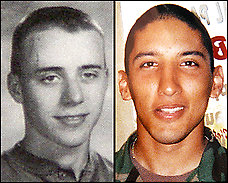
Pfc. Tucker, left, Pfc. Menchaca, right

To the left, Pfc. Thomas L. Tucker, 25, of Madras, Oregon, to the right Pfc. Kristian Menchaca, 23, of Houston, Texas. Both abducted, tortured, and probably beheaded by Muslim terrorists. I was unable to find a photo of Spc. David J. Babineau, 25, of Springfield, Massachusetts, who was the driver of the Humvee in which the three men were on patrol and who was killed in the attack at which the other two were kidnapped.

This is the nature of the enemy the West is up against:

BAGHDAD, Iraq (CNN) -- The bodies of two U.S. soldiers found in Iraq Monday night were mutilated and booby-trapped, military sources said Tuesday. Pfc. Kristian Menchaca and Pfc. Thomas L. Tucker went missing after a Friday attack on a traffic control checkpoint in Yusufiya, 12 miles (20 km) south of Baghdad. The sources said the two men had suffered severe trauma. The bodies also had been desecrated, and a visual identification was impossible -- part of the reason DNA testing was being conducted to verify their identities, the sources said.

An organization which calls itself "Mujahedeen Shura Council", allegedly an umbrella group for AQ in Iraq and four organizations of Sunni terrorists, claimed responsibility for the callous act:

"We announce the good news to our Islamic nation that we executed God's will and slaughtered the two crusader animals we had in captivity," says the claim, reportedly from the Mujahedeen Shura Council, a group linked to al Qaeda. "And God has given our Emir, Abu Hamza al-Muhajer, the good fortune of carrying out the legitimate court's command in person."

Cowards. Sexually frustrated illiterates. 7th-century Wife-Beaters and Child Molesters. Cruel, stupid, uncultivated, unshaven, unwashed Untermenschen and yes, if believe there are occasions when one can use this dreadful word. I'm thinking e.g. of what happened to Wesley Batalona, Jerry Zovko, Michael Teague and Scott Helvenston. I'm thinking of the swine who preferred to self-detonate in the middle of 7- and 8-year old children getting candy from a GI.

America is a nation of 300 million and a GNP of 11 trillion. It fields the world's most awesome military, equipped with state-of-the-art weaponry. It is a beacon for all those who cherish freedom, the "pursuit of happiness" and healthy self-development.

What are you going to do? Are you going to cut and run for cowards who are so spectacularly incapable of beating your troops in face to face combat they have to resort to butchering a few hapless tied up and powerless prisoners? Are you going to cut and run for this vermin, like Murtha and Kennedy want you to do?

Or are you going to stomp these cockroaches to death?

The choice should be obvious.


MFBB.

Saturday, June 17, 2006

ZZZZZZZ.... AUSTRIAN EU PRESIDENCY ALMOST OVER....ZZZZZZZZ.....

We’re almost halfway 2006 now, and who’s nuts enough to read MFBB’s EU posts knows what that means: time for another EU summit!!!

Austrian EU PresidencyYes indeed, one of those fancy EU leadership thingies is that, while legislative power is in the hands of the EU Parliament (just like legislative power in the States is in the hands of Congress), the executive power is shared by two entities: there’s the EU Commission, led by José Manuel Barroso, which has a four year term and which is responsible for the day-to-day decisions, and then there’s the EU Presidency, which rotates among the EU member states in six-month periods, and which is supposed to set out, and implement, the strategic guidelines. During the first half of 2006, Austria had the EU Presidency, as I'm sure you noticed.

(............................)

Hey, come back! I got some nude, uh, new Diane Lane pics yet! It was only a "graptje"! (Flemish slang for joke - MFBB)

Austrian EU PresidencyBut it's true. I’m hitting 41 this summer and have seen already quite some EU Presidencies, but I can’t recall none which was so boring. Appointing Scott McClellan for EU President for six months would have been more fun. And the two-day summit (15 and 16 June) they’ve just concluded the show with in Brussels was just as dull (the photo shows Austrian PM Wolfgang Schluessel , center, with to the left Austrian FM Ursula Plassnik and to the right Commission Chief Barroso). Actually, the only thing that sticks with me about Austria at the EU helm is that poster campaign in January with these larger-than-life photos of Bush, Queen Elizabeth and Chirac fornicating. Btw, QE and Chirac are Europeans, but why Bush? Answer: 21st Century Artists' logic, ya know. The last sane artist, Hopper, dropped dead back in 1967 already. But I digress. The next EU Presidency, till 31 December 2006, is for Finland and judging from their performance at the Eurovision Song Festival, there's hoping the EU won't look like a dead hippopotamus by year's end. Btw, did you know that "Finns" spelled backwards sounds as "sniff"? Mu ha ha ha.

OK, that summit. The 25 were mainly still blathering about the EU Constitution. That is to say, with all the focus that has been on France’s “NON” and Holland’s “NEEN” of last year, you might think the whole of Europe has rejected the Constitution. Well, that’s actually quite far from the truth. In fact, of the 25 member states 13 have already ratified it, while two more are close to ratification. Of course, in a number of countries the Constitution did not pass by popular referendum and the parliaments ratified it. This happened, a.o., in the Union of Soviet Socialist Repooplickers of Belgistania. For me, being an Outlaw, voting was a moot point anyway. Notice that, although a slight majority is thus in favor, only one country’s “NO” is sufficient to stall the general adoption of that dreadful 500-page document as the European Constitution.

Now, if I say “blathering” it’s mainly between two blocs, the bloc which wants to see the EU Constutuon approved asap and move on towards further integration and the bloc which wants to take a break, take a deep breath and consider what to do next. As the situation is now, the EU can expand further to 27 countries, and almost certainly will, by accepting Bulgaria in 2007 and Romania in 2008. After that, there's no legal basis provided by the existing Treaties anymore to allow for further expansion. If you wonder why that should be a problem, well, the existing treaties provide for one Commissioner ("Minister") per country, and so Barroso's Commision (the EU's "day-to-day gumint so to say), is 25 Ministers strong. But apart from Bulgaria and Romania there are still six other countries waiting in the wings: Croatia, Bosnia, Montenegro, Macedonia, Serbia and... Turkey. Since adding six more ministers to the EU Commission would make it unworkable, there's a general consensus already that after Bulgaria and Romania not every country will have an own commissioner. For distributing these key posts among the smorgasbord of nationalities there have to be rules. And these rules have yet to be established. These were some of the topics discussed at this latest summit, utterly boring I guess for non-Europeans, but that's what you get when you try to make work a supranational entity with a lot of fierce egos. It became also clear on this summit that, while accession talks with Turkey have started, the Turks are by far NOT on board yet – phew. Actually, in the most optimistic scenario access is only for 2015 or so, and even then I don’t really see it happen. Barroso said on this summit that "it (Turkish membership) will be a very difficult task". Oh yeah, if there's any Turk out there reading this, you may be interested to know that if someone had asked me back in, say, 1984, whether you guys could come on board, I'd have answered you could right away, no problem. Anno 2006 however, with a closet islamist like Erdogan in power, and the Turkish population already here growing ever more islamist itslef, I say njet, definitely.

Lake Bled, SloveniaBasically, right now I can see only one tangible development, and even then it’s about a real small country: Slovenia, a nation about the size of Israel (20,273 sq. kloms, that’s 7,827 sq miles) and with just under 2,000,000 inhabitants. Capital Ljubjlana. The photo shows the famous Lake Bled, a must see when visiting this tiny but very beautiful nation. More info and nice pics here. Slovenia, not to be mistaken for Slovakia, was the very first republic to break free from the artifical construction which was Yugoslavia, in 1991. There was a brief “war” with about 100 KIA between the young republic and the federal Yugoslav army, but nothing comparable to what went on later in Croatia and Bosnia. Already prior to the rift, Slovenia was the most wealthy part of Tito’s realm, it got through the troubled nineties unharmed, and is today fairly prosperous.

Well, Slovenia will join the so-called Eurozone on the 1st of January, 2007, as the 13th country. It is the first of the 10 new EU members to meet the criteria of the so-called “Stability Pact", which outlines the conditions for access to the Eurozone and thus adoption of the euro as currency (photo shows the biggest note in use, the 500 EUR one. Worth about 600 bucks). To cut a long story short, the Stability Pact states that eurozone members must have a budget deficit of less than 3% of the GDP, a public debt not exceeding 60% of the GDP, as well as low inflation and interest rates. Note that Lithuania’s candidacy for adopting the euro was rejected only because its inflation was considered too high – a bit of a sham, since it was only slightly higher than the benchmark (see also this table). In fact, some neighboring countries supported Lithuania’s bid, as did the European Parliament itself. But the EU ministers of Finance were adamant. Ludicrous imho – the two biggest member states, Germany and France, violated the budget deficit rules last year and were not punished.

Slovenia's current currency is the tolar. Under normal circumstances, the EU Finance ministers will on July 11 establish the exchange rate between the tolar and the euro, and then the Slovenian Central Bank must prepare the task of distributing 155 million euro coins and 42 million bank notes by January 1, 2007. Brings back memories of how our currency, the Belgian franc, was replaced with the euro, some four years back already. One euro was set to equal 40.3399 Belgian francs. The actual replacement, from a technical POV, went quite smooth. Getting used to a totally different money scale is less evident however. To this very day, most Belgians, when confronted with a purchase, especially an important one, mentally do the math and quickly calculate what a euro price stands for in BEF.

Gorenje factorySlovenia has more to offer than postcard images, btw. Finland may have Nokia, but Slovenia has Gorenje. I fear that over there in the States Gorenje is still unknown, but this brand of electrical household appliances is conquering Europe by storm. Its modern main factory, with more than 8,000 employees, is set among rolling hills and cozy villages an hour's drive outside the capital Ljubljana. It churns out more than three million fridges, cookers and washing machines yearly, the grand majority of it for export throughout Europe. Qualitywise it's a match for established values like AEG, Siemens, Bosch, Smeg etc., and they are at the forefront of the altest developments, with brainy washing machines, state-of-the-art steam ovens (all the rage in Eurowonderland now) and so on. Lately they have begun focusing on design too. Capitalism works, you know.

OK. I promised it.


You will agree that it's better to start with the Austrian EU Presidency and end with Diane lane than the other way round. MFBB for Radio DowneastBlogo, Old Europe, over and out.


MFBB.

Tuesday, June 13, 2006

BEATRIX, QUEEN DUMB OF HOLLANDISTAN

Guess the fact that Ayaan Hirsi Ali, the Dutch MP of Somali origin, was as good as expelled from the Netherlands two weeks ago did not go unnoticed on the other side of the Atlantic. Ayaan Hirsi Ali is scheduled to leave for the United States in September, where she will be working for the American Enterprise Institute. If she stays alive long enough, that is. Her new movie Submission 2, on the position of gays in muslim societies, is coming up and some don't like it. Now, if you put your fingers in your ears, shut your eyes and sing loudly LALALALALALALALALALALALA!!!! for about a weekend, you may be able to temporarily restore the illusion that Holland is still just the country where pot smoking gay married couples with children can peacefully pedal along on their bikes over the dykes enjoying the sights of tulipfields, windmills and the likes.

But it gets increasingly difficult, take it from moi.

Not shaking a hand; just handing over Koran and HadithDuring the first week of June the Dutch Queen, Beatrix, widow of the late Prince Claus, visited the Mobarak Mosque in The Hague. With its fifty-one years it's the oldest mosque in The Netherlands. The brand of Islam practiced there is called Ahmadiyya-Islam. Like Shiite muslims, Ahmadiyya-muslims are not allowed to shake hands with women, or even touch them, with the obvious exception of their wives. Women are deemed less than men in Islam you know, and these chaps don't mind showing it. Anyway, in comes Zhe Kween, puts off her shoes and is given a guided tour of the mosque. "Out of respect for the muslim faith" she doesn't shake hands with the Imam or any other male muslim. However, there is still hope to save her filthy kuffar soul since as a consolation prize she is given a fancy leatherbound Koran, see photo. Ladies and gentlemen, this is Holland Anno 2006.

To add insult to injury, the Dutch PM, Jan-Peter Balkenende, praised Queen Beatrix for the “example of religious tolerance” she gave by not shaking hands. How this dork ever got his government so far as to send a light brigade to Iraq is beyond me. He must have been very ill when he pushed for it. As usual, there was but one reaction of sanity among Dutch politicians, when Geert Wilders, the center-right, anti-immigration MP who has by now been living for almost 2 years under round the clock protection from bodyguards, decried in Parliament how "greatly irritated" he had been by the Queen and the Prime Minister, who "under the pretext of tolerance are selling out Dutch values such as the equality between men and women."

Wilders, btw, is a fella who wants to:

* amend Dutch Constitution so that it states that the dominant culture in The Neterlands is that of the judeo-christian and humanistic traditions
* stop the building of new mosques for a period of 5 years
* stop the establishment of new islamic schools for a period of 5 years
* stop immigration for a period of 5 years
* forbid preaching in another than the Dutch language
* introduce minimum penalties (right now "small" criminals get sweets, a porn dvd and are "released" with a fatherly thump on the shoulder and after having promised that they won't never do it again on that day)
* impose more severe maximum penalties
* strongly lower taxes
* strongly reduce the size of government and the whole public sector
* abolish the European Commission and the European Parliament
* stop development aid (not emergency aid however)and abolish all trade barriers with developing countries


Geert Wilders, in the back, with bodyguardsIn short, I gather that if Geert didn't have a name which must sound awful in English, as well as a horrible hairdo (ashblonde, Mozartlike), he could be GOP nominee for the 2008 Presidential Elections. Instead, the man is constantly surrounded by bodyguards since he regularly receives death threats from islamic radicals and extreme leftists, and as a consequence has to live on secret locations. Ironically, one and a half year ago one of these was a modified prison cell in a military camp, Kamp Zeist, a place also used to temporarily house illegal immigrants.

Actually the whole business is too insane for words. There's almost not a week going by without reports of roundups of radical islamic youths, findings of explosives and troubling news of salafist mosques acting as hate factories. Hirsi Ali gets expelled, much to the joy of extreme leftists and islamic organizations. Top rightwing politicians like Jozias Van Aartsen and Rita Verdonk need bodyguards to move about and are driven around in armoured mercedeses. A site like Dutch Disease Report, which was something like a local LGF, is mysteriously shut down. And then Queen Beatrix enters a mosque and won't shake hands with muslim males, thereby acknowledging her own inferiority. In Bending over and Royally lifting the Robe, Beatrix is actually stabbing one of her own ministers in the back: Rita Verdonk, nicknamed Iron Rita, of the pro free market VVD and responsible for immigration and assimilation. Two years ago Verdonk addressed a gathering of imams and when offering her hand to one was greatly insulted since the chap refused to do so because of his faith. Afterwards it became clear that half of the imams attending Verdonks speech did not understand Dutch. On April 26, 2006 the incident was repeated when Mrs. Verdonk, when she wanted to hand out a certificate proving the successful attendance of an assimilation course to the imam of Zoetermeer, again was explained that said imam could not shake her hand because of his faith. Duh. There should be handshaking chapters in assimilation courses.

Paul Belien of The Brussels Journal offers an interesting take when he compares the Dutch Queen's willingness to meet with, and submit to, members of a faith which denounces her own gender as inferior, with her unwillingness to meet with members of Vlaams Belang, the Flemish bulwark against the islamization of Belgium:

In truth this “tolerance” of Beatrix is a sham, which is proved by the fact that in 1982 she refused to visit a group of radical Orthodox Jews because they... refuse to shake hands with women. And there are others whose hands the Dutch Queen will not shake. Politicians from Belgium’s largest party, the Vlaams Belang, learned today that they will not get to see the Dutch Queen during her official state visit to Belgium next month. While in Brussels Beatrix will meet members from all the parties represented in the Belgian Parliament except the VB. This allegedly “far right” party aims for the independence of Flanders, the Dutch-speaking northern half of the country, and many of its members feel Dutch rather than Belgian. However, the VB also opposes the “islamization” of the country and voted against bills legalising abortion, euthanasia, gay marriage and other legislation which the Belgians copied from the Dutch.

Belien is correct. By coincidence, last week a client of mine, who happens to work at the Royal Palace in Laken, disclosed some of the preparations that are being made to make this Dutch Royal Visit to Belgium a success. There will be a huge gala dinner and he estimated the number of guests at 250. That means that not only the Dutch Royals are coming over but the "better" part of Dutch politics as well. In short, it's gonna be a jolly good camaraderie of the fine fleur of Dutch and Belgian royalty and the establisment. The pariahs of the VB are not allowed though.

Thus, no handshaking for Imams out of respect for Islam.
No handshaking either for the VB, but this time out of disrespect for coming up for our civilization.
We are doomed.


MFBB.

UPDATE:

40% of Moroccan youth in The Netherlands rejecs democracy.

A study of the CRES, the Centre for study of Radicalism and Extremism, found that 40 percent of Moroccan youth in The Netherlands reject western values and democracy. Six to seven percent are prepared to use force to defend Islam. The majority are opposed to freedom of speech for offensive statements, particularly criticism of Islam. CRES's Director, Mr. Buijs, said on Wednesday that the government must provide alternatives for Salafism, a contemporary movement in Sunni Islam that seeks a return to the 'pure Islam' of the days of Mohammed. Salafism is a gaining ground in the Netherlands and Buijs said the government must do more to stimulate a more pluralistic form of Islam.

THAT's the answer!!! The government must do more!!! I know what the Dutch government should do!!! Print im-me-di-a-tely millions and millions of assimilation courses!!! Every last one of them to be personally signed by Queen Beatrix!

And, uh, maybe they should not include the shaking hands chapters. Just a thought you know...