First, like I mentioned already in the comments section, the VB (Vlaams belang, Flemish Interest) does make significant gains in virtually every town from the North Sea to the river Maas, and in several cities (Aalst, Lier) becomes the largest party. The results thus far indicate that the VB almost doubles its number of seats in town councils (from 439 to over 800) as well as its number of seats in provincial councils (from 54 to 87).
 In Flanders's big cities, like Antwerp and Ghent, there was a either a status quo (the former) or a slight drawback (the latter). The same phenomenon could be observed in smaller cities with a huge immigrant population, like Mechelen. But especially Antwerp was the focus of national - and international - media attention, since it is the place where the VB originated and since it was considered the main battleground where the VB's strongman Filip De Winter (not the party chief, that's Frank Van Hecke) would challenge the sitting socialist mayor Patrick Janssens. Before October 8, De Winter had indicated he hoped to reach 35% of the vote in Antwerp (in 2000, the party got 33% of the vote). It turned out the VB won "only" 33.5%... while the socialists jumped from 16% to 35%!
Now, the disappointing status quo in Antwerp City is one thing, solid gains all over Flanders are another. To illustrate this, the following table shows the progress the Vlaams Belang made per province (Belgium has five Flemish and five Wallonian provinces) vis-à-vis the previous municipal elections, held in 2000 (in Belgium, there's municipal elections every 6 years):
West Flanders: +7%
East Flanders: +6%
Antwerp: +7%
Flemish Brabant: +6%
Limburg: +6%
Keep in mind that this is a table per province: there is thus also a province called Antwerp, and on the whole and despite the VB status quo in Antwerp City, throughout the province the party chalked up a 7% gain.
But if you had been in Belgium last night and watched TV, the impression you would have got was that VB had suffered a severe setback. There's a saying that Antwerp City, pop. 460,000, is a big village. Yesterday one would have thought that the whole of Flanders was a big Antwerp. The progress made "nationwide" was totally overshadowed by the socialist gain in Antwerp. With the written press it was the same story: the headline of De Standaard, Belgium's main newspaper, screamed "VLAAMS BELANG STOPPED". While actually, it doubled its seats. The headline of Het Laatste Nieuws: "THE BEGINNING OF THE END FOR THE VLAAMS BELANG". Goebbels already said that a lie repeated a hundred times becomes the truth, and from glancing at a few newspaper covers today I got the impression that the regime press studied Goebbels well.
Nevertheless, the admittedly disappointing result in Antwerp deserves to be scrutinized. And then we see an interesting evolution. Check out the following map:

The map shows the nine electoral districts of Antwerp, which by and large are determined by the center and the suburbs. In case you wonder, yes, "7" is the place the Hoboken in Hudson County, New Jersey, is named after. Since in Antwerp the election was basically a megacontest between the VB and the socialists of the SP.a, the map shows which one is the biggest in each of the nine districts, whereby grey has been chosen for socialists and black for the VB (not a coincidence imho). In Antwerp City, "1", the center, the SP.a is biggest. Good. Now look at the periphery: with the exception of "2" and "4" it's all black. So, socialist are biggest in the center, VB is biggest in the suburbs. How to explain this?
1° Well, firstly, as you may or may not know, in 2004 the Belgian State, in one of its many instances of criminal insanity, granted voting rights in municipal elections to immigrants who do not even have the Belgian nationality on the condition that they know what Smurfs are, can tell Belgian fries from French ones and say "merci" upon receiving their monthly 1,000 EUR stipend from Social Security. Since it is a well-known fact that the socialists were the driving force behind these voting rights, it can be safely assumed that those who use these rights voted SP.a.
2° Secondly, there is the impact of the so-called Snel-Belg Wet (Quick Citizenship Bill), rushed through Parliament in 2000 after the previous municipal elections in which the VB, then still Vlaams Blok, also gained considerably. The "Snel-Belg Wet" (literally "Fast-Belgian Law") gives one Belgian nationality on very easy terms, namely:
* remain in Belgium for some time (some = three years, sometimes as less as two years)
* work in Belgium
* be married to a Belgian
Since North African youths who already possess Belgian nationality almost invariably prefer imported, unspoiled (and unassimilated) girls from Morocco, Algeria et al for brides, the Quick Citizenship Bill granted every newlywed young woman from these countries automatically Belgian nationality, and thus the right to vote. No one argued more in favor of this bill than the socialists, who correctly reckoned that the newcomers would in all likelihood vote for them.
3° Thirdly, there's the fact that those Belgians of North African origin who have been here since decades and whose numbers are quickly rising thanks to a much higher feritlity rate, vote overwhelmingly for the left.
4° Fourthly, not only is the fertility rate of the "old" Belgians much lower, since a couple of years they are moving out of the center in droves. Currently, Antwerp Central has a population of 460,000, of which around 120,000 are immigrants, or one quarter, most of them Moroccans. Of the remaining 3/4 of indigenous Belgians, around 4,000 leave each year and their place is being taken by about 5,000 newcomers of foreign origin, mostly from muslim countries (although recently there's been an influx too of East-Europeans). Almost as a rule, the newcomers vote for socialists.
And these dynamics yield the picture above. The "old" Belgians leave Antwerp Central for the (residential) suburbs and bring their political preferences with them, which explains the very high Vlaams Belang scores in places such as Deurne (nr. 5) where the party received a staggering 43.46% of the vote. Or like in Hoboken (nr. 7) where VB also got more than 40% of the electorate behind it. The very good VB results extend even beyond the nine districts. Not visible on the map, but lying immediately alongside the nine core districts, are such towns like Schoten, Boom, Niel, Borsbeek, Willebroek and Stabroek, and here also VB becomes the biggest party.
However, the other side of the medal is that in Antwerp Central the upward dynamic of the VB has (almost) come to a standstill: from 33% in 2000 to 33.5% in 2006. But as we have seen, since over a timespan of six years tens of thousands of potential VB voters have moved out and tens of socialist voters moved in, one can only conclude that the VB must effectively have grown further strongly in Antwerp City - only among "old" Belgians! Indeed, my fellow Flemish blogger Peter, who lives in Antwerp, gathers that 4 in 10 of every "Flemish" Antwerpian might have voted VB. Which, of course, does not detract from the fact that the socialists won significantly, and that this gain has been brought about largely by the immigrant vote. It is a phenomenon which will produce itself exceedingly all over Europe. We have already seen how, on March 7, 2006, the Dutch municipal elections were won by the Left and how the immigrant vote was largely responible for it. In Rotterdam, Amsterdam, Utrecht and Leiden the native population is effectively being ruled by people of Moroccan origin. Antwerp on October 8, 2006, is basically the same story. The Antwerp City Council has 55 seats. SP.a won 22, and 7 of them, or one third, are going to muslim immigrants: Sener Ugurlu, Karim Bachar, Ouardia El Taghdouini, Youssef Slassi, Fauzaya Talhaoui, Fatma Akbas, and Güler Turan. Only Fauzaya Talhaoui is a veteran. The other six seem to have suddenly come from nowhere, a result of the fact that immigrants not only seem to vote SP.a but in particular for their "own" SP.a candidates. This unlike "native" SP.a voters, who will often vote for immigrants out of a misplaced feeling of having to make good for past colonial injustices or whatever. Possibly the best illustration of this select link of immigrant candidates vs. their "own" electorate was offered in the runup to the elections in Gent, another large Flemish city with a huge immigrant population. There a Turkish candidate for the Christian Democrats, Fuat Korkmazer, opted for distributing leaflets uniquely in Turkish. Hooray for assimilation and the multicultural society!

Notice how the Belgian flag (Black/Yellow/Red) flows over in the Turkish one. If you visit the site of US Congressman Bobby Jindal, who is of Indian origin, which flag do you see up there? Yeah, that one. So, where do you think Mr. Korkmazer's principal loyalty lies, hmmmm? Interesting to know too is that Mr. Korkmazer was chairman of Gent Türk Ocagi, an organization with strong ties with the Turkish racist and fascist organization of the Grey Wolves. When news leaked out in the local Gent press, Mr. Korkmazer first denied his membership (of the Grey Wolves), then stepped down as chairman of Gent Türk Ocagi. It is interesting to notice that this sympathizer, if not member, of the Grey Wolves chose to be a candidate for the Christian Democratic CD & V. Pope John Paul II's would be assassin, Ali Agça, was a former Grey Wolf.
In Brussels, although the situation is more complicated there by the Flemish/Walloon antagonism, the situation is nevertheless comparable. Here too, not only is the number of immigrant councillors steeply on the rise, but also they tend to belong to the left. As Paul Belien from The Brussels Journal reports:
The Brussels borough of Sint-Joost-ten-Node (where the party headquarters of the Vlaams Belang party is located) has 19 councillors of non-European origin on a total of 27. Eleven of the 16 Socialist councillors in Sint-Joost are non-European immigrants, as are 4 of the 5 Christian-Democrats, 2 of the 3 Greens and 2 of the 3 Liberals.
...
Exactly 50% of the Brussels electorate are either foreigners or naturalized Belgians. Six years ago the figure was only 32%. In Antwerp, where 17% of the electorate are immigrants (11.5% in 2000), one third of the Socialist councillors are Muslims. In Ghent, where 12.6% of the electorate is foreign (8.1% in 2000), one quarter of the Socialist councillors are Muslims. In Vilvoorde, a Flemish suburb of Brussels, where 14.8% of the electorate is foreign (9.3% in 2000), half the Socialist representatives are Muslims.
Now, one could rightfully argue whether dominance, or indeed only a strong presence, of "new" Belgians in Belgian politics necessarily needs to be a bad thing. And my answer is: it doesn't. Or rather, it wouldn't have to be. It wouldn't have to be, if only the newcomers would subscribe to the Leitkultur here, which, despite the obvious drawbacks, still gets Belgium ranked among the world's foremost societies. Belgian industry may not produce things with ringing names like Sweden's Volvo, Saab or IKEA. But small as it is, our little country does produce an awful lot more than beer and chocolate. There are satellite and cyclotron and train builders here, there is top-notch pharmaceutical industry, and there is a powerful car and petrochemical industry. Some Belgian companies create huge artificial islands in the Persian Gulf on which superrich oil sheikhs erect cities, others build technology for integrating laptops in the world wide web. If you computer uses DSL, that was invented here! And why is that? Because our entrepreneurs still have the old zip. Because modest, low profile businessmen from small localities like Dendermonde somehow manage to secure contracts with the South Korean Army. Because our workforce by and large (especially the Flemish part) takes pride in delivering a tough and good job. Because our ways of dealing with each other, either in everyday life or in business, are still ruled to a large extent by old-fashioned, christian-inspired notions such as decency, reliability, honesty.
All this is not meant to denigrate the abilities and ways of other peoples who have come to my country. But we have to face the naked fact that our immigrants are mostly muslims, come mostly from arab countries, and vote overwhelmingly for the left. There is a reason for that. After the end of colonial rule, the arab countries almost without exception embraced socialism as the economical doctrine. Socialism applied without religion is bad enough, see the USSR. But when it is mingled with Islam, it will kill your country's economy. That is why anno 2006 the 22 muslim countries in the Middle East, with 270 million inhabitants, produce about as much as 5 million Finns, if you discount the oil. Somehow, the many millions of Algerians, Moroccans, Egyptians, Tunisians, Syrians and what not who flocked over the decades to Europe, failed to see the connection between the deadly combination of the socialism of their Nassers, Ben Bella's or Assads and their religion. Once in Europe they were showered with all the surplus welfare of our modern and rich societies, and the fact that the state was taking care of them and took responsibility out of their hands must have seemed normal, since where they came from the State had been omnipotent too. It may be one reason why muslim immigrants vote so massively for Europes socialist parties. But in the end, the net effect for Europe threatens to be the same. Already, the economic contribution of muslim imigrants is a mirror image of what passes for economy from Rabat to Baghdad: economies overwhelmingly based on trade with very little real production. Think, e.g. of countless small companies doing nothing but buying secondhand European cars and shipping them to the Middle East. Think of eateries and carpet shops. Of course, there is nothing wrong with that. But while that kebab shop around the corner may indeed be an enrichment for Belgian gastronomic diversity, the lack of muslim companies producing anything more complicated than stools or tables can hardly be described as an enrichment for economic diversity.
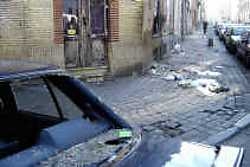 And so it is with sadness that I see the current developments. The Left, traitors as they have always been when faced with bullies, do not even hide anymore that they are after the immigrant votes NOT because they care so much to reach out for them. It is about power, nothing less. Stayin in power. How do you stay in power when your traditional electorate dumps you? Simple: you usher in newcomers, give them rights, pamper them with free housing and positive discrimination and the only thing you ask in return is that their vote. It works. We see it in Rotterdam, Amsterdam and Leiden. We see it in Antwerp, Gent and Brussels. We see it in Londen, Leeds and Birmingham. What we are seeing is that instead of us implanting Middle-Easterners in European economy, it's them implanting Middle-Eastern economy in Europe. Still, Europe can kid itself it's on a par with the US and Japan. But in twenty years? That magnificent Mercedes 280E you buy today is still the work of bright German engineers. But their hairs are silver, and their heirs increasingly scarce. I don't like to say it, but Europe obviously cannot count on Moroccan or Algerian engineers. Twenty years ago I was an engineering student in Gent. In my seven years of study, during which I held class with possibly three hundred different individuals, I have known only two muslim colleagues. The first one did not even make it past his first year. The second was indeed very intelligent and a computer whiz kid. But all in all, one has to conclude that so far, the muslim community among us has shown a spectacular ability to not contribute technical novelties in what is supposed to be the space age.
The Belgian municipal elections offer us an interesting glimpse into the future. A future with bipolar societies. In the cities, a large, miserable immigrant body asking itself why it finds Brussels 2025 not so different from Cairo 1965. Out in the country, an ageing local population angry and desperate over the loss of their country's prosperity, bitterly lamenting the fact they ever thought a limitless and conditionless immigration could ever solve their problems. Bitterly lamenting the fact they were so unbelievably foolish to once scold for racists, xenophobes and hatemongerers, those who saw what was in the making decades earlier.
Yesterday, I noticed an article in Gazet Van Antwerpen in which a certain Jan Hertogen, Sociology Professor and Professional Lunatic, had the following to say about the so-called defeat of the Vlaams Belang:

"The VB has only stalled in cities with a lot of Belgians of foreign origin. Eighty per cent of the inhabitants of foreign origin in the big cities have used their voting rights and stopped the extreme right. Therefore, it's the immigrants who have saved democracy."
Weep Europe. Weep.
MFBB.
 In the 308 communes of Flanders, the northern, Dutch-speaking part of Belgium, 4,648,649 people will head to the ballot box. Together, they will elect 7,350 town council members as well as 411 provincial council members, out of 31,906 candidates. For those of you who are interested in such matters, if you follow
 One week ago, in an effort reminiscent of the 2003 Rock The Vote Tour performed by a Moooooooooooo-ron in the U.S.AAAAAA---, Tom Barman, a Flemish "rocker" as red as Che Guevara is dead, orchestrated the so-called


 For at least three consecutive nights there has been heavy rioting in the Marollen, an old neighborhood near the Palais de Justice in the centre of Brussels. At this moment, Thursday night, things seem to have calmed down but the incidents show once again that every European community with a fair number of North African, read muslim immigrants, is a potential powderkeg needing very little to go off, see also the
 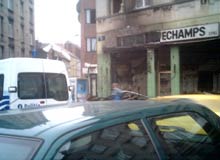 On Monday night 25/26 September tens of Moroccan youths (I know, actually they are Belgian youths but since the authorities keep referring to Vlaams Belang voters as SS Einsatzgruppen, shit, why not play the game) ventured out in the Marollen,
  Apparently having become smarter, the representatives of the Brussels City Council this time made no rendez-vous to listen to the youth's grievances come Wednesday evening. And goddam right they were, for as far as I know, apart from the usual innocent passers-by stone-pelting, café-burning, carglass-busting,
 That is why Mr. Reinfeldt in his bid for PM decided to take a different course than his predecessor Bo Lundgren, held responsible for the Moderates' disastrous 2002 showing, and instead of hammerring upon less taxes and regulation chose to emphasize small pro-business adjustments and a soft approach for reforming social security. In fact Reinfeldt did not rock the boat and even beat the Social Democrats on their own turf. Personally, I have reluctantly come to agree that this is the best way for rightist parties to regain power in Europe. A series of small incremental steps intended to streamline social security and in the process regularly confront the electorate with the (necessary) fait accompli. Reform is needed, but it has to be done stealth mode so as not to lose control again to the socialists at the first occasion. Using this technique, Germans are right now getting slowly accustomed to the knowledge they will have to work till 67. If a rightwing party would trumpet that out loud, it would be kicked out in no time.
 Some quick country facts: Sweden's consolidation as a nation happened fairly early for European states, namely in the 12th Century, and perhaps not coincidentally with the Christianization of the country. In 1389, Norway, Sweden and Denmark formed one unity under one monarch through the Union of Kalmar, but in 1521 King Gustav I of the House Vasa broke with that union and laid the foundations of the Sweden as we know it today. In the 16th and 17th centuries Sweden was despite its small population of approximately 2 million, one of Europes superpowers, and its most famous characters from that era are Gustavus II Adolfus who fought (and died) in the Thirty-Year War, and Charles XII who famously invaded Peter The Great's Russia but in the end was utterly defeated at Poltava in 1708.
 In the 19th century, the two most relevant socio-economic phenomena to occur in Sweden were massive emigration to the US (an estimated 1 million between 1850 and 1910) and industrializaton (from 1870 on). In the 20th century, Sweden managed to stay neutral in both world wars, and after that latter conflict acquired worldwide fame with quality automotive and aeronautical products. During the Cold War it remained nonaligned, and it only joined the European Union in 1995. Today, Sweden, with capital Stockholm, has a population of app. 9,060,000, which on a surface of 449,964 sq km (173,732 sq miles) still translates in a very low (average) population density for European standards. In 2005, its GDP was estimated at $268 billion. The colours of the Swedish flag are yellow and blue. If you look closely, you can discern a woman on the photo. Rumor has it that one in every two Swedes is a woman. Before you pack your coffers for Stockholm, keep in mind that


 Mons, pop. 91,000, is quite an amiable place with a picturesque town centre and a fair share of beautiful historical buildings. While there's little industry, it is important as an educational centre since there are a lot of colleges and a university. It is also the centre of the Borinage region, and old coal basin lying along the French/Belgian border. In early September 1944, that border was crossed en masse by rapidly advancing US units which had just all but destroyed a huge body of German armor and infantry in the notorious Falaise pocket in Normandy, France. The photo to the right shows the very first GI to cross the border, PFC James W. Carroll, a scout of the 628th Tank Destroyer Battalion, on his trusted Harley Davidson WLA. Because 3rd Armored had more WLA's in service (some 300 plus) than Shermans, it could be argued that the Spearhead should rather be called the 3rd Armored Hell's Angels division! Actually, Tanks in Town is also made possible by the

 People from our age, used to seeing fast moving tanks in newsreels and war movies, have a tendency to dismiss the effects of armoured warfare and indeed may not grasp what a tremendous advantage he, who uses combined arms properly, has over he, to whom warfare is adjusting your front like a child would arrange his toy soldiers and model tanks. A couple of the latter here, a cannon there, a sole tank somewhat further, then an antiaircraft battery, finally the whole interspersed with infantry. The innocent reader who pores over handy stats in his newspaper comparing the strenghts of opposing armies may assume, because party A has much more troops and much more tanks than party B, that the former's victory in case of conflict is guaranteed. Not at all! Of equal, if not greater importance, is how you properly use your military potential. Few people realize that at the beginning of WWII Britain, France, Belgium and The Netherlands had actually more boots on the ground and more tanks than Nazi Germany. But in May 1940, the numerically inferior Germans truly revolutionized warfare. Panzer divisions were acting independently from infantry formations or, indeed, had their own infantry moving along with them in armoured personnel carriers, travelling at the same speed. Thanks to radio, tank commanders could interact with their subordinates, directing platoons here and there, ordering the whole formation to at once turn left or right, even call in pinpoint artillery barrages from mechanized (!) artillery or airstrikes from the ever present Stukas – divebombers – buzzing overhead. These dreadful planes could perform precision hits by releasing their deadly charge within meters of the designated target, and had a "net" effect roughly comparable to an F-16 performing a precision strike. Fuel, ammo, all kinds of supplies were flown in on captured airfields right behind the advancing panzer juggernaut. All of this required top-notch logistics, which the Germans mastered just as well. In short, the German armor, infantry, artillery, and airforce acted unisono. In 2006 codespeak, they were networked. Opposing the Germans were the combined armies of British, French, Belgians and Dutch – with outdated equipment, lacking tactical doctrines, lacking essential communication between ground units and own planes flying overhead, finally, when seeing the strength and ability of the enemy, lacking conviction. In 2006 codespeak, their computers were 80's AT’s and they exchanged info by distributing floppy disks. In ten days, the Germans traded their border for the French coast at Calais, a feat they had not been able to produce in four years during World War I. It was a lightning war indeed. Three and a half weeks later, half France lay down in tatters and Belgium and The Netherlands were completely occupied, while a shocked Britain was anxiously awaiting a German invasion.

 Dang, there you have it. Amir Peretz, a socialist as Defense Minister. Tell me all about it. In Belgium, for some reason the post of Defense Minister goes in 9 out of 10 cases to the Parti Socialiste, and the result is that over the past three decades the Belgian Army has morphed into a cross between the Boyscouts and The Waltons. Then we have PM Ehud Olmert. Yeah, I heard all the excusing stuff that he truly is a military figure since he served in the Golani Brigade. He may have deserved the Israeli equivalent of a Purple Heart for injuries to his arm and leg, but after all he completed his military duties as a war correspondent for the IDF magazine Bamahane. And about that later stint in the IDF, that 1980 reserve officer course: he was already a MK then, so I guess that episode wasn't exactly
 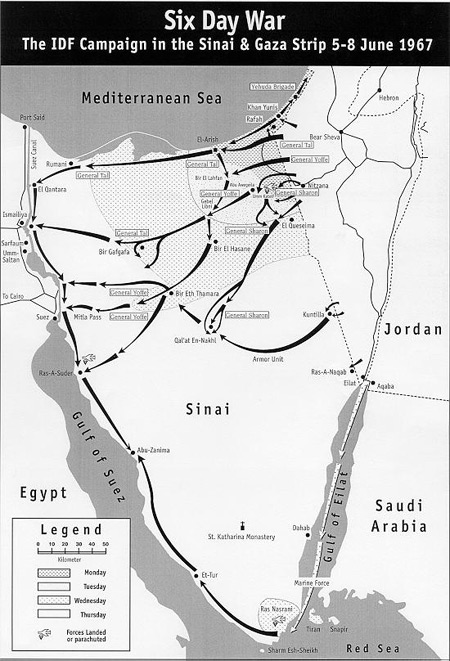 But when faced with real soldiers it's always the same song, and this kind of stories goes a long time back, even beyond the time when the banner the adversary was gathering under was not so much islamism as it was pan-arabism. Consider the map of the


 What kind of a "Belgian government website" is Mr. Belien talking about? It's
  Cyberhate is an initiative of this CEOOR organization, an outfit with far-reaching powers, able to invoke Belgium's notorious Anti-Racism Law, and directly responsible to the Belgian government. CEOOR is led by Jozef De Witte, a radical leftwing apparatchik who - what a coincidence - happens to be the brother of the socialist governor of the province of Flemish Brabant, Lode De Witte. When one scrutinizes the careers of people like Jozef De Witte, one is always struck by how these creatures manage to secure fancy posts with resounding titles which have little or nothing to do with decent management but everything with nasty tutelage.
 One of the more "memorable" initiatives developed by 11.11.11 with De Witte at the helm was the
 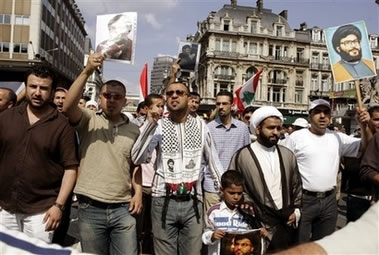 While the predecessor of the Vlaams Belang, the Vlaams Blok, was outlawed, while the Belgian government tries to dry up the financial resources of the VB, while Belien has to shut up and while Féret has now less rights than Sharia-practicing muslims in Molenbeek, sympathizers of Hizballah have come out TWICE in Brussels over the last ten days, namely on July 30 and on August 6, the last time with an 8,000 strong demonstration. More info on Flemish site