Sunday, January 29, 2006

BUY DANISH PRODUCTS!


Denmark Danmark National Flag


QUESTION: To what extent has Islamic extremism already limited freedom of expression in the Western World?
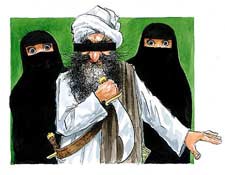
In case that, despite the tremendous bruhaha over the Danish cartoon issue since fall 2005, you still missed the crux of the matter, here follows a short overview. Last summer, a Danish writer complained that he could find no one to illustrate his book on Muhammad (MHBC). The Danish daily Jyllands-Posten thereupon held a contest for twelve illustrators to draw the prophet. Now, as you probably know, depictions of Muhammad are forbidden in Islam. JP’s editor, Carsten Juste, explained this contest as an attempt to determine to what extent Islamic extremism has already limited freedom of expression in Denmark (and for that matter, Europe). On September 30, the twelve cartoons were published. You can see them here if you scroll down. The story has gotten such an awful lot of coverage that I will simply limit myself to the reactions, where possible with links, from the Muslim World and their western apologists. So here goes:

A 17-year old "youth" of "non-Danish origin" was arrested in Arhus for death threats by telephone against the cartoonists immediately upon publication.

On the insistence of the Danish Intelligence Service PET (Politiets Efterretningstjeneste) two of the twelve cartoonists had to go undercover. Jyllands-Posten itself came under constant surveillance from security agents after bomb threats.

On October 14 in Copenhagen a demonstration was held by 3,500 Muslims to protest the publication.

Muslim organizations in Denmark demanded apologies from Jyllands-Posten.

A Danish imam, Raed Hlayhel, upon being explained that freedom of expression is one of the basic tenets in a democracy, stated: "This type of democracy is worthless for Muslims. Muslims will never accept this kind of humiliation. The article has insulted every Muslim in the world."

Eleven ambassadors from Muslim countries, a.o. Iran, Indonesia, Bosnia, Egypt, Pakistan and several arab countries, wrote Danish PM Anders Fogh Rasmussen a formal complaint brandishing the cartoons’ publication a "provocation" and demanding apologies from the newspaper.

On the website of the "Glorious Brigades in Northern Europe", an extremist Islamic organization, a demo showed bombs exploding over pictures of Jyllands-Posten and blood flowing over the Denmark’s flag. "The Mujahedeen have numerous targets in Denmark – very soon you all will regret this." the website said.

Sixteen Muslim organizations asked judicial experts whether the publication of the drawings could be classified under Danish law as blasphemy.

The eleven ambassadors took the matter to international Muslim organizations such as the Arab League and the Organization of the Islamic Conference.

10° The Turkish ambassador asked Rasmussen to call Jyllands-Posten to account for "abusing Islam in the name of democracy, human rights and freedom of expression."

11° At te beginning of December, the Danish Foreign Ministry warned its citizens not to travel to Pakistan.

12° The Pakistani religious party Jamaat-e-Islami and its youth branch offered a bounty of 50,000 Danish crowns (6,725 euros) for anyone who would murder the Danish illustators who drew the Mohammed cartoons, plus demanded that all Danish diplomats be expelled from Pakistan. The Danish embassy in Islamabad received hundreds of angry protest letters.

13° In a scandalous gesture of dhimmitude Louise Arbour, UN Commissioner for Human Rights, sent a memo to the Organization of the Islamic Conference (OIC) saying: "I understand your concerns and would like to emphasize that I regret any statement or act that could express a lack of respect for the religion of others."

14° On December 8, 2005, shops and and companies in most parts of the Kashmir Valley were closed to protest JP’s publication of the caricatures, three months earlier. This strike was called upon by the separatist Hurriyat Conference Group led by Syed Ali Geelani, but the Kashmir Bar Association and other groups also supported the shutdown.

15° "Most Muslims feel deeply affronted", said Abdur Rasheed, editor-in-chief of the newspaper Kashmir Observer. The Jammu and Kashmir Liberation Front (JKLF) said in a statement that the Danish editors "by resorting to such acts have given enough evidence that they are against Islam."

16° In mid-December, the UN’s Muslim members gathered this week in Mecca for a meeting of the 56 member states of the Organization of the Islamic Conference (OIC) and unanimously condemned the publication of the cartoons.

17° Instead of standing by the courageous Danish government's decision that the complainers should take their case to the court, the Council of Europe (CoE), an organisation of 46 European countries, criticised the Danish government for invoking the "freedom of the press" in its refusal to take action against "insulting" cartoons of the Prophet Muhammad. The CoE Committee of Ministers discussed the case during a meeting in Strassburg last week. In a statement the Committee said that "a seam of intolerance" is noted in certain Danish media – a reference to the Danish cartoon case.

18° Egypt cut off its talks on human rights with Denmark while the Egyptian Grand-Imam Muhammad Said Tantawy condemned the Danish government. Tantawy is the religious leader of Egypt, appointed by the Egyptian president, and chancellor of the prestigious al-Azhar University, one of the Sunni Muslims’ most important centers of learning. Turkish Prime Minister Recep Tayyip Erdogan criticised his Danish colleague during bilateral talks last month.

19° Following in the footsteps of the UN's Louise Arbour and the CoE, Franco Frattini, the Vice-President of the European Commission, called the publication of the twelve cartoons "thoughtless and inappropriate" in a time when animosity towards Islam is on the rise. According to Frattini, the EU Commissioner for Justice, Freedom, and Security, the cartoons foment hostility against Islam and foreigners: "Honestly, these kinds of drawings can add to the growing Islamophobia in Europe. I fully respect the freedom of speech, but, excuse me, one should avoid making any statement like this, which only arouses and incites to the growing radicalisation."

According to Robert Spencer the EU reaction shows that the EU recommends dhimmitude: "Instead of praising Rasmussen for his defense of Western values of free speech, the EU is demanding that he stand down and adopt their policy of appeasement."

20° An influential Islamic organisation, the Islamic Educational, Scientific and Cultural Organization (ISESCO), has called upon its 51 member states to boycott Denmark unless the Danish government "presents an official apology for the drawings that have offended the world’s Muslims."

The ISESCO's Director General stated a.o.: "On the basis of the said objectives, I request you, dear PM, to protest in the manner you deem appropriate against this newspaper as well as against every other information means in your country that damages the image of Islam and Muslims, following in that the policy of tolerance that rejects the contempt of religions and the profanation of religious sanctities in which believe a billion and a third people on this earth."

21° On December 29, Foreign ministers from the 22 Arabic League nations criticised the Danish government on Thursday for its actions following daily newspaper Jyllands-Posten's decision to publish twelve drawings of the prophet Mohammed. The foreign ministers also decided that the league's secretary-general, Amr Moussa, and secretary-general for the Islamic Conference, Ekmeleddin Ihsanoglu, would take up the issue with the Danish government.

22° Towards the end of December some imams, Muslim intellectuals and representatives of Muslim organizations in Denmark visited a number of Muslim countries to "explain" the matter to local political and religious leaders and media. Their "explanations" were biased and inaccurate. The Danish-Egyptian Dialog Center in Cairo says that after meeting with the Muslim representatives from Denmark the Egyptian press claimed that Danish newspapers were waging a campaign against Islam, that Copenhagen planned to introduce a state censored version of the Koran, that a Danish film was underway "to show how horrible Islam is", and that the matter involved 120 cartoons – not 12. Muslims know a thing or two about lying and cheating.

23° Danish Prime Minister Anders Fogh Rasmussen subsequently was shocked at the way in which some Muslims misrepresented Denmark in the Islamic world. "I am speechless that those people, whom we have given the right to live in Denmark and where they freely have chosen to stay, are now touring Arab countries and inciting antipathy towards Denmark and the Danish people." Rasmussen told journalists.

24° After the rejection of their complaint by the public prosecutor, Danish Muslim organisations announced that they would take Jyllands-Posten to the European Court of Human Rights over the controversial publication.

25° On January 10, 2006 the 12 cartoons were published in the Norwegian Christian newspaper Magazinet "in support of the freedom of expression." "We are ourselves a nation that has been exposed to increasing Muslim violence against freedom of expression" said Vebjørn K. Selbekk, the editor of Magazinet, and referred to the 1993 murder attempt on Willam Nygaard, the Norwegian publisher of Salman Rushdie’s Satanic Verses. Consequently, Selbekk said, Norway has a special responsibility to confront this problem, adding that Norwegian illustrators were tending towards the same self-censorship as their colleagues in Denmark, not daring to depict Muhammad for fear of a violent Muslim reaction.

Magazinet immediately started receiving threats via e-mail from around the world. Among them, sent anonymously through a popular e-mail service in the Middle East, was mailed to Selbekk, simply stating: “You’re a dead man!” Other Magazinet staff members also received threats. According to Selbekk, it looked as if the newspaper’s e-mail addresses were being distributed in an organized manner. One of the e-mails contained a couple of pictures showing a burnt body, sent through an e-mail address in France.

26° By the end of the year, the Danish tabloid Ekstra Bladet got hold of a 43-page report that Danish Muslim leaders and imams, on a tour of the Islamic world, handled out to their contacts to "explain" how offensive the cartoons are. The report contained 15 pictures instead of 12. The first of the three additional pictures, which are of dismal quality, showed Muhammad as a pedophile demon, the second showed him with a pigsnout and the third depicted a praying Muslim being raped by a dog. Apparently, the 12 original pictures were not deemed bad enough to convince other Muslims that Muslims in Denmark are the victims of a campaign of religious hatred.

Akhmad Akkari, spokesman of the 21 Danish Muslim organizations which organized the tour, explained that the three drawings had been added (!) to "give an insight in how hateful the atmosphere in Denmark is towards Muslims." Akkari claimed he did not know the origin of the three pictures, and said that they had been sent anonymously to Danish Muslims. However, when Ekstra Bladet asked if it could talk to these Muslims, Akkari refused to reveal their identity.

27° The Islamic World Association condemned the Norwegian papers that published the cartoons, and asked the Norwegian government to intervene.

28° An international organization of Muslim intellectuals has threatened to mobilize "millions of Muslims all over the World" to boycott Danish and Norwegian products unless the Danish and Norwegian government condemn the publication of the cartoons, which is called an "attack on the Muslims of the World and on the Prophet." In the meantime, in Saudi Arabia people receive e-mails and sms messages urging them to boycott Danish products "until Denmark offers an official apology." The Organization of the Islamic Conference protested last week’s publication of the cartoons in the Norwegian paper Magazinet. The Iranian Embassy in Oslo said "that freedom of expression cannot justify publishing the cartoons."

29° It is typical for leftwingers to side with dictators and oppressors, so it came as no surprise that Norway's extreme left-wing government apologized to Muslims worldwide for the publication of twelve Muhammad cartoons in the Norwegian newspaper Magazinet. Oslo sent out instructions to all Norwegian embassies on how to respond to queries about the cartoons. Unlike the Danish government, the Norwegian government is apparently not concerned about safeguarding the right to freedom of expression.

30° Saudi Arabia called its ambassador to Copenhagen home for "consultation in light of the Danish government's lack of attention to insulting the Prophet Muhammad by its newspapers." In Saudi Arabia there are now calls to boycott Danish products in Friday prayers and on Saudi television and in newspapers, and some Danish companies are already losing customers. A number of stores are labeling Danish products with yellow markers to indicate they come from Denmark.

31° KUWAIT CITY - (AP) -- Kuwait's state-supported supermarkets on Saturday announced a boycott of Danish products, and the Foreign Ministry called in a regional Danish ambassador to protest caricatures in a Danish newspaper that have been deemed insulting to Islam's prophet.

32° In Bahrein MPs are calling for a boycott on Danish and Norwegian products over offensive caricatures depicting Prophet Mohammed, published in their countries. The Al Asala and Al Menbar Islamic Blocs have urged supporters to gather after Friday prayers for demonstrations all over the country, in condemnation of the caricatures. Representatives from all parliamentary blocs also signed an urgent request for an extraordinary session to discuss the issue, after meeting at the National Assembly Complex in Gudaibiya. Al Wefaq National Islamic Society, Bahrain's biggest political group, has issued a strong statement demanding that the Danish government apologise.

33° In Baghdad, Iraq, between 500 and 1,000 protestors took to the streets to demonstrate against the Danish cartoons. Never mind dat Danish peacekeepers are doing their part in securing a part of Iraq's south.

34° TRIPOLI - Libya said on Sunday it had decided to shut down its embassy in Denmark to protest against the Danish government’s silence about newspaper cartoons offensive to Islam. The Libyan Foreign Ministry added in a statement carried by the state news agency Jana that Tripoli will also take unspecified "economic measures" against Denmark.

35° The UAE yesterday condemned the publication in a newspaper in Denmark of cartoons depicting the Prophet Mohammad (PBUH), which have sparked a wave of denunciations and boycott of Danish products across the Muslim world. The publication of the offensive cartoons could spark "a dreadful clash of civilisations," said the UAE Minister of Justice, Islamic Affairs and Awqaf, Mohammad Nakhira Al Daheri.


ANSWER: Very simple.

STOP MUSLIM IMMIGRATION IN WESTERN COUNTRIES. STOP MUSLIM IMMIGRATION IN WESTERN COUNTRIES.

STOP MUSLIM IMMIGRATION IN WESTERN COUNTRIES. STOP MUSLIM IMMIGRATION IN WESTERN COUNTRIES.


MFBB

Pics and most info via the excellent The Brussels Journal, the Voice of Conservatism in Europe. Danish Flag via Free Webmaster Tools.

Saturday, January 21, 2006

BELGIAN DHIMMITUDE WATCH


Nah. It’s not him. It’s a fake. It’s an "artwork" by Czech "artist" David Cerny, representing Iraq’s National Leader in a Damien Hirst pose. Hirst, you may or may not recall, is another artsy fartsy dork who first used this configuration with a real shark on formaldehyde in 1991.

In my not so humble opinion Cerny, Hirst et al are complete nutters. However, they have the goddam RIGHT to display their trivia if they can find even nuttier guys willing to finance them. One of these chaps is Willy Van Den Bussche, curator of the Arts Festival Beaufort 2006, to be held this year in Middelkerke, a Belgian coastal town. During the event, Cerny’s work Shark was meant to be placed in the Dronkenput Museum.

Well, it ain’t gonna happen. Middelkerke’s mayor, Michel Landuyt (VLD), has declared that Shark is NOT welcome on Beaufort 2006. The reason? Mr. Landuyt says that a Saddam Hussein on formaldehyde is better not exposed because:

"...the population is not enchanted with such a display". Furthermore Mr. Landuyt is of the opinion "that the work is not exactly sensitive" and he "fears that certain population groups might find it offensive. You never know what could happen if you put up such explosive items."

In short, Mr. Landuyt’s underwear has turned smelly, yellow and maroon because he’s afraid putting up an imaginary explosive item might well provoke a real one. Now, what struck me in Mr. Landuyts explanation is that he thought the display "was not exactly sensitive". Ahhhh, us sensititive Europeans!!! He has a point you know. After all, Mr. Hussein was FOR THIRTY-FIVE YEARS the Legitimate President of Iraq, he had tens of palaces, he was a worthy successor to the great Nebuchadnezar and so on! True, to put an effigy of such a dignified man in an aquarium, with only underwear on... That’s so... crude, you know. That’s so... repulsive!!! Ok, now and then he may have exaggerated a little, see that slightly sensitive pic to the right, but hey, we all act a little overheated now and then, don’t we?

Life in Belgium for MFBB TM types is weird. Half of the time you walk around dazed and confused, on the brink of asking yourself if you are mad or if it's the others. Mostly, I tend to lean to the latter possibility. Take that abovementioned fella Willy Van Den Bussche e.g, czar of that Beaufort 2006 farts eat, wooops, arts feat. Upon learning of Landuyt’s decision to scrap Saddam The Shark, Mr. Van Den Bussche had the following to say:

"When this started out, Mayor Landuyt was very enthusiastic about the artwork, but I do somehow understand his present reaction. Apparently some people from the neighborhood have complained and Saddam has here and there provoked angst reactions. We are, after all, in an election year. That he has reversed his opinion, will likely have political motivations. It’s just that it’s a pity that he does not understand that this work has to be seen in its artistic context. Artist David Cerny is very politically engaged and with "Shark" wanted to question American policy too. Saddam is precisely the thought-provoking element with which Cerny wants to denounce political situations."

Apart from the fact that I fail to see what exactly is the logic behind criticizing US foreign policy by displaying Iraq’s former national leader half nude in a fishbowl, it’s clear to me that like all artsy fartsy types Mr. Van Den Bussche has a low opinion of Amerikkka. You can bet on it that the good curator thinks the real danger in the world comes not from extremist Islam but from Christian fundamentalism, the real madman is not Ahmadinejad but the Bushitlerchimp, and the real terrorists are not suicidal islamonuts but American soldiers. The pic to the left shows just two of those evil legionnaires, instruments of US foreign policy, doing... yeah, what? I can’t exactly figure out what these heaps are they are looking at, but in all likelihood it must be part of some questionable US policy. It’s certainly thought-provoking, and to arrogantly trample around like that in a country where they have no business, well, that's indeed a denouncable political situation.
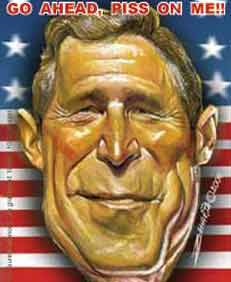
So, is Sharky Saddam a goner then? No. Not yet anyway. Plans are now to transport David Cerny’s masterpiece to the neighboring city of Oostende, where it will be displayed in the Museum of Modern Art. I am sceptical however. Oostende is the hometown of Johan Vande Lanotte, former Budget Minister and now Chairman of the SP.a, the Flemish Socialists. No one farts in Oostende without Johan getting a whiff of it. And one of Mr. Vande Lanottes cabinet subordinates happens to be a certain Laurent Winnock, amateur artist if you like, who last year during his working cough cough hours, designed and produced Bush Piss Stickers, see pic below, to be distributed by the thousands in Belgian cafes at the occasion of the President’s visit to Belgium.

To paraphrase the mayor of Middelkerke, at the time I didn’t think this sticker action was very sensitive either but the thing nevertheless went ahead, designed and planned in the Cabinet of the Belgian Budget Minister. No objections from the neighborhood, and apparently there was no fear for an explosive reaction of pissed off Americans either. Isn’t this a marvellous country? People here just know when is the time to show some guts!


I know Beljun politics, so I think there’s a good chance that Mr. Vande Lanotte decides that Saddam floating in his formaldehyde tank is a too sensitive issue for Oostende, given the presence of certain population groups and so on. Therefore, let us terminate with two artworks which, imho, are at least on a par with the finest of David Cerny’s work. Enjoy!


Yee-haw!!!


MFBB

P.S.: shark and Bush piss sticker pics from Luc Van Braekel's blog, mass graves pics from this site. Forgive me.

Sunday, January 15, 2006

THE GREATEST BELGIAN EVER...

Believe it or not, but one of the more charming competitions among European nations lately was to choose their greatest national ever. The Brits evidently chose Winston Churchill, a sane choice if ever there was one, the Germans a certain Austrian corporal Konrad Adenauer, successful post WWII Chancellor, the French somewhat mysteriously elected an airport (it's called CDG! Bwahahahahahaaaaa, those funny Fwench!!!), the Dutch, in another embarrassing sign of having-lost-the pedals, chose Pim Fortuyn (the man’s merits as whistleblower notwithstanding), the Finns Marshal Mannerheim, their strong but controversial WWII-leader, and the Belgians...

… well, not surprisingly, the Belgians couldn’t decide on their greatest one so they chose two of them!

How come? Well… in 1913 already, Jules Destrée, a forceful advocate of an independenent Wallonia famously remarked to King Albert I:

"Your Highness, there are no Belgians. There are only Flemings and Walloons."

and the chemistry apparently not having changed that much over 90 years we ended up in 2005 with Father Damien for the Flemings and Jacques Brel for the Walloons. We leave aside the small German-speaking part of the Belgian population in the eastern border region of the realm since there are so few of them (70,000) and because they are Krauts anyway.

Father DamienSince the Flemings constitute the majority in our country, I think it’s only appropriate to first shed some light on the figure of Father Damien. He was born on January 3, 1840 as Jozef De Veuster in the small town of Tremelo, between Antwerp and Brussels. Destined to take over his father’s grain business, he nevertheless succeeded in forcing his will to become a priest through, and became a brother in the Congregation of the Holy Hearts of Jesus and Maria in Leuven, where he chose the name of Broeder Damiaan – Father Damien. In 1863 he fulfils the dream of his sick brother Pamphile to become a missionary and arrives in Honolulu in 1864, where, for sheer lack of priests, he is immediately ordained one. In 1873 Bishop Maigret decides to send a priest to the leper colony of Molokai for a period of three months. It is Damien, who will remain there for the rest of his life. Shocked by the horrifying circumstances in the colony, he goes to work with enormous will and courage to lessen their suffering, acting not only as a priest but also as a doctor, building his own church but also roads, making coffins and digging graves, and generally becoming a nuisance for his superiors with his incessant pleas for support. His efforts were not fruitless: soon there came decent housing for the patients as well as a school. His fame quickly spread, and while he himself was a Catholic, most financial support came from American protestants, while the Church of England also made substantial contributions. In 1884 he was diagnosed with leprosy himself - he had been lax about hygiene. He nevertheless continued to work with the help of four others until two weeks before his death on April 15th 1889. He was 49 years old. In 1936 his remains were brought back to Belgium by the naval schoolship the Mercator, and was buried in Leuven. In 1999, a movie was made with Australian born actor David Wenham in the lead role.

Groeningekouter 1302Now Jacques Brel. Brel, born in Schaarbeek, Brussels in 1929, was simultaneously poet, performer, musician, actor and director. As a kid he displayed not so much an affinity with music as rather with poetry, and indeed, even when he was a successful singer-songwriter, for him the words were always more important than the music. In 1953 he recorded his first two songs. After an unsuccessful session attempt in the studios of Belgian Radio and TV (BRT), he decided to try his luck in Paris. There, in 1957, discovered by Parisian talent scout Jacques Canetti, he achieved his breakthrough with "Quand on n'a que l'amour". It is the beginning of the great era of the French chansonniers, and the sole little Belgian soon competes on his own with big names like Jacques Dutronc, Georges Brassens, Charles Trenet, Gilbert Bécaud and Julien Clerc. In the next ten years, he achieved worldwide fame, with lyrics that radically broke with the sentimental post WWII-songs but focused instead on social satire (mocking the church, the bourgeoisie and, alas, Flemish nationalists) and universal emotions such as loneliness, friendship, despair, lost love, failure. His musical oeuvre comprises some 100 songs, including numbers like "Marieke", "Le Plat Pays", "Les bourgeois", "Ne me quite pas" and "Le Moribond". Brel greatly inspired other singer-songwriters, and he is surely one of the most covered artists around, with Neil Diamond, Petula Clark, Shirley Bassey, Nina Simone, Leonard Cohen, Ray Charles, David Bowie (Amsterdam!), Mark Almond and many others performing one or some of his songs. His many concerts (up to 300 a year!) always had an electrifying effect on the audience, with Brel and his public joining in an emotional embrace which left no one untouched. At the same time, his performances were so fiery and dramatic that in the course of one show he could lose 800 grams of bodyweight! A life like that took its toll on his health, an the fact that Brel smoked four packs of Gitanes a day did not help either. In 1967 already he bade the podium farewell with a last dramatic concert at the Parisian Olympia concert hall. After he finished, he got a 20-minute ovation, capture a glimpse of that moment here. Brel essentially made his name with that sole decade between 1957-1967. After that, he had a brief career in the movie business, acting in some ten films and directing two. It was no success. In the early seventies, lung cancer was discovered. A 1974 an operation deprived him of one lung, yet he manages to occasionally record a song. He died in 1978, and is buried on the cemetery of Atuone on the island of Hiva-Oa, Tahiti.

I will very likely never become as famous as Brel, yet we may have one thing in common. Like me, he seems to have had a love/hate relationship with his country. He never denied his Belgian roots. Me, although I'm immensely proud to be a Fleming, will do so neither. A number of his songs were recorded both in Dutch and in French, e.g. the legendary "Mijn vlakke land - Le plat pays" (My flat land - Belgium and The Netherlands aren't called The Low Countries for nothing). I fear that sound excerpt, when heard for the first time, won't impress much, but you gotta hear it whole, and be in the mood for it. Insert a mental picture of dramatic skies heavy with clouds over a flat green country interspersed with woods and waterways, with stately cathedrals here and there towering over medieval towns. Brel sings about stone devils - the gargouilles (rain water dispensers) - on those cathedrals. He sings about the dunes holding back the waves of the North Sea, about skies so low canals seem hung up to them, about rainy roads and the northern wind. He sings about "Le Plat Pays qui est le mien". He sings about my country, Belgium, 175 years young in 2005. Brel was, I guess, torn about it - like me. He once said:

"If I were king, I would send all the Flemings to Wallonia and all the Walloons to Flanders for six months. Like military service. They would live with a family and that would solve all our ethnic and linguistic problems very fast. Because everybody's tooth aches in the same way, everybody loves their mother, everybody loves or hates spinach. And those are the things that really count."

If only it were that simple.


MFBB


UPDATE: MFBB's CHOICE FOR GREATEST BELGIAN EVER

Albert I, King of the Belgians
Personally, I can find myself neither in the Flemish nor the Wallonian choice. My "greatest Belgian" is King Albert I (1875-1934), who ruled from 1909, when he succeeded his (in)famous predecessor Leopold II, to 1934, when he died in a mountaineering accident. Albert Leopold Clément Marie Meinrad was not Leopolds son, but Prince Philip’s, the Count of Flanders, Leopold’s brother. Albert had German blood running through his veins, since his mother was Princess Maria of Hohenzollern-Sigmaringen, and was thus a full nephew to the German Emperor Wilhelm II! There was another German connection: in 1900 he married Elisabeth, a Bavarian duchess with whom he had three children, one of them to become his successor Leopold III.

When Albert became King in 1909, he inherited a country which under the forceful aegis of his uncle Leopold II had developed into a prosperous and industrious nation. Indeed, by the turn of the century Belgium was the fifth industrial power in the world, a fact which was helped greatly by the cheap import of precious ores and minerals from its Central African colony the Congo (with regards to the treatment of the natives we Belgians have unpleasant thruths to face, but that will be the scope of some future post. I hope).

In the decades of building up its industrial potential however, Belgium had dangerously neglected its defenses, falsely assuming that its neutral status, granted in 1830 by the then Superpowers, would forever protect it from invasion. The result was that when World War I broke out in summer 1914 and Germany sought to advance into France over Belgian soil (as required by the Schlieffen Plan), Belgium, when suddenly faced with an invading army of 800,000, could only rely on a field army of 60,000 and some 130,000 fortress troops. Despite that, King Albert flatly rejected the German August 2 ultimatum for a free pass-through, and thus established himself as our national hero. On August 3, after a nightly meeting with the Cabinet, he sent out a telegram in response saying that Belgium would with all her might resist the violation of her neutral status and territory. On August 4, the Germans invasion began.

The Germans soon found the ring of forts around Liège a tough nut to crack. It took them almost two weeks, with heavy losses, to neutralize them. A cavalry probe by two Uhlan divisions in the province of Limburg was soundly defeated by General De Witte at Halen. However, there was no stopping the German juggernaut, which by the end of August had basically swept the Belgian Army to the northwest, where it consolidated its hold around Antwerp with its ring of forts – Belgium’s "National Redoubt", so to say. It was from Antwerp that King Albert personally conducted two counterattacks in Von Kluck’s rear, as the latter's armies advanced towards Paris.

Precisely these attacks made the Germans decide they’d better finish off what was left of our troops, and so they set on besieging Antwerp, which finally fell by October 10. However, the bulk of the army had managed to slip away to the West at the last moment, ready to fight another day. King Albert and his troops were relentlessly pushed further to the southwest, until they ended up by the end of October behind the river Yser in the westernmost corner of Belgium. An ingenious flooding of the lowlands along the river made for a near impenetrable barrier and thus it was that the King, with his exhausted troops, finally managed to put an end to the retreat and hold the line, with his HQ in Veurne, almost within German artillery range, and his back on the French border.

Then trench warfare set in. Throughout the war, the Belgian sector of the front would not change much, not only because the flooded areas severely hampered large troop movements but especially because Albert refused to put the Belgian troops under allied command, still insisting on keeping his neutral status. Albert received a lot of scorn for this, for it meant that Belgian divisions could not be deployed in the great offensives as waged by Joffre, Foch, French and Haig. It is certainly true that the British troops, who defended the other small part of non-occupied Belgium around Ypres, paid a far higher blood price for the liberation of our country. But the point can also be made that Albert understood much better than Foch and Haig that massed offensives against well dug in machinegun positions and artillery were pointless and a scandalous waste of lives, unless some novel tactic was introduced which would effectively break the enemy line. There is something else: both Foch and Haig could rely on the near complete manpower resources of their respective nations to fill up the ranks. Albert however, who perhaps held a mere 5% of Belgian soil, had to sit out the war with whatever troops he had left, plus perhaps 100,000 men whom he could draft from among the Belgian refugees in France and Britain. The participation of the Belgian Field Army in a "typical" allied offensive, say, the Somme 1916, would have bled it white in the course of several days, never to recover again for the remainder of the war. What he did do, as a gesture of military cooperation within the allied framework, was send an armoured car battalion to the eastern front to fight with the Russians against the Austrians, there being no use for them behind the Yser, given the static nature of the front.

King Albert I on board of his SpadAnd so the years went by, with the front lines not changing except for isolated outposts overrun and retaken. There is a very good 1915 account of what life for the troops in the flooded land was from the hand of an American female reporter, Mary Roberts Rinehart. From time to time, King Albert would visit the trenches or fly over the Yser front in his Spad, which on such occasions was always accompanied by four fighters. He kept receiving heads of state and generals, e.g. the French President Poincare and the generals Haig and Foch, all insisting -to no avail - that Belgium should abandon its neutral status. It is true that in the years 1915-1917 Albert was often very pessimistic on the outcome of the war, and had an outspoken respect for German combat power. I would however dare to challenge any present day politican to keep his head as cool as Albert, having lost 95% of your country in a cataclysmic event with your population suffering from a cruel occupation. As it was, Albert simply kept his front for four years with the least possible losses. Given that the allied generals basically "kept" unaltered fronts too, although at the cost of several million men, King Albert’s stance was probably not so opportunistic as it seemed at the time. Only in 1918, after the last German offensives had petered out and fresh 20,000 strong American divisions under General Pershing changed the stalemate in favor of the allies, did Albert agree to place his troops under allied control. In September 1918, as a reward, Foch appointed him overall commander of the new Army Group Flanders, comprising Belgian, French, British and American troops. In reality however, command of the army group lay in the hands of the experienced French general Jean-Marie Degoutte, a situation which can very well be compared with the first Gulf War, where the Saudi Prince Khalid bin Sultan was nominally the Coalition’s Supreme Commander but the day-to-day decisions were taken by General Schwarzkopf. By the time the Germans decided to surrender, on November 11, 1918, the offensive had liberated the provinces of East and West Flanders.

From before the outbreak of the Great War, Albert understood that the growing importance of the Socialist Party might one day undermine his position. In studying his relationship with socialist prominents and with the Social Party itself (BWPBelgische Werklieden Partij Belgian Workers Party) from the end of the 19th century till his death in 1934 – once cannot escape the conclusion that Albert I was a shrewd pragmatist, as he managed to buy off the BWP’s goodwill with – necessary – social reforms, while at the same time firmly keeping the reins of monarchical rule over Belgium. A monarchy which in prewar years was generally considered by socialists as out of date at best and a tyranny at worst. As it was, Albert, before and after the war, managed to steer clear of the waves of militant socialism and communism which either severely shook the estabishment, like in France, or overthrew it, like in Germany or Russia. Indeed, only 11 days after the November 11 1918 armistice, Albert held a King’s Speech in which he promised general singular suffrage, recognition of syndical liberties (a.o. the right to strike) and extension of social legislation. In recognition of the rightful demands of the Flemish community, Albert I also promised the University of Ghent be made Flemish and full equality would exist between Flemish and French. And sure enough, by keeping his promises Albert effectively neutralized the threat of revolution and basically "incorporated" the socialist movement in the establishment, in the process nevertheless managing to keep the monarchy intact. By the time the social and consitutional reforms were finished (in 1921) Albert felt strong enough again to resist the socialists when these came with new demands, like 6-month (!) military service and new social laws. Like in World War I, Albert had cleverly sat out the storm to emerge from it in a stronger position.

A final word should be said about the high esteem Albert had for the sciences. In 1928 he founded the National Fund for Scientific Research. Its principal purpose was to finance research at Belgian universities. It started with assets of 110 million Belgian francs from private funds and a complementary donation from the Belgian government. The NFSR supported a great number of major research projects, some of which had a significant international impact. E.g., it supported Professor Picard's 1931 atmospheric balloon experiment to measure and analyse cosmic radiation.

Not only the industry benefited from the NFSR’s financial support of research. Its funds enabled the setting up of numerous expeditions which brought home a wealth of archeological, anthropological and biological data. One of the most noteworthy expeditions is the 1934 Franco-Belgian Easter Island Expedition, during which the naval schoolship Mercator transported two moais back to Belgium, one of which is now in the Parisian Musée de l’Homme, and the other one in the Brussels Royal Museum for Arts and History.

Albert I died on February 17, 1934, in a mountaineering accident in Marche-les-Dames in the Ardennes, under circumstances which to this day remain unclear. There has been heavy specualtion as to likely causes for murder, with theories ranging from jealous husbands to elimination by the French Secret Service (because Albert wanted to leave the military partnership with France and return to neutral status). These and other theories have flourished because Albert was an able alpinist and in excellent health. Whatever the exact reasons for his death, he was greatly mourned by the population and received worldwide recognition. His widow, Queen Elisabeth, would survice him for 24 years.

King Albert I was a man with flaws and opportunistic when it suited him, or the complicated nation he was king of. At times he seemed to falter - e.g., at the end of the Siege of Antwerp he considered surrendering to the Germans. However: the man was a War Hero who foiled the Sclieffen Plan, a social and constitutional reformer, a man who finally granted elementary rights to the majority in his country, a promotor of sciences, and a great athlete. Compared to today's spineless European elites he stands like a Giant. To me, King Albert I is the Greatest Belgian Ever.
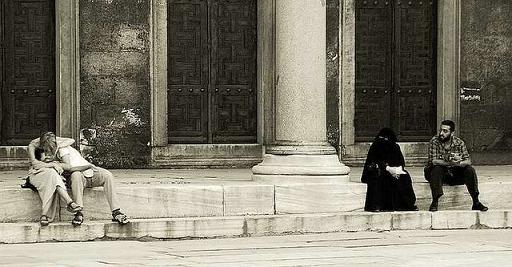
But that is just my opinion, of course.

MFBB

Tuesday, January 10, 2006

WHY ISLAM WILL REMAIN CONFINED TO PLANET EARTH... (THANK GOD)

A.) SCENE 1: A PRESTIGIOUS, WELL RESPECTED AND AUTHORATIVE UNIVERSITY IN EGYPT.

At the prestigious, well respected and authorative al-Azhar University in Cairo an Egyptian theologian, former Rector of the Sharia Faculty (Islamic Right) has issued a fatwa forbidding married people to undress completely when making love. "Complete nudity while having sex renders marriage invalid", declared the drooling islamonutter prestigious, well respected and authoritive university prof, Rashar Hassan Khalil. However, another islamoloon gone bonkers prestigious, well respected and authorative university prof, Abdallah Megawer, Head of the Fatwa Committee of al-Azhar, replied that "the lovers do have the right to see each other naked, but that they should not stare at each others genitals". And yet another rambling owner of a 1-digit IQ prestigious, well respected and authorative university figure, Mrs. Soad Saleh, Director of the Woman Branch for Islamic Studies at al-Azhar, is a great advocate of "everything which brings the married ones closer to each other and enhances their love". Mrs. Saleh however "advizes couples however not to undress completely, taking into account the decency and example of the prophet". Right. How old was his last wife exactly?

I must admit that the level of scientific discourse at the prestigious, well respected and authorative al-Azhar University is breathtaking.


B.) SCENE 2: A PRESTIGIOUS, WELL RESPECTED AND AUTHORATIVE UNIVERSITY IN MASSACHEWSITTS.

At the prestigious, well respected and authorative Massachusetts Institute of Technology in Cambridge, MA, a Masters Candidate for Aerospace Engineering/Propulsion Systems, an unknown fella by the name of Michael Tsay, is developing a numerical model for describing the inductively coupled plasma (ICP) discharge of a miniature Radio Frequency ion thruster. His approach is to assume uniform electron density and temperature except in the sheath region, to solve electron temperature by balancing ionization and diffusion loss, to transform the model for calculating coupled magnetic induction, to balance the deposited RF power and the plasma power, to study the induced electrical field and calculate the skin effect, and to predict thruster performance. His motivation is: "Ion engines have been extensively studied since 1960s and it is also the type of electric propulsion device that has the most experience in space operation. The characteristics of high specific impulse (Isp) and adequate efficiency make ion engines a good candidate for high _V missions (i.e. deep space or interplanetary missions). However, the service life of ion engines is hindered by the limited operation of its internal hot cathode. Germans first came up with the solution by utilizing microwave ionization instead of traditional DC discharge for an ion engine. The German RIT-series ion engines proved to be a success but without much explanation on the physical nature of microwave discharge. My study aims to model the microwave discharge of a 30 mm miniature radio-frequency (RF) ion thruster, which is currently researched and developed by Busek, Co. The experimental results obtained from Busek, Co. will be used to validate my microwave discharge model."

I must admit that the level of scientific discourse at the prestigious, well respected and authorative Massachusetts Institute of Technology is also breathtaking.


MFBB

Thursday, January 05, 2006

MFBB AWARD 2005: AND THE WINNER IS...

...the American Soldier.

Sorry Navy. Sorry Air Force. To me the Most Outstanding Person Of 2005 is still The American Soldier, whether Army or USMC. I don’t doubt the professionalism and courage of airmen and sailors alike, but I think it is clear that in this conflict the foot soldier bears the brunt of the fighting.


After the initial elation about the Iraqi elections, the news about the enormous gains made by the religious parties came as an anticlimax, and I suppose that many of those who supported OIF with heart and soul, myself included, may have felt at least momentarily fooled. Basically, it seems to have turned out that offering a population which has never really known democracy, not necessarily leads to that population making the right choice when given the chance to elect its leaders. By which we assume that the right choice would have been the secular parties. And why not? We westerners, thanks to our unrestricted access to online and printed data, and flooded with visual and audio information, are in a better position than Ahmed Q in, say, Yemen, to understand what a godforsaken fucked up region the Middle East is. We rightly lay the blame for that at the feet of the region’s dominant politico-religious ideology, Islam, which indeed is fast becoming a burden to humanity’s progress.

In the particular case of Iraq however some caveat concerning the wits of the average Iraqi voter may be justified. After all, Iraq just emerges from fifty years of secular regime, and the average Iraqi’s experience under it may in fact have been the strongest argument against secular rule. It is the religious parties which for the greater part had to lay low during Saddam’s rule, and so their ascent during the December elections is not illogical per se. In Iran, where mullahs have ruled for 25 years, the people, when given a fair chance to cast their vote, would in all likelihood have elected secular leaders.

Therefore I would urge our American readers, who are all too aware of the blood, sweat and tears shed by your troops and their relatives, not to lose heart. For rule of law and democratic representation to take hold and blossom is in fact a very quaint and tough, if not unlikely event. Russia e.g. is a country which throughout the ages has produced countless eminent leaders, statesmen, artists, scientists, engineers, writers, poets and architects. Regardless its troubles, regardless the horrendous crimes against humanity committed on its soil, when speaking of Russia, we do not mentally connect it with backwardness like we do with the Middle East. And yet in Russia, an educated and gifted population lets its right to democratic rule slip away towards some de facto tyranny under a former KGB agent who literally said that the demise of the Soviet Union was one of the greatest geopolitical disasters of the 20th Century. By which I mean to say: the path to democratic rule is long and hard and by no means evident.

The task facing America is enormous, and great perils lie ahead. Even after all the suffering, success, even in the long term, is not guaranteed. But you have been down this road before. I remember seeing a short film taken just before the end of World War II, about the liberation of a concentration camp by GI’s. If there were still soldiers among them who, before entering the camp, doubted deep in their hearts why they had fought so long and so hard, I guess that after going through the gates that feeling was gone. At one point, the camera zoomed in on the still face of a US soldier, kaki clad, steel helmet on. He was dead pale and his black eyes, twitching so it seemed, tried to cope with the horrendous scene in front of him: piles and piles and piles of half-skeletons in grotesque bearings, mouths disfigured in painful snarls, hollow eyesockets looking up to a sky they would never walk under anymore. In Spring 45 the full horror of Nazi Germany finally came to light, against which even the most vile crimes of Saddam Husseins regime pale in comparison. In Spring 45, "Germany" was a filthy word. People of the free world did not look upon Germans the way they do today. Here was a country which in the span of a mere 70 years thrice had invaded the west, and caused havoc and loss of life on a scale not seen before in history. In Spring 45, and in the immediate years afterward, people, when taking the word "German" in the mouth, subconsciously connected it with untold evil and barbarism.

Yet Americans believed. With what now seems sheer improbable good will and vast amounts of that unique American "can-do" spirit, they took to the task of implementing democratic rule in Germany, when in 1946 nearby Czechoslowakia passed the so-called Benes-Decree, named after its president, which effectively ruled the deportation of a couple of million ethnic Germans, and which was thought of by the free world as a non-issue, or rather as something deserved.

Yet Americans believed.

That is why, despite the hardships and the setbacks, and plans not seeming to unfold the way we would like to, I think America should carry on in Iraq. For you have done this before, and a positive outcome was much more unlikely than it is today. For there is no other way, since quitting will make look the Vietnam aftermath like a fait-divers. And last but not least, for you have the most magnificent armed forces the planet has ever seen, and militarily you are simply – INVINCIBLE.


MFBB


PS: speaking of your fine military, find a good sample over at CDR Salamander. He has an amazing story about a Staff Sergeant James Gilliland, who from his Ramadi sniper nest called "Hotel" killed a terrorist at a distance of 4,100 ft.

Saturday, December 31, 2005

WHERE THE F*CK IS THE GLOBAL WARMING CROWD WHEN YOU NEED ‘EM?????

Yesterday my ass froze off.

Okay, almost. Still, it was so god-dam-COLD that either W must be held responsible, or else I have become a pussy those Kyoto folks are completely nuts. We spent a couple of hours in Gent, the capital of the province of East Flanders, for some end-of-the-year-bookshopping. Gent, in Anglosaxon literature referred to as Ghent, is one of the core historical cities of Flanders. Archeological finds demonstrate that the place, at the confluence of the Schelde (Scheldt) and Leie (Lys) rivers, was already inhabited during the Stone Age. In Roman Times it was an important agricultural settlement. But its Golden Age really was in medieval times between 1100 and 1500. Ironically, its historical demise began with the birth within its walls of that pivotal political figure of the Renaissance, Charles V, the Habsburg Emperor, and indeed, the square where he was born is called to this day the Prinsenhof, or Prince's Court.

Peace Treaty of GhentGent, or Ghent if you like that better, has also an American link! Indeed, it was here that the Treaty of Ghent was signed, which concluded the 1812-1814 War between the young United States of America and Great Britain. The leader of the American delegation was the later President John Quincy Adams, who while on the spot seems to have had other interests beyond burying the battleaxe with the Brits. Unlike Jefferson in Paris however, Adams seems to have been a good boy. He was a great aficionado of plants and flowers and frequently visited the Plantentuin, the city’s botanic garden. Once or twice a week he accompanied the friends he had made here to theatre plays by the Rhetorica society. On mondays, the plays in the Hall at the Parnassusberg were performed in Flemish (keep in mind that the bourgeois language in Ghent was French, Flemish was for peasants - note by MFBB), and Adams somehow bungled in on one occasion. It was no success. He wrote to is wife: "I did not understand anything and fell asleep. Thereafter I withdrew." Sigh, us Flemings have always had a hard time finding appreciation for our mother tongue, fighting the Frogs since well before 1302 and the Krauts already prior to 1288 and so on. Well, at least Adams did not withdraw from the negotiations.

Old Carthusian MonasteryThe American delegation stayed at Hotel Lovendeghem in the Veldstraat, the British one in a Carthusian monastery on Meerghem. It was also in this monastery that on Christmas Eve 1814, after nearly four months of negotiations, the treaty was finally signed. There are identical commemoration plaques on the façades of both buildings. I will be glad to show them to you should you ever happen to be in Ghent for touristic purposes or for signing a treaty of your own. Anyway, the hotel is a shop now, the monastery a funny farm (Psychiatric Institution Sint Jan de Deo). It’s a mad, mad world.

Please allow me to ramble on before you fall asleep. Below you see some photos I had the occasion to shoot despite continued tugging from two females intent on spending money. Mine of course, Mu Ha Ha Ha.

The row of houses on the pic below is arguably Gent's most famous street: the Graslei. The slumped forward building in roman style, the third from the right, is called "Het Spijker", literally The Nail. It dates from 1200 and was used to stock grains which were transported through Ghent (via the Leie River, Lys in English). Its façade with the brick stairs is the oldest one of its kind in the world. For a very brief period the building was even a Calvinist University! The central building, seemingly just below the clock tower, is the Guild House of the Free Masons, mind you, the fellas who put bricks on each other, not the ones you first thought of. The building looks old but isn’t. It is a reconstruction from 1912 in Brabantine Gothic. Virtually every building along the Graslei is noteworthy, you will find a brief description here.

Graslei, Ghent

Another famous sight in Ghent: below, to the left, you see the old Postal Office(now a shopping mall), in the centre the Sint-Niklaaskerk (Saint Nicholas Church), built, from the beginning of the 13th century on, in so-called Scheldt Gothic. Interesting to note is that from the very beginning this church suffered from stability problems due to architectural or construction faults. Throughout its history it was the subject of renovations, a series of important ones starting in late 19th century when the situation had become critical, not to say dangerous. The current renovation effort was started in 1960 (!) and was only in full swing by the time yours truly in vain tried to impress hot females in Ghent student clubs. In the mid-eighties, that was. In 1992 transept and choir were made accessible to the public, right now the ship is being renovated. More pics and info here.


Gravensteen
And another must-see when passing through Ghent: the Gravensteen, a medieval water castle smack in the middle of the Old City. Originally built by Philip from Alsace, Count of Flanders, in 1180. Residence of the Counts of Flanders until the fourteenth century, after which it was first used for making coins and then, more notorious, as a prison. Don’t miss the torture chamber!!! OK, I know the fancy tools on display there will be regarded by your average Gitmo Guard specialized in Eminem and Christina Aguilera tapes with some degree of disdain, but still it is worth a peek. Visit the armory too.

When I started this post it was 2005. And I am finishing it now after watching Wedding Crashers with Vince Vaughn and Owen Wilson on dvd, all the while quietly slipping into 2006. I'd say the first 3/4 were quite entertaining, but the last quarter sucked. I am talking about the movie, with the year it was rather the other way round. Oh well. I can imagine there are worse means to say a year goodbye. An especially vile year at that, imho.

Anyway, I'd like to wish the readers of DowneastBlog - those of good will, mind you - and their loved ones a HEARTFELT HAPPY AND SUCCESSFUL 2006!!!


MFBB

Monday, December 26, 2005

MUDWRESTLING OVER EUROS...

In Europe, there was quite some fuss the last two weeks concerning the planning of the EU Budget for the period 2007-2013. Basically, the debate got the UK pitted against, well, virtually against all the other 24 member states. To understand what was going on, understanding two buzzwords might be helpful: "EU Presidency" and "UK rebate".


A.) The EU Presidency.

UK EU Presidency 2005First, the EU Presidency. Currently, Britain holds it. What does that mean? Well, if you think of the EU as one country, does right now the UK, personified by Blair, fulfil the role of EU President then? Somewhat simplified, yes, but not completely. There is also the EU Commission, headed by Barroso. Now hold it, I realize it’s real tough for non-Europeans to grasp Euro leadership, but basically, EU Presidency and EU Commission combined, equal the EU’s "Executive Body". The two are supposed to act as the EU "government" so to say. One could liken the EU Commission to a company’s Board of Directors, responsible for the day-to-day business. And the EU Presidency – to be correct, we speak of a Council of Ministers of which the presidency rotates among the EU member states – would then be the Executive Committee, responsible for the strategic decisions.

Now, while Barroso serves a four-year term, EU Presidencies only last six months. In other words, EU Commission chiefs typically see eight EU Presidencies come and go. Luxembourg had it from January till July, after which Britain took over, and as we are rapidly approaching the end of the year, it soon will hand over the torch to Austria. But I said EU presidencies do the "strategic decisions", and indeed, the UK’s last important task was to establish a sound budget plan for the period spanning 2007 till 2013. To give you an idea of the kind of budget we are talking about, this year it was 106.3 billion EUR, or 1% of the combined gross national income of the 25. In US dollars, that's give and take a 128 billion US$ budget - roughly what the Danish government spends yearly! So for those of you who in the back of their minds nurture an atavistic fear that one day Uncle Sam will be challenged by, uh, Uncle Jean, fear not!!! That day is apparently still far off!


B.) The UK Rebate.

Most of you will recall Margaret Thatcher’s famous 1984 quote "I want my money back". What was that quote about? In the early eighties, 80% of the EU’s budget went to the CAP, or Common Agricultural Policy.

The CAP provided farmers throughout the EU – or EEC, as it was then known – with guaranteed minimum prices for their products. This was by means of subsidies, which were also paid for planting certain crops – or planting no crops at all! All EEC member countries contributed to a common pot, which was then essentially re-distributed with the more agricultural countries receiving the bulk of the subsidies. Now Britain paid disproportionately much, due to its relatively small agricultural sector. At the time, as the EEC was joined by precisely those countries with weak industry but strong agriculture – Portugal, Spain, Greece – the EU budget and thus the CAP subsidies – was set to expand further, thus likely to strain the UK’s precarious financial situation even more. Do not forget that Britain was then the third poorest EEC member, and that in 1982 it had fought an expensive war with Argentina over the Falklands! That is why, in 1984, Mrs. Thatcher negotiated a rebate, or a payback of funds, in order to redress the imbalance between what the UK put into the EEC and what it got back out from it. The method of calculating the rebate is complex, but as a rule of fist one can assume that it amounts to 2/3 of the amount by which the UK contribution exceeds EU expenditure returning to Britain.

UK Rebate financingSo Mrs. Thatcher got part of her money back in 1984 – a unique accomplishment, because the UK is the only EU member that got a discount on its Euro membership fee, so to say. That of course left the proposed EU budget with a gap, which subsequently had to filled up somehow. And here’s the angle: all other EU members are supposed to make good the lost British contribution, and France finances roughly 31 per cent plus of it. You understand why France is so eager to scrap the rebate, and from the French viewpoint a reduction is reasonable: after all, nowadays agricultural subsidies "only" account for some 42 % of the EU budget. Keep in mind that an EU budget consisting of not much more than agricultural subsidies was precisely the reason why Britain got its rebate. Plus, over the past two decades Britain has gotten rich - it can no longer claim it is the sick man of Europe as it was in 1984.


Now, the EU budget 2007-2013. In short, the following were the main bargaining positions at the opening of the budget talks, now some two weeks ago:

* Most if not all EU members with France up front wanted the UK rebate to be reduced, if not scrapped, and changes to the CAP postponed till 2014.

* Britain wanted the CAP – the agricultural subsidies – toned down by 2010 and, you guess it, keep its rebate. In fact Britain, never suspected of Europhilism, also wanted a smaller and poorer EU, and proposed an EU budget of only 1.03% of the combined gross national income of the member states.


This was the UK’s last important task before handing over the torch to Austria come January 1st, and its last occasion to rescue what is generally regarded as a very weak and uninspired EU Presidency. Indeed: putting African debt relief on the G8 agenda, establishing new emission targets for when Kyoto expires, a failed Hampton Court Summit on economic reform, a moderate success in organizing Europes first cohesive antiterror strategy, and starting EU membership talks with Turkey… it reads like a lame list of non-issues, and while Blair and Straw regard the Turkey admission talks as a "success", fewer and fewer across the Channel think in their adjectives. Anyway, reaching a solid budget deal was the only way to "sex up" the UK EU Presidency.

Well, my take is that most Brits are none too fond of Blairs deal, while the rest of Europe is. The deal is:

*During the period 2007-2013, the UK agrees to a cutback of 10.5bn euros (£7bn) of its rebate, some 20%, while the EU budget grows to 862.4bn euros, helping to fund the development of new member states. The budget is scheduled to be 1.045% of the composed gross national income of the member states.

*In return, Britain obtained an agreement that in 2008-2009 there will be a wide-ranging budget review, and not only on the CAP. From the beginning Blair stressed that reviewing European spending was of major concern to him.

*There were a lot of sweeteners for the new member states, paid for with the cutbacks on the rebate - a.o. 100 million EUR for Poland (a Merkel feat, Angela Merkel was also the one who apprently got the budget talks moving again)


These are really the most important headlines. To most observers, it looks like the UK yielded a lot and France very little. Blair took quite some heat at home, The Daily Telegraph even labelling the Brussels Summit a "surrender" and William Hague, foreign affairs spokesman for the Tories (the British Conservatives) smartly paraphrizing Winston Churchill with "Seldom in the course of European negotiations has so much been surrendered for so little". To be honest, France did not get all it wanted either. E.g., it opposed giving Macedonia EU candidate status next year - Macedonia got it. It wanted the EU to impose lower VAT rules for its restaurants - it did not get it. And while the promise to review the CAP in 2008-2009 is a thing that blows in the wind, Romania and Bulgaria, set to join the EU in 2007 and 2008 respectively, were told they can expect no agricultural subsidies. Which means that the same CAP pie by that time will have to be divided over more countries, thus effectively reducing CAP subsidies at least proportionately. But all in all, to me too it looks like the UK indeed yielded the most. Paul Beliën over at The Brussels Journal thinks so too, although he puts it in starker terms:

How the French are gloating, to be able to present themselves as the champions of the "poorer member states" while not contributing a single extra cent, and lecture Britain on its duties to the new member states while France has always opposed enlargement.


Some fleshing out yet tomorrow, God willing. Europe here, over and out.


MFBB.

Sunday, December 25, 2005

LET IT SNOW, LET IT SNOW, LET IT SNOW...

Alas, again no white Christmas in BelgoSmurfLandTM this year. Prospects for it had been better though ever since I was a kid, for we had our first snowfall halfway November, an absolute rarity ever since Bush screwed the climate.

Nevertheless, I'd like to share these pics with you, taken yesterday, December 24, at around 9pm on or around my hometown's market square. I really love this place. Although I live now in Wallonia, I can nor will ever forget I'm a (censured) at heart. Every year a beautiful Christmas Tree adorns the square, as well as a large Christmas stable right in front of the Saint-Bartholomew Church.


Market SquareThe photo to the left shows the same market square taken from the opposite side. The beautifully lit building between the Tree and the church is the old Town Hall, now used for touristic purposes only. My hometown was officially declared a town in 1068 by Boudewijn VI, Count of Flanders, and IIRC the building in the photo is built on the same location where the original townhouse, built in the twelfth century, stood. Time and again it was destroyed and rebuilt, the last time, roughly one hundred years ago, in neogothic style.

Anyway, White Christmas or not, I'd like to wish the readers of DowneastBlog - those of good will - a heartfelt MERRY CHRISTMAS!!!


MFBB

Sunday, December 18, 2005

Tuesday, December 06, 2005

'APE WITH A HEART MAKES GROWN MEN CRY'

King Kong review

"Grown men around me were crying," says one Hollywood insider. "

Ok, I haven't seen the movie yet, and it looks like it's going to be great, but any grown man who weeps at this film is a sitzpinkler.

Saturday, December 03, 2005

GENTLEMEN, GIRD YOUR SWORDS.

I guess most of you learned this week that Belgium finally sent fighters to Iraq. One of them was 38-year old Muriel Degauque, a Wallonian woman from Monceau-sur-Sambre near Charleroi. On November 9 she blew herself up near a US convoy in Baquba, Iraq, thus becoming the first European woman suicide bomber, at least for Allah’s cause. Fortunately, she was the only one killed. Zeg niet te gauw ‘t is weer een vrouw, like we say over here, a tad unrespectfully translated Don’t say too quick it’s again a chick. Paul Beliën of The Brussels Journal offers some perspective. Anyway, about one year ago I posted on these pages that in the West we should focus on Islamic converts and dang, there it is. Dutch daily De Telegraaf writes that police increasingly gets info on converts radicalising. Closer to home, one of the five or six schtoopid cunts wo whore, wooooooooooops sorry, who wore, burqas in Maaseik, is a Flemish woman, a certain Maureen R. For the record, Maaseik, eastern Belgium, is where Khalid Bouloudou is from, one of the thirteen suspected GICM members in Belgiums fourth terror trial currently going on in Brussels. The GICM, or Groupe Islamique Combattant Marocain, is one of the outfits responsible for the Madrid bombings. But back to Our Lady of the Exploding Hollowness.

Muriel Degauque had always been the trouble child in Jean Degauque’s family. As a teenager, she drank, smoked and used drugs. She was unable to find a steady job and had relationships with a Turk and an Algerian, whom she married in her early thirties. She herself asked her husband to teach her Arabic so that she could read the Quran. She also started to wear a headscarf. The marriage was short-lived, for in 2000 the couple divorced. Muriel’s parents Jean, a retired steelworker, and Liliane, a medical secretary, were flabbergasted when a couple of months later she married again to a certain Hicham Goris, a Moroccan of mixed parents (in some publicatins he is referred to as Aissan). To her parents she explained that "marrying so soon after divorce was easy in Islam". Her new husband had the most radical influence on her, since from then on she appeared in burqa with only a slit letting the eyes free. She even wore gloves so that the skin of her hands would not be visible anymore.

After a while Hicham started to demand that father Degauque quit drinking beer and that men and women ate separately. This finally led to a breech in the relation with her parents and the radical couple moved from Charleroi to Sint-Gillis, Brussels, where they learned suicide methods. I am told it's one of the very few courses Methodist Vanuatuans truly excel in there, apart from, under certain circumstances, farting in the general direction of Reykjavik. A couple of months ago, they travelled to the Middle East and the Degauques got a last telephone call from their daughter from - but what a coincidence!!!! - Syria. The next and final stop was Baquba, Iraq. As for the woman, my greatest concern is that she damaged the precious paint, dutifully paid for by American taxpayers, on the trucks in that convoy. As for the man, he was shot dead by US forces. Thanks for cleaning up our garbage America!

Don’t you now think too bad of Belgian women. Mark Steyn’s mother is Belgian.


MFBB


UPDATE:

Brigitte GrouwelsBelgium is a federal state with both Flanders and Wallonia having their own regional governments. Little known is the fact that Belgium’s capital, Brussels, is a separate region of its own, since neither Flemings nor Walloons would ever accept Brussels being an administrative part of either region. So in the Belgian federal framework Brussels is technically the Brussels Capital Region, with its own (small) government as well as a parliament. One of the "ministers" in this government is Brigitte Grouwels, from the Christian democratic party CD&V. Her official title is State Secretary for Equal Opportunities. This is what she had to say last Friday:

"In large parts of Brussels women are called names and reproached of being whores by young immigrants, often of Moroccan origin. It suffices that they are fashionably dressed with tight skirts and a flash of a bare belly. Some native women don something on their heads, because then they are not troubled anymore."

Mrs. Grouwels has her own site, where you can read the interview she gave with the daily Het Laatste Nieuws in full:


Q: "Have you been harassed yourself?"

A: "Yes, and my daughter repeatedly, just like her friends. These are young women aware of fashion, with sometimes tight skirts and a glimpse of a bare belly. Immigrant girls are reprimanded if they don't wear a headscarf, but also just because they walk on the streets, or if they dare to laugh among each other. Take the Zuidlaan across the Zuidstation. It used to be a very mixed neighborhood, where many Belgians had shops. Now it is a quarter where immigrant shops dominate, which are controlled by a certain type of men. They watch from cafes who passes and intimidate women. Gradually these disappear from the street. There is an atmosphere of intolerance. Women can't dress the way they would like to. Well, we are fed up being called whores because we are not dressed the way certain men would like us to be. It is an offensive and disrespectful attitude towards women."

Q: "What do these men say then?"

A: "Remarks like you don't belong here, how are you dressed, you are a prostitute. It is no longer only along the Zuidlaan, but there it strikes that less and less women walk on the streets. It just as well happens in Sint-Joost, in Molenbeek, in Schaarbeek, when they shop along the Louizalaan (Avenue Sainte-Louise) and very frequently on the tram. Respect is extremely important in those men's culture. Well, we demand respect for ALL women. It is a form of verbal violence, which is very annoying. There are women who say that if we don a headscarf, we are no longer called names. Well, that's a step too far."

Q: "It's the Belgians who have to adapt to the immigrants?"

A: "That's it yes. Women must be able to walk day and night on the street in safety. We have not fought 50 years for our emancipation just to be beaten back in time. We don't want that in a single quarter of Brussels."

Q: "Who are those men?"

A: "They are mainly Moroccan youths, who think that they have the right to impose their rules on girls. With Turks it's similar, especially in their own commmunities, but it is just as well unacceptable. They must also have the right to dress the way they like."


Look, it's not that I like to post those things. In fact I hate it. I have a company to run and I had better spent the last hour on doing some necessary paperwork. But I think it's of paramount importance that everyone who cherishes freedom ought to know what is happening in Europe. Because it's not in Brussels alone. If the usual multiculti dorks show up, throw them stories like these in their faces. These assholes are going to let it come to the point of no return, and then it's too late.

Mind you, Mrs. Grouwels is not someone whom you would categorize in the Belgian rightwing political sphere, certainly not the quarter occupied by the Vlaams Belang. In fact, the remedy she proposes: an action plan with a sensitive approach costing 670,000 EUR to make people aware and "reach out" to immigrants, is purely socialist by nature: throwing money away while avoiding to step on sore toes. So when a lady like her bluntly says this like "Gradually these (women) disappear from the street" and "but there it strikes that less and less women walk on the streets", bells ought to ring.

Friday, December 02, 2005

The economy is kicking ass

Ok, let's make a pact: Everyone has to agree to not let any liberal in their presence get away with any "the economy is bad" BS.

Here's an article if you need one to forward, although since the evidence is completely overwhelming it's not hard to find others.

I can understand people being against the Iraq invasion or any number of other Bush policies, but if you think we're in the middle of a struggling economy you're just ideologically blind or just plain stupid.

Monday, November 28, 2005

Michael Barone on Unions

Barone lays out in plain English what a disaster labor unions have been for the US. And forget about all the "unions brought us the weekend" crap. The sooner we get rid of these parasitic organizations the better it will be for everyone, including union members.

Sunday, November 27, 2005

PARTNERS IN CRIME?

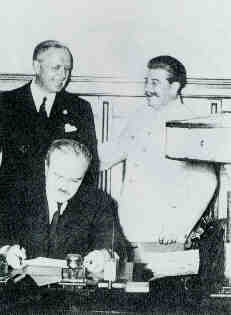
Molotov Cocktail Party1939. Commies ally themselves with Nazis… The photo shows a jovial Stalin addressing Nazi Germany’s Foreign Minister, Von Ribbentrop, on August 23, at the signing of the so-called Molotov-Ribbentrop Pact or Nazi-Soviet Non-Agression Pact. The guy scribbling his name onto the rag is the USSR’s Foreign Minister Molotov and in case you wonder, yes, that’s the fella the French youths’ drink of choice is called after. I am not going to elaborate on this document, ain’t the place nor the time, suffice to say that Article 1 stated that:

"Both High Contracting Parties obligate themselves to desist from any act of violence, any aggressive action, and any attack on each other, either individually or jointly with other Powers."

and it must be said that Both High Contracting Parties behaved themselves admirably till, duh, June 22, 1941.

Article 2 furthermore stated that:

"Should one of the High Contracting Parties become the object of belligerent action by a third Power, the other High Contracting Party shall in no manner lend its support to this third Power."

And indeed, when the Polish Army fought back when the Nizis invaded Poland on September 1, 1939, that could be interpreted as Nazi Germany becoming the object of belligerent action by a Third Power, subsequently Uncle Joe in no manner lent his support for the Polish but rather chose to stab them in the back.

…………………xoxoxoxoxoxoxoxoxoxo……………

2005. Maybe it’s just MFBB’s mean f*cking bad behaviour, but as I learn these days of certain suspicious alliances I can’t resist musing about that 1939 gentleman’s agreement.

Take Copenhagen, Denmark for example. There a Muslim immigrant and city counsellor by the name of Wallait Khan participated in the November 15 municipal elections as a Venstre candidate (Venstre = center-rightwing party; it is also the party of Denmark’s courageous PM Anders Fogh Rasmussen - MFBB). A political scandal of the first order developed when Mr. Khan, immediately after a poor showing, decided to defect to to the city council’s left wing when promised the post of 2nd deputy mayor along with some other functions. Now, if gaining a post cheaply was the only issue, Khan’s treason would be mere political backstabbery. However, it has also emerged that he supports two radical Islamist organizations, Minhaj-ul-Quran and Hizb-ut-Tahrir. Moreover, undoubtedly as a sign of his near perfect assimilation in Danish society, he simultaneously ran for elections in his native Pakistan, and I bet it wasn’t for the Pakistani Christian Democrats. Danish daily Weekendavisen has the story (translation by Viking Observer):

In the November-issue 2005 of the urdu-language monthly Sahil, that is distributed in Copenhagen, it says in reference to Wallait Khans own campaign materials: "There has been this whole campaign against Minhaj ul-Quran and Hizb ut-Tahrir, Wallait Khan has always supported these organisations and schools and institutions all that he could."

If a Hizb-ut-Tahrir supporter isn't a good candidate for deputy mayor of a Eurabian capital then I don't know what is, don't you agree. Note also that Wallait Khan does NOT have Danish citizenship. So with only slight exaggeration you basically have here a Pakistani who gets to decide whether he will spend public money for fixing the potholes in the street in front of Lars Q’s house or funding Copenhagen’s mosques. Some of you may recall that this whole travesty of allowing non-residents of a country to participate in local elections, a pet idea of the despicable European Left, is precisely the reason why I joined the Vlaams Belang.

anna rytterAn even more striking example of Islamic radicals joining up with the Danish Left is offered in the city of Odense, where the Islamic convert Anna Rytter of the Communist Party Enhedslisten (Unity List), was elected to the city council. Que???? So here we have someone who is supposed to be a Sophisticated God Bashing Vatican Spitting Post Modernist Quintessential Atheist Non Believer, and yet she has submitted herself to the will of Allah???? Things are getting goddam f*ckin' weird in the Leftist Brainhole-O-Sphere you know. In October Wouter Bos, Chairman of the PVDA, the Dutch Social-Democrats, announced that he would join the Muslims in the Netherlands in a day of fasting during Ramadan. Bos’s day of fasting like a devout Muslim was recorded and aired on television. Now you have to understand that this is the same Mr. Bos who recently insisted that the traditional "Bede", the Prayer in the Dutch Queen's annual speech in Parliament, was abolished. I get it Wouter. I am not that dumb! Christianity is makroob, and Islam is halal!!! And anyone who suggests that your Ramadan fasting had sumpin to do with the municipal elections in Holland on 7 March, well, that is just a mean racist xenophobic Flemish redneck!

Sikandar SiddiqueBack to Copenhagen. Where we also have the case of a certain Sikandar Siddique who was the Social Democrat’s candidate for mayoral post in Copenhagen. Danish blogger Sappho reports that Mr. Siddique may be a member of the radical Islamist organization Hizb-ut-Tahrir:


Today Sappho can reveal, that a vote for Siddique in all likelyhood also is a vote for the radical moslem organisation Hizb-ut-Tahrir, that advocates the establishement of a caliphate run along 1400-year-old principles, where there is neither freedom of speech, democracy, freedom of the courts nor rights for women and non-believers. So far, Hizb ut-Tahrir has always claimed, that these conditions would not be introduced in Denmark, but that they exclusively had far-off Oriental regions in mind. Danes thus had no reason to be nervous about the organisations agitation and big influence on especially the moslem youths in Nørrebro in Copenhagen.

Something indicates, that Hizb ut-Tahrir now also is seeking direct influence on Danish politics - and that Sikandar Malik Siddique has been chosen as the spearhead of these aspirations.


Duh. MFBB's simple brain draws some conclusions from this. First, the Danish, and by extension the European Left is clearly whoring for votes among its Muslim communities whom they have given in most European countries the right to vote in municipal elections (for starters). Given their very high fertility rates as compared to the natives' catastrophically low ones, one could argue that from the Leftist POV this is a smart move to stay in power. Of course, what these doofuses don't seem to foresee is that once Islam is in power there will be precious little love left for fancy lefty issues such as gay marriage and/or adoption, your right to grow cannabis in your backyard or get stone drunk while enjoying that new sex-inciting drug I heard about. Well, in 1939 Uncle Joe too thought he was being smart.

Second, if you want to see that famous braless li'l mermaid in Copenhagen's port, you might want to book a ticket to Denmark presto, since I can't guarantee for how long these famous Danish boobies will remain halal.


MFBB

Sunday, November 20, 2005

ONE YEAR AGO... OPERATION PHANTOM FURY

One year ago, on November 20, 2005, Operation Phantom Fury(or Dawn) to clear the city of Fallujah from terrorists, was concluded.

In May of that year there had been an earlier attempt to flush them out, but the (very modest) Marine units involved then were prematurely ordered to a stop on the insistence of high-ranking Iraqi GC officials, a.o. al-Jaafari, so as not to stir up the mood of Iraqs Sunni population. It was a bad move, as soon became apparent. The so-called "Fallujah Brigade", initially a 1,600 strong force commanded by Muhammed Latif, a former general of Saddam Hussein’s Army, and intended to restore order in the restive city, was quickly joined by the very insurgents the 1st Marine division had been fighting. By June it was apparent that the brigade was part of the problem rather than of the solution, to put it mildly, and so by August it was disbanded.

The city then sunk further and further into chaos and became a hotbed for insurgents and al-Zarqawi linked terrorist groups, prompting precision airstrikes which gradually turned Fallujah into a combat zone and ultimately forced at least 90% of the citizens out.

By October it was obvious that a Fallujah left undisturbed would prove a possibly fatal impediment to the upcoming January elections. So an operation to clear the city once and for all was scheduled, its codename being originally Phantom Fury, later changed to al-Fajr (Dawn) on the request of Iraqi generals.

Aerial view on Day 1, from the westGiven the size of Fallujah, essentially a 3km wide on 3.5km long rectangle, with an estimated prewar population of 250,000, the forces assembled to take it seemed oddly insufficient, give and take 10,000 USMC and Army troops, plus another 2,000 Iraqi security forces. Anyone familiar with World War 2 literature will recall that if the battles fought in cities like Stalingrad, Berlin, Arnhem, Warsaw etc. proved one thing, it’s that in street fighting the attacking force can litterally bleed white even when opposed by a numerically far weaker adversary. In Stalingrad during the fall of 1942, the Germans deployed almost an entire 250,000-strong army, the 6th under Von Paulus, against the Russian 62nd Army under Chujkow, which numbered at some point not more combat troops than a weak division (10,000). Yet it took them two months (and tens of thousands of casualties) to occupy 9/10 of the city. In Arnhem in September 1944, the fresh British 1st Airborne division, 10,000 strong, melted away in the space of a week against a veritable hodgepodge of ad hoc German units still shattered by the Normandy campaign. It never saw combat as a unit anymore for the duration of the war.

To military historians Fallujah November 2004 may therefore be treated not as a typical example of urban warfare but rather as the exception which proves the rule. The roughly 80 US and Iraqi soldiers which gave their lives for an operation which very likely saved Iraq’s first true parliamentary elections are bad enough – but the focus of future investigations will rather be on why there were not 800 – or 8,000 for that matter. For opposing the US and Iraqi troops was a determined force of between 2,000 and 3,000 insurgents, and for those who think that the Marines had a distinct numerical advantage, see the number of 12,000 US/Iraqi troops mentioned above, it may come as a surprise that as for the number of fighting men involved the discrepancy was far less obvious. The best way to explain this is to keep a knife in mind: the cutting edge itself represents only a tiny fraction of the knife’s mass, while it is the blade which provides the main weight. In the same manner the guys seeing the "white in the enemy’s eyes" are always far outnumbered by the ones in the rear providing supplies, medical services, artillery fire, communications, transport and what not. Thus it was that in fact only 6 US combat battalions, numbering together perhaps 4,200 troops, took on Fallujah’s main defenses in a broad sweep from north to south (the Iraqi units were engaged mostly to the west of the city, with a noted commando action to take control of the city’s hospital). These six battalions, arranged to the north of the city, were, from west to east:

a.) the 3rd Battalion of the 1st Regiment (3/1) of the 1st Marine Division (the "Guadalcanal" division)
b.) the 3rd Battalion of the 5th Regiment (3/5) of the 1st Marine Division
c.) the 2nd Battalion of the 7th Cavalry Regiment (2/7) of the 1st Cavalry Division
d.) the 1st Battalion of the 8th Marine Regiment (1/8) of the 2nd Marine Division (the "Tarawa" division)
e.) the 1st Battalion of the 3rd Marine Regiment (1/3) of the 3rd Marine Division
f.) the 2nd Battalion of the 2nd Infantry Regiment (2/2)of the 1st Infantry Division ("The Big Red One")

Order of Attack, 7 November 2004Phantom Fury/al-Fajr started with a night attack on November 7 at 7pm local time, with Iraqi commandos seezing the main hospital in the west, on a peninsula in the Euphrates, and Marines taking the two nearby key bridges across the river. The aim was to prevent fleeing insurgents from turning the hospital into a stronghold and/or using the bridges as an escape route.

On November 8 the main assault started, but not before massive aerial and artillery bombardment lasting 12 hours had saturated the zone of attack. It was again 7pm in the evening before the attack got under way, with 3/5 in the west immediately seizing a huge apartment block, giving their machinegun teams and artillery observers an excellent overview of the battle area. The most significant gain in the centre was the railway station, which was seized by 2/7.

Order of Attack, 7 November 2004November 9 saw 3/1, 3/5 and 2/7 joining forces to focus on conquering the Jolan District in the northwest (on the map this effort is dubbed "The Wedge" - it seems in Jolan the toughest resistance was met), 1/8, 1/3 advancing towards the center and 2/2 consolidating its hold over the Askari District in the northeast. When you look at the map to the right, basically one sees the 3-battalion "Wedge" group focussing southwest and 2/2 focussing, with a bit of imagination, to the southeast. It appears that in doing so, the two Marine battalions and the cavalry battalion in the west, and the Big Red One battalion in the east, wanted to seize both ends of Highway 10 on the outskirts of the city. Highway 10, the dotted yellow line on the photo, is the main traffic artery of Fallujah, running from a huge traffic exchanger in the east to a Euphrates bridge in the west. Possession of both ends of Highway 10 gives one virtual control over who enters and leaves the city.

On November 10, 2/2 indeed secured the eastern approaches to the huge clover leaf traffic exchanger, thus allowing supplies coming from the Baghdad direction to flow in. This day was to prove the toughest day of the fighting yet, with key battles erupting around some mosques which were used as enemy strongholds, ammo dumps and IED factories. Among the captured mosques were Al Tawfiq, Hydra and Muhammadia, the latter one being the site of one of the largest battles of the assault, and actually taken by Iraqi Security Forces. By the end of the day, US and Iraqi forces controlled 70pct. Of the city. Since the lead elements of the six battalions had by then crossed Highway 10, the stage was set for taking the southern half of the city, even as mopping up operations behind them were still taking place.

On November 11, US forces turned control of the Jolan district over to the Iraqi Army. By evening, the northern half of Fallujah was generally under US/Iraqi control. Unfortunately and inevitably, a price was paid for the success, with American troops losing 18 KIA and Iraqi troops reportedly 4. There were at least 164 wounded. Remember them all. Unknown to the general public though, was that Phantom Fury/Dawn thus far had proven to be an astonishing feat of arms,with half of a large city subdued in the space of a mere four days. One could argue that US troops enjoyed the advantage of tanks and artillery, and so it was. But the same could be said of the Germans in the Stalingrad operation, where they regularly conducted 1,000 sorties a day (on one day even 2,000), often with Stuka divebombers, the then-equivalent of A-10s performing precision strikes. All across the world, people gazed at TV screens and thought not much of it. In Fallujah, history had been written and rags like The Guardian and The Independent utterly and shamefully ridiculed.

(to be continued)

MFBB


NB: credits to most of the info and all of the pictures go to www.talkingproud.us.